
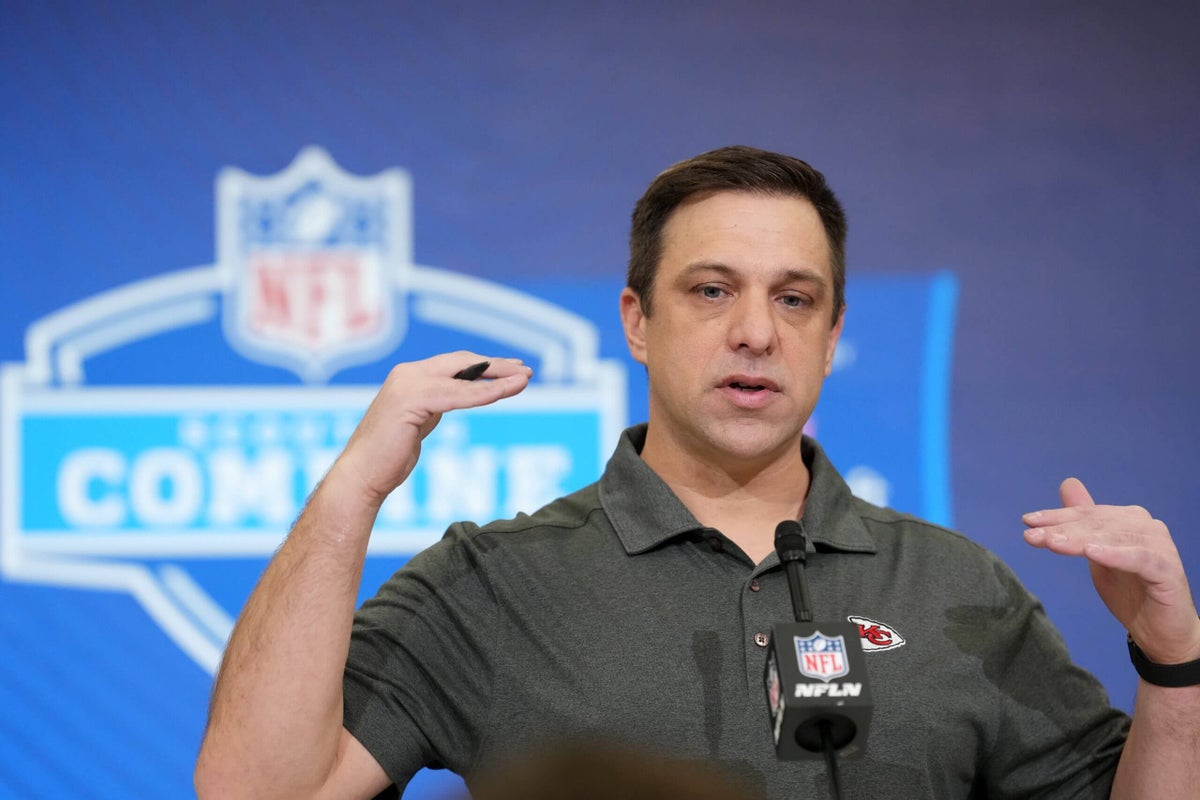
The NFL Scouting Combine has ended, so it’s time to compile some Kansas City Chiefs nuggets.
Here are some things I heard about the Chiefs — and also some things I think — after attending last week’s event in Indianapolis.
Two needs stand above the rest
Listen to Chiefs general manager Brett Veach at the podium, and two positions will have the highest priority this offseason: running back and defensive line.
On the defensive line, though, the Chiefs are likely to target the interior. All-Pro defensive tackle Chris Jones will be 32 next season, and an injury to rising 2025 second-round pick Omarr Norman-Lott put the Chiefs in an untenable spot last year while having to rely on unproductive veterans.
The Chiefs could also use another edge rusher this offseason, but the team’s depth there is in a better place than at defensive tackle. George Karlaftis is still ascending and should be better next season, while not having to deal with a thumb injury that hampered his production. Third-round pick Ashton Gillotte, meanwhile, showed more consistency down the stretch and is likely to continue improving after his rookie season.
A glance around the NFL, however, illustrates how much interior guys can help out their pass-rushing teammates. One notable example is Patriots defensive tackle Milton Williams, who signed a four-year, $104 million free-agent deal last offseason, only to be worth all of it as he helped lift the Patriots’ defense to a Super Bowl appearance.
The Chiefs don’t have that kind of money in free agency, so expect them to use some real draft capital in an effort to add to their defensive interior depth. In fact, I’d be surprised at this point if K.C. doesn’t use a Day 1 or 2 pick to address this spot.
As far as running back goes … the Chiefs can attack that differently. That position is flush with free-agent talent, and Veach’s consistent philosophy has been to address base needs before the draft so he can pivot depending on how the board falls.
In other words, the Chiefs will not pigeonhole themselves into having to take Notre Dame running back Jeremiyah Love at No. 9 because they ignored the position in March. There will be an addition before then who could serve as a starting running back for the Chiefs, even as they look to solidify that spot in the draft.
Why Chiefs’ free-agency checklist will be different
In the past, Veach has been open about the offseason to-do list regarding his team’s pending free agents.
An example? Last year, Veach said at the NFL combine that the team’s top priority was re-signing right guard Trey Smith, with linebacker Nick Bolton next in the pecking order.
Things went exactly that way. The Chiefs re-signed Smith, then Bolton, as Veach followed his prescribed plan exactly while working through free-agent options.
This year, though? K.C. isn’t expected to have that type of blueprint. There are a few reasons for that. For one, the Chiefs have less salary-cap flexibility after re-signing so many of their own players to recent extensions.
The other part is that they don’t appear to have the pressing need for any of their free agents as they did in previous years, while also simultaneously believing many of them could be a fit to return at the right price.
Cornerback Jaylen Watson is likely to command the highest dollar amount and, because of that, seems least likely to return. But one advantage the Chiefs often get with their own players in free agency is the ability to match other teams’ offers — especially if those guys enjoyed their time in K.C. and would prefer a return rather than uprooting themselves and their families.
There’s also the question of how the market will value certain free agents. Safety Bryan Cook is coming off a career year, but there also appears to be quite a bit of safety depth in the draft. Linebacker Leo Chenal’s value also is a mystery, as some 3-4 defenses might see him capable of a bigger role than he has in K.C.
In any case, the Chiefs are likely to do less targeting of their own free agents this year and more monitoring to see whether a reunion might make sense at the right price.
That’s a change from previous years, but also probably prudent, given the team’s situation.
“We do have some flexibility with how we’re set up to do some different things. But it’s not like we have $90 million in cap space,” Veach said during his media session Tuesday. “We have to execute an efficient game plan in free agency.”
So, what’s up with the No. 9 pick?
After an NFL Combine interview with Veach alongside Chiefs radio broadcaster Mitch Holthus, Chiefs team reporter Matt McMullen shared an anecdote in a video on the Chiefs’ team site.
“My favorite part of that was off camera,” McMullen said in the video, “when (Veach) asked each of us who we would take (with the No. 9 pick).”
The thought of Veach asking everyone he sees for their draft thoughts is a bit humorous … but also somewhat telling. Veach has earned a reputation for fostering a collaborative culture within team offices, and partly because of this, we can say with certainty that they aren’t anywhere close to the end of their process for determining whom they might take with their first top-10 pick since 2017.
Some names that seem like fits, however, probably are.
Start with Miami defensive end Rueben Bain Jr., who shared at the combine that he believed he had a “strong” formal interview with the Chiefs. That would track with the vibe around Indianapolis, where a few people said they were impressed by Bain’s football IQ in their talks with him there.
The Chiefs need a defensive end, and if questions about Bain’s arm length drop his stock a bit, he’ll certainly be worth considering at No. 9.
From there, the Chiefs also will be doing plenty of research on the top three wide receivers: Ohio State’s Carnell Tate, Arizona State’s Jordyn Tyson and USC’s Makai Lemon. The position is a short-term and long-term need, and K.C. rarely gets the opportunity to shop in this top-shelf aisle when it comes to wideouts. Their evaluations of each will be important as the draft approaches.
Yes, Love is a possibility at No. 9 as well, though we can’t ignore Veach’s history. The last time the Chiefs selected a running back in the first round, in 2020, it ended up being a bust, as Clyde Edwards-Helaire never lived up to the promise he showed in college.
Veach mentioned during his podium time that most of the players with the best tape in this draft were at non-premium positions. Does that mean safety Caleb Downs or linebacker Sonny Styles could be considered a “safer” pick if the board doesn’t go K.C.’s way? We shouldn’t rule that out.
One other interesting thing Veach revealed Tuesday was that in past drafts, he’d always wished the Chiefs selected just a little bit higher in the first round than they did. He said that thought continues in this draft as well.
“Now we’re at 9. I’m like, ‘Man, if we were just at 4 or 5, we’d be exactly where we want to be,’” Veach said.
Though Veach has a long history of being aggressive in trade-ups, we shouldn’t count out the possibility that he’ll look to move back from No. 9 while seeking more draft assets. Perhaps the most likely way that happens? It probably would involve a scenario if (unexpectedly) no offensive tackles were off the board in the first eight picks.
If that played out, teams could be motivated to swap with K.C. in an effort to land either Miami offensive tackle Francis Mauigoa or Utah’s Spencer Fano. And the Chiefs, given that their offensive line is mostly set, would have an incentive to take advantage of the depth of this year’s draft by trading back.
However the first round turns out, there’ll be a lot of pressure on Veach and his staff to get full value from their rare draft asset.
The latest on McDuffie
A lot was made of Veach’s comments Tuesday that the team was set to meet with the agents of cornerback Trent McDuffie at the combine. That planned gathering, however, was to continue discussions — and was not meant to indicate that a long-term deal with McDuffie was imminent.
McDuffie has one year left on his rookie deal and is due for an extension. If the Chiefs can’t find agreement there, however, now would be the ideal time to trade him to gain draft capital.
The Chiefs love McDuffie. He’s been excellent for the team on the field and off, serving as a leader of the secondary and a standard for the work ethic they hope their players emulate.
It won’t be easy to re-sign him, though. The Chiefs have recently re-signed many of their drafted players to lucrative contracts, and the cornerback market has exploded, meaning it’s likely that McDuffie’s ask as a top-tier player could be somewhere in the $30-million-a-year range.
Historically, the Chiefs haven’t paid up for secondary players like that. Defensive coordinator Steve Spagnuolo and defensive backs coach Dave Merritt also have a strong record of developing those players, which could make it slightly easier to move on from McDuffie.
It’s worth noting that McDuffie is represented by CAA, which also represented Trey Smith. The negotiations with Smith on an extension went all the way until deadline day before Smith signed the richest-ever guard contract in NFL history.
If that’s the precedent for how McDuffie’s conversations go, the Chiefs aren’t likely to get a hometown discount. In an ideal world, they’d probably love to get through free agency, see how much financial flexibility remains, then get back to McDuffie’s people to see if they can work something out.
More likely, though? McDuffie’s agency will want a resolution sooner than that to ensure that other teams looking to acquire McDuffie have the financial means to do so.
This much seems clear: K.C. won’t want McDuffie to simply play out the final year of his current contract. He’ll either be signed to an extension or the team will make the difficult decision to trade him while recouping draft resources.
Like other aspects of the Chiefs’ offseason, however, McDuffie’s status remains just one piece of a puzzle that will be affected by earlier moves.
That means the attention will likely first turn to tight end Travis Kelce. His decision — return or retire — should be the opening domino.
And the first transaction to shape the critical next few months.