
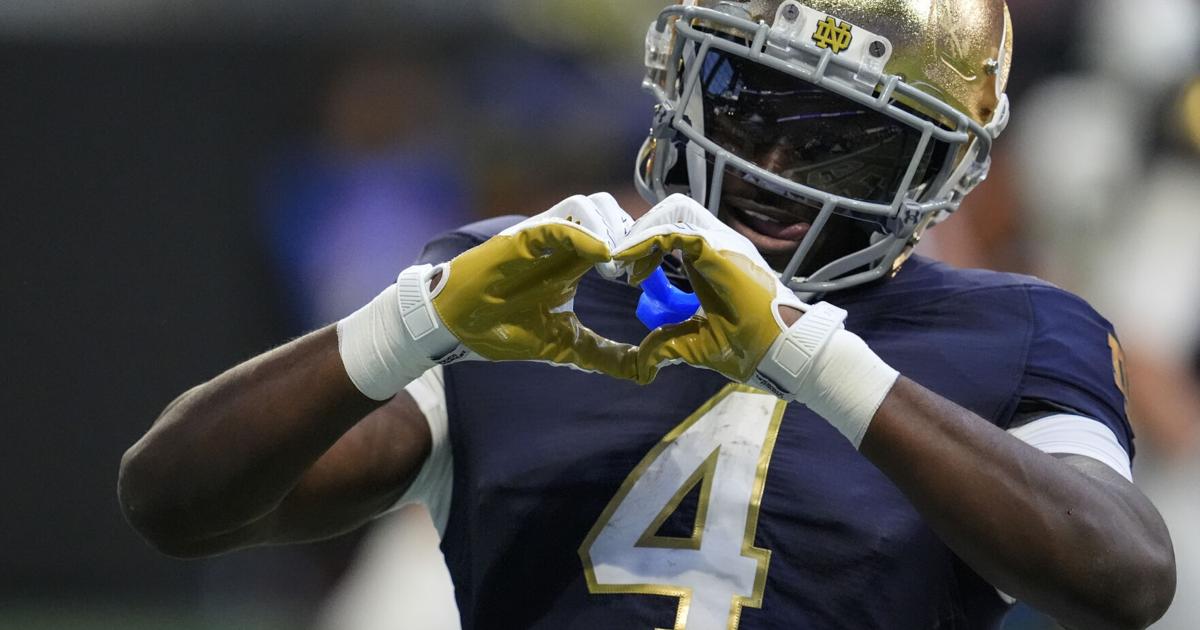
INDIANAPOLIS — Jeremiyah Love can already envision what it would be like to be drafted by the New Orleans Saints.
“They’ll find a way to use me,” the Notre Dame running back said, “like they did Alvin Kamara.”
If it happens, Love’s selection would once again see the Saints usher in a transition from one era to the next. When Kamara was taken in 2017, the electric rookie was paired with veteran Mark Ingram before eventually becoming the main back. And that passing of the torch was reminiscent of the one that happened between Reggie Bush and Deuce McAllister the previous decade.
On the surface, picking Love would mark the Saints’ most tantalizing draft choice since Bush in 2006. No player in this year’s draft arguably has more talent. At Notre Dame, Love was a down-to-down home run hitter who became the focal point of entire game plans — the exact sort of player missing from New Orleans’ offense.
But as enticing as Love is, do the Saints have the resources in place to justify taking a running back in the top 10?
The NFL has changed in the 20 years since the Saints took Bush. Teams have become much more selective about when to take the position in the first round due to durability concerns and the value often found in later rounds. That’s not to say first-round running backs are a complete waste, but picking one requires a more thorough examination of the fit rather than the plug-and-play nature that Love’s skill set suggests.
“There is something to, OK, when the team is ready to really take off, then you drop in the running back,” NFL Network draft analyst Daniel Jeremiah said. “You utilize all of his carries. They all matter and they’re helping you, you know, get in the playoffs and chase the championship.
“I think there’s some other pieces to fill before you say that rocket’s ready to take off there in New Orleans.”
Jeremiah initially had the Saints selecting Love in his first mock draft of the year. But when updating his latest version, the former Baltimore Ravens scout flipped his prediction to the Saints selecting USC wide receiver Makai Lemon. Jeremiah, in a conference call with reporters last month, said he thought coach Kellen Moore would “know exactly” how to use Lemon, who he said would help find easy completions for a young quarterback in Tyler Shough and be a perfect complement to Saints wide receiver Chris Olave.
Wide receiver is a piece the Saints feel they need to fill, too. Based on conversations with people at the NFL scouting combine, New Orleans recognizes it could use another burner across from Olave and take the top off defenses. The first round, in particular, could unfold nicely for the Saints in that regard between Lemon, Arizona State’s Jordyn Tyson and Ohio State’s Carnell Tate — the latter of whom still plays fast, despite an underwhelming 4.53 40-yard dash. Any of those three, in theory, would prop up Shough.
The other question about Love and the Saints is whether New Orleans has the offensive line to make him effective. The Saints had one of the worst rushing attacks in the league last year, and the line didn’t do its backs any favors. According to Pro Football Focus, the Saints had the league’s second-lowest run blocking grade in the league. ESPN found the Saints had a run-block win rate of 70%, good for 23rd.
Either way, the Saints’ running backs averaged only 3.7 yards per carry.
“Certainly, we got to run the football better,” Moore said at the combine.
Maybe Love would be so good right away that he’d be able to overcome any less-than-ideal circumstances. He’s seen as that type of prospect. And as poorly as the Saints’ run blocking appeared to be, there were yards that might have been left on the table. According to Next Gen Stats, Kamara had 95 fewer rushing yards than expected, third behind San Francisco’s Christian McCaffrey and Tampa Bay’s Bucky Irving. Kamara’s rushing yards expected per attempt of -0.7 were also tied for the league’s worst among qualified rushers.
Love has that sort of burst. To match the game-changing speed he put on film, the 20-year-old ran a 4.36 40-yard dash. He performed well enough that he might not even be on the board still when the Saints pick at No. 8, with the Arizona Cardinals (picking third) and Tennessee Titans (fourth) recently mentioned as possible suitors.
“Running backs are very valuable,” Love said. “I feel like that’s being more and more recognized as of today. I mean we had (Seattle’s) Kenneth Walker (win) Super Bowl MVP. Running backs like him continue to pave the way for guys that are just coming into the league.”
One of the worst-case scenarios for the Saints and Love would be if the situation mirrors what happened with the Las Vegas Raiders and Ashton Jeanty a year ago. After Jeanty went to Las Vegas sixth overall in 2025, the Boise State product couldn’t overcome a porous Raiders offensive line and averaged only 3.7 yards per carry on a whopping 266 attempts. And even if Jeanty feasts under new coach Klint Kubiak next season, the Raiders still have plenty of holes elsewhere.
Even the Falcons have yet to make the playoffs since drafting Bijan Robinson, one of the league’s best backs, three years ago. The New York Giants also famously drafted Saquon Barkley second overall in 2018 but failed to maximize the roster around him.
Then again, there’s still time for the Saints to address their offensive line in free agency. And New Orleans fielded one of the league’s most improved defenses last season, another plus when propping up a young quarterback.
If Love is still available, the choice is fascinating.
“I don’t know if there’s a wrong answer,” Jeremiah said.