
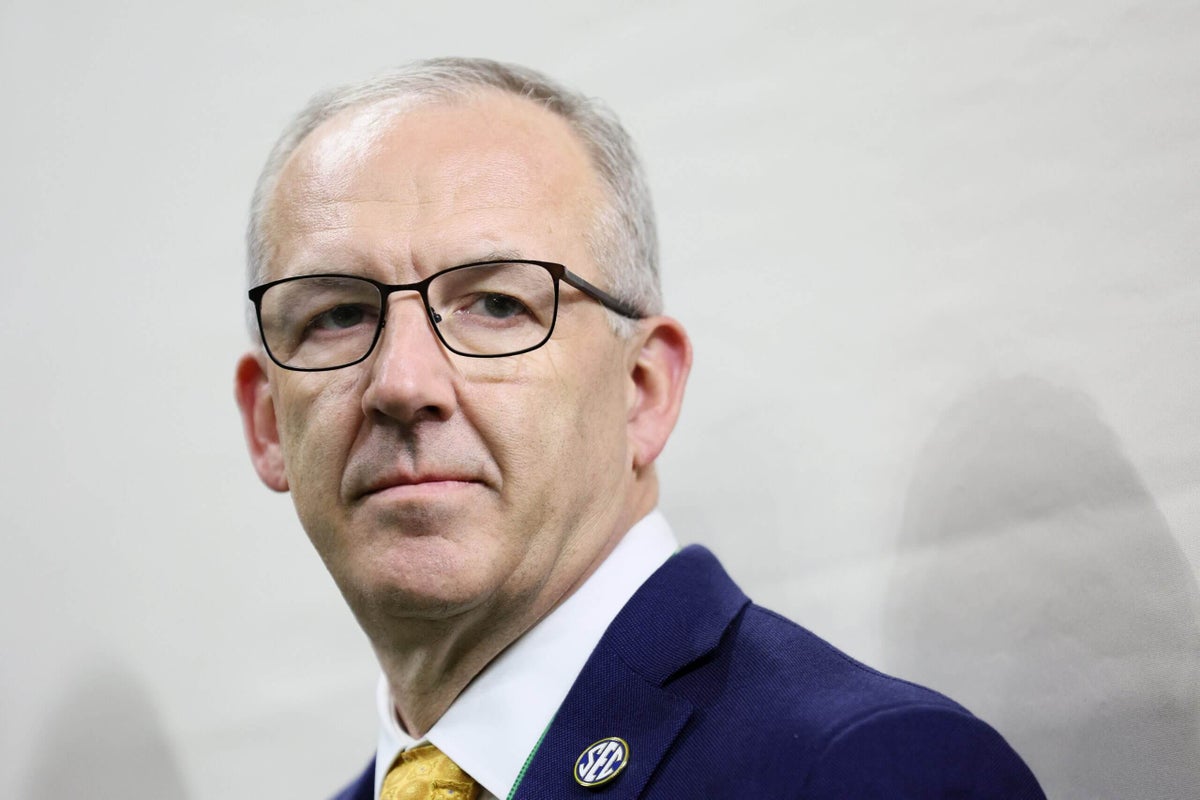
The SEC is prepared to go its own way on eligibility and other rules if necessary, commissioner Greg Sankey acknowledged Monday in an interview on the SEC Network.
Speaking on the “Paul Finebaum Show,” Sankey said, “There is great frustration in my league that we’ve not been able to work collaboratively through some of the challenges or opportunities that we face. There’s great frustration that as we go through the economic transition with our student-athletes, we haven’t better defined the boundaries and the guardrails, and help people to those, and we have a responsibility in that. So I’m not just casting blame. That’s part of us solving problems and I think properly, that’s where our focus should be. How do we work with colleagues to solve problems? Can we do that collectively?”
Sankey emphasized that his first priority remains getting national standards that work for everyone, either through Congressional action or something else. But if that fails, the 16-team conference would be willing to adopt its own off-field rules, while still competing on the field against the rest of the country.
“If there’s a point at which we cannot do so, I think the conversation that informs the question that you ask, is there something you do alone? I think that starts to generate more and more interest,” he said.
Sankey stopped short of saying the SEC should just make up its own rules, an opinion that has gained ground within the conference, including recent comments by Georgia president Jere Morehead. But the commissioner himself giving voice to the possibility is noteworthy.
What would be the tipping point? Sankey called that “undefined.” He also said his preference is not to “go our own way,” quoting the Fleetwood Mac song from the 1970s. Sankey said that relationships with the rest of the sport are important, citing basketball’s NCAA Tournament and competition in general. So he made clear that’s not what separating would entail.
“I know in the Southeastern Conference, we’re prepared, and we’ll have some of the conversations about a framework that we’re in the context of national competition, but what are the right policies?” Sankey said. “Whether it’s eligibility policies, whether it’s transfer policies that need to work within this conference.”
Sankey’s comments came just three days after he attended a White House roundtable led by President Trump to discuss the problems and future of college sports. Morehead was also there, along with some of the most prominent political and college sports leaders in the country.
Trump finished the roundtable by saying he planned to issue an executive order — it would be his second — and let the courts decide its legality. Sankey, however, appears to want to steer a solution back towards Congressional action, specifically the SCORE Act, which could eventually clear the House of Representatives but which faces high hurdles in the Senate.
The biggest point of contention, especially among Democrats, is that college athletes are not considered employees. There’s also the perception that Sankey and other NCAA power brokers are seeking to restore the pre-2021 state of college sports, or at least put limits on how much athletes can make via name, image and likeness.
On Monday, Sankey focused more on eligibility standards, including transfer rules, both of which have been challenged constantly in courts. Morehead spoke in January about tampering rules. NIL issues are intertwined with all that, of course, which makes any action difficult.
“We can’t go on as we are,” Sankey said. “There’s also a recognition that it’s never going to be the way that it was. But it doesn’t have to be the way that it is.”