
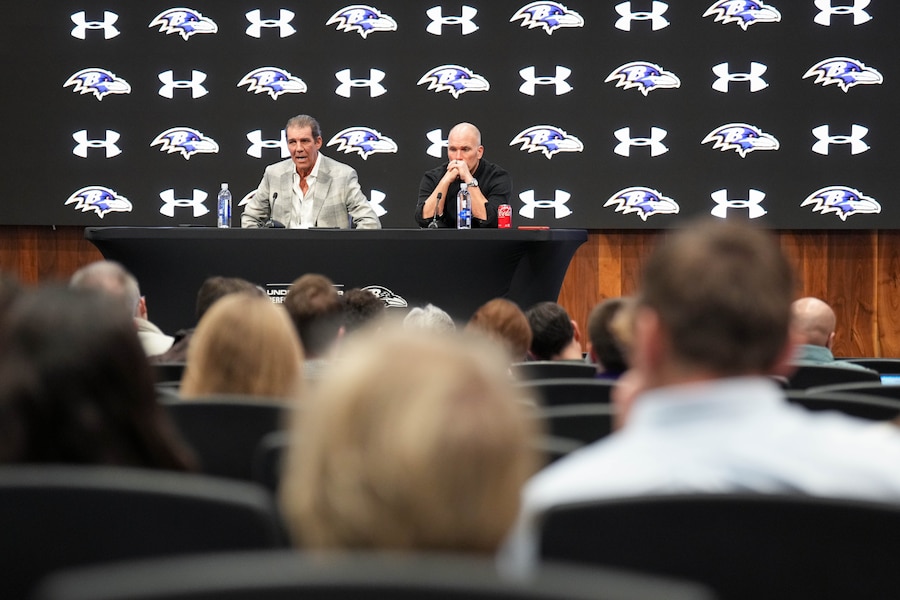
Football teams are always rising and falling in the NFL. In a weeklong span, the Baltimore Ravens have managed to do both.
Days after creating buzz throughout the league in a surprising deal for defensive end Maxx Crosby, the Ravens were gutted during the first day of the legal tampering period. The biggest domino fell when center Tyler Linderbaum agreed to a massive deal with the Las Vegas Raiders, but tight ends Charlie Kolar and Isaiah Likely, punter Jordan Stout and outside linebacker Dre’Mont Jones were also early defectors for big-money deals.
There are a few remaining unknowns, including just how much salary cap space the Ravens have. They’ve yet to acknowledge a new contract with quarterback Lamar Jackson or any other restructuring that will help ease their cap burden. But there is still plenty to break down from a wild Day 1 of legal tampering.
Here’s what reporters Jonas Shaffer and Giana Han and columnist Kyle Goon make of a transformative Monday and how it might affect the Ravens’ roster-building strategy.
Could the Ravens have — and should they have — found a way to match the Raiders’ contract offer for Tyler Linderbaum?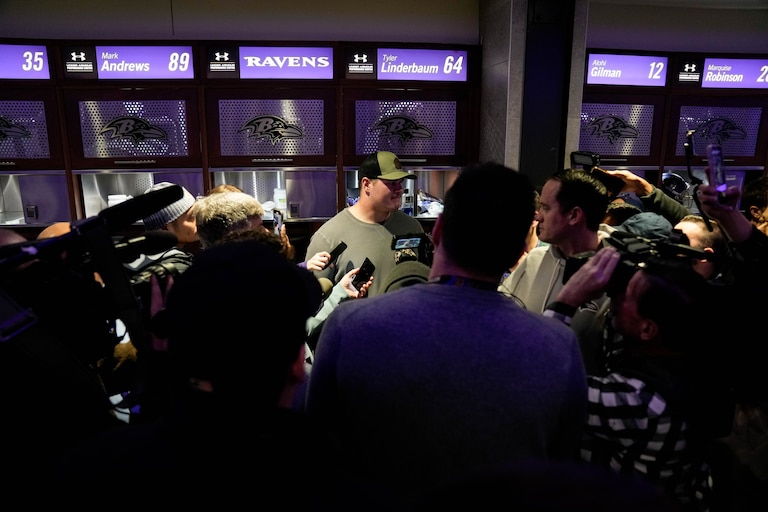 Former Ravens center Tyler Linderbaum is interviewed in a media scrum during the team’s end of season locker room clean-out on Jan. 5. (Ulysses Muñoz/The Banner)
Shaffer: Could they? Sure. Should they? No. This is C.J. Mosley in 2019 all over again. Linderbaum had what general manager Eric DeCosta would call an “irrational” market: The Raiders were willing to pay $27 million a year for a player most of the NFL’s 31 other teams would’ve probably valued at $18 million to $23 million. Linderbaum is only 25 and has already backed up his dynamic run blocking with flashes of brilliance in pass protection. But it hasn’t been sustained, and his physical limitations suggest it might never be sustained.
Offensive line guru Brandon Thorn tweeted Monday that Linderbaum “is a very good player and an ideal fit in a zone-heavy system” like the one coach Klint Kubiak will bring to the Raiders. “But I see a clear tier separation between him and Creed Humphrey as overall centers due to play strength.” The Ravens were right to offer Linderbaum a market-setting offer. Making him the highest-paid interior lineman in NFL history, however, might’ve done more harm than good.
Han: Having spent the past few weeks diving into Lamar Jackson’s contract and the Ravens’ salary cap numbers, I just don’t know how they would have cleared up that much money. They likely could have made room for Linderbaum’s 2026 base salary, which is reportedly $10 million in this framework. But they would have had to do some serious maneuvering to stay cap compliant over the rest of the years considering the rising cost of their other contracts. And then there are the bonuses to consider.
Linderbaum is an incredibly important player, and I’m worried about the state of the line without him. But at that price tag, it doesn’t seem feasible. And good for Linderbaum. Make your money. But the Ravens aren’t in the wrong for not wanting to give up that much of their tight cap space to a center.
Goon: It’s hard to see how the deal could have been reached. Good on Tyler for squeezing $81 million in three years out of Las Vegas, which spends money in a way that rarely translates to wins. Linderbaum chose to maximize his average annual value at a range that was pretty much out of reach for the cap-strapped Ravens. But the choice he made was also to go to a rebuilding Raiders team with a potential rookie quarterback in Fernando Mendoza. While Linderbaum will be bathing in green with the richest deal ever for an interior offensive lineman, I wonder whether he’ll find that the grass was greener back in Baltimore once the games start this fall.
Who made the more impactful addition to their roster: The Ravens with Maxx Crosby, or the Raiders with Linderbaum?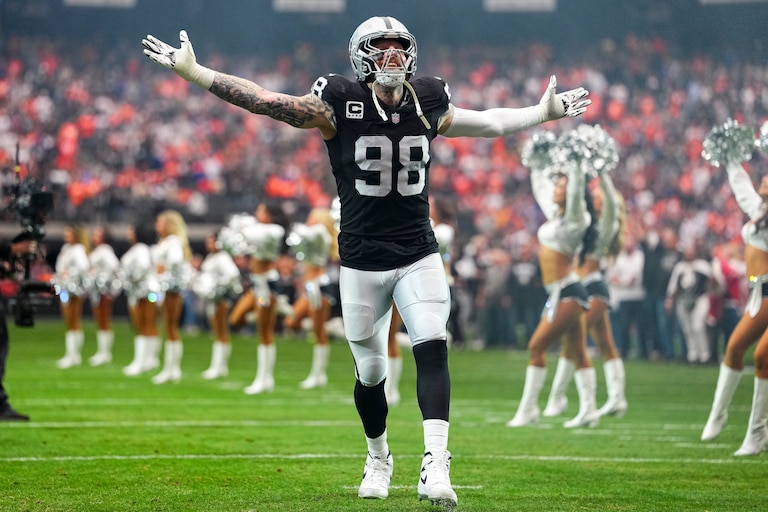 Maxx Crosby takes the field prior to the Las Vegas Raiders game against the Denver Broncos in Week 14. (Chris Unger/Getty Images)
Shaffer: Crosby, obviously. The Raiders needed someone reliable snapping the ball to projected No. 1 overall pick Fernando Mendoza, and Linderbaum could very well mean the difference between a shaky and smooth college-to-pros transition. There is a delicious irony, too, in Las Vegas potentially helping its 2027 draft positioning by weakening the 2026 Ravens.
But on a play-to-play basis, they have different gravitational pulls. Crosby commanded a double team on nearly a third of his pass rush snaps last season and is perhaps even harder to block in one-on-one duels as a run defender. Linderbaum is an elite run blocker with the mobility to unlock a zone-heavy running scheme, but can he handle elite pass rushers one-on-one? Can he reliably sort out protections before the snap? Both were issues at times last season.
Han: Maybe we’ll get to put this to the test in 2027 when the Ravens and Raiders play. Will Linderbaum and his new line be able to protect his quarterback from Crosby? But I think both players’ impacts are quite different. Crosby is older and coming to a team that needs to win now. He can be a game-changer on any given play.
Meanwhile, Linderbaum is a younger building block. He gives the Raiders an experienced but not-too-old center to communicate with the line and, presumably, their incoming rookie quarterback. But I won’t back out of the question, and I’ll choose Crosby because I think he can be a force multiplier.
Goon: The Raiders will get a great blocker and heady center in Linderbaum, who can help unlock some of the young backfield talent they are investing in. But an elite edge rusher is the second-most important position in the NFL. Crosby’s role as a run stopper and pass rusher means he can help on any down, regardless of situation. He’s one of the best at his job.
The first-round picks the Ravens gave up in the deal make this conversation a little different, but if we’re talking about straight-up player impact, Crosby has to win out.
Which free-agent departure, aside from Linderbaum, will be the hardest for the Ravens to replace?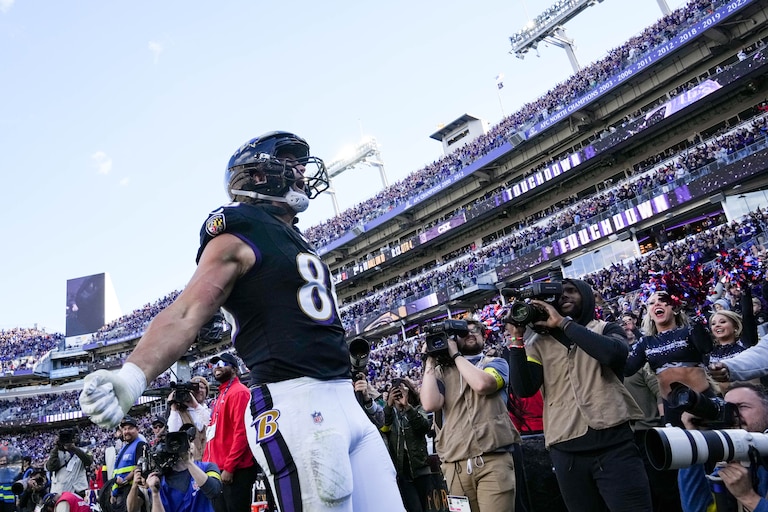 Ravens tight end Charlie Kolar celebrates after catching a touchdown in the fourth quarter against the Chicago Bears in Week 8. (Ulysses Muñoz/The Banner)
Shaffer: Blocking tight ends don’t grow on trees! They need time to develop, to mature, to know what it takes to wall off a 230-pound inside linebacker on one play and double-team a 285-pound edge rusher on another. Charlie Kolar arrived in Baltimore as a big slot target and left as an in-line blocker. Not every fourth-round pick can handle that transition, physically or psychologically.
With the Ravens perhaps embracing more under-center looks under offensive coordinator Declan Doyle, I’d all but penciled Kolar in as a starter in the team’s heavier personnel groupings. Many of the signature run concepts in the Chicago Bears’ offense last season required a tight end holding his own at the point of attack. Now the Ravens may have to acquire a less experienced tight end — or a less athletic tight end — to do the job. Free-agent fullback Patrick Ricard, if re-signed, could also be forced into more in-line snaps.
Han: While Isaiah Likely saw a higher target share, considering the here and now, Charlie Kolar will be harder to replace. If the Ravens draft a tight end with good hands or draw more out of their wide receivers behind Zay Flowers, they’ll be able to make up for a lot of Likely’s production, if not his ability to improvise with Jackson.
I’m not saying the Ravens should have paid Kolar what the Los Angeles Chargers did, but the Ravens will certainly feel the loss of his presence, even if it’s not obvious in the stat sheet.
Goon: All-Pro punters don’t fall from the sky. The Ravens have been blessed with elite specialists for decades, so it may feel like replacing Jordan Stout should be an achievable goal. But given the runway it took for Stout to get as good as he was in 2025, paired with the shock of losing a guy who seemed like a slam dunk to be back in Baltimore, his departure to New York was a bit of a sucker punch.
It’s not necessarily the most important role on the team, and if coach Jesse Minter’s defense is as dominant as we think it can be, maybe Stout’s absence matters less. But a year after going through some ups and downs with kicker Tyler Loop, trying to break in another rookie specialist doesn’t sound so appealing.
Are you surprised that the Ravens didn’t tender Keaton Mitchell, and do you expect them to regret the decision?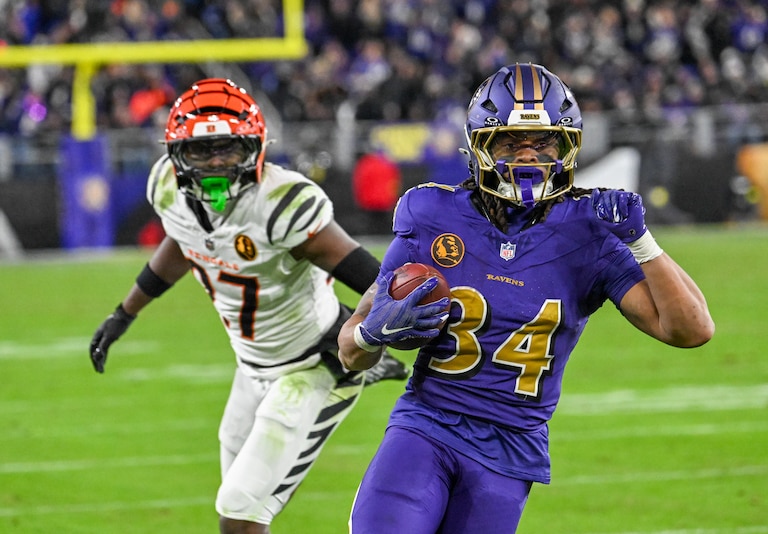 Running back Keaton Mitchell scores a touchdown in the 3rd quarter as the Ravens host the Cincinnati Bengals in Week 13. (Jerry Jackson/The Banner)
Shaffer: Doyle wants explosive plays, and Mitchell has been Mr. Explosive over his three seasons in Baltimore. Of his 121 career carries, 22 (18.2%) have gone for double-digit yards. Of his 19 career catches, four (21.1%) have gone for 15-plus yards. Over Mitchell’s first 57 carries last season, he reached a top speed of at least 20 mph seven times, the most in the NFL, according to the NFL’s Next Gen Stats.
I predicted the Ravens would consider a right-of-first-refusal tender that could help establish Mitchell’s market, or at least sign him to a two-year extension. A return to Baltimore is still possible, but how much value is there in adding to an expensive running back room when there are serious run-blocking questions?
Han: The Ravens stuck with Mitchell through his ACL recovery. That sure makes it seem like they’re big fans of his. But there was also the five-game stretch when he was a healthy scratch. I’m not entirely surprised. But I do think that, should Mitchell stay healthy — and that’s a big if — he’s going to end up in more NFL highlights. And if they come with another team, the Ravens’ front office might have a few moments of regret.
His speed is proven, and he added some runs between the tackles to his highlight reel this year. If nothing else, the fan base’s Keaton Mitchell backers will tag the team’s social accounts whenever Mitchell does something. They’re not a quiet bunch.
Goon: The three-headed beast of the Ravens’ backfield was ungainly when Justice Hill was healthy, but still, I didn’t think Mitchell was the one to be let loose. His right-of-first-refusal tender would have cost less than $3.6 million. Mitchell’s explosive-play ability showed up a little less often in 2025 than when he burst onto the scene in 2023, and he wasn’t as valuable as a return man as you might have expected for someone with his speed. I think wherever Mitchell lands, he’ll make some plays that make Ravens fans shake their heads, but if they need a blocker to match up with Henry more than they need a speed back, it’s a rational choice to make.
As of Monday night, is there a free agent you would target if you were the Ravens?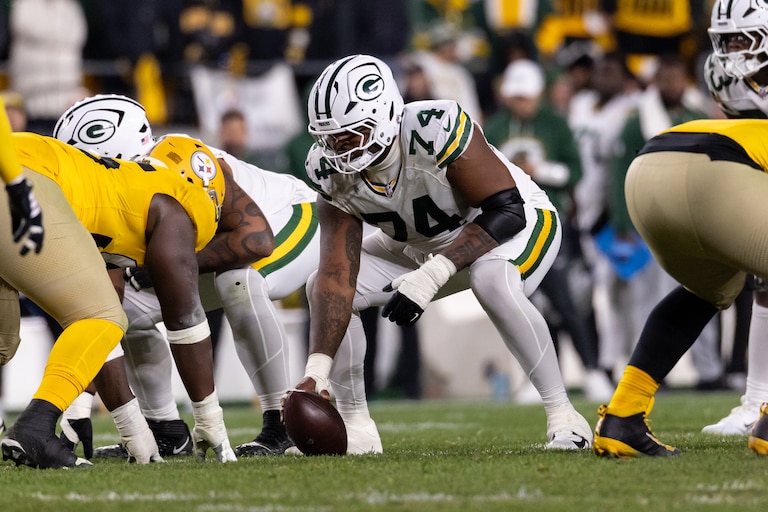 Former Green Bay Packers center Elgton Jenkins (74) readies to snap the ball during Week 8. (Matt Durisko/AP)
Shaffer: Ever heard of the “Scottish Hammer”? Just kidding. Kind of.
If the Ravens have the cap space to acquire a veteran on a deal worth at least $15 million annually, wide receiver Jauan Jennings would be a sound investment. The 28-year-old had a combined 1,618 receiving yards and 15 touchdowns over the past two seasons with the San Francisco 49ers. Jennings can win as an isolated outside receiver or in the slot, a versatility that could help unlock Zay Flowers (and perhaps Rashod Bateman). At 6-foot-3 and a listed 212 pounds, he’s a contested-catch threat and a hard-nosed run blocker.
Han: It’s hard to get a handle on the Ravens’ cap numbers without knowing whether Jackson is signing an extension, so I’m not sure this is entirely possible, but former Green Bay Packers center Elgton Jenkins would be a great addition. The Ravens would replace a Pro Bowl center with a Pro Bowl center, and they’d have someone with experience directing communication up and down the line. With guard John Simpson already set for a return, adding Jenkins would leave the Ravens with just one open starting position along the line. They could have Emery Jones Jr. and Andrew Vorhees compete for the job, or they could add more competition through the draft. After the number of injuries Jackson dealt with last year, protection up front should be a priority.
Goon: I kind of can’t believe I’m about to say this, but: The Ravens should re-sign DeAndre Hopkins. There is so much smoke around the Baltimore receiver room right now, with Zay Flowers going into a potential contract year and Rashod Bateman subject to trade rumors. What if the Ravens brought back Hopkins, who frankly was underutilized in the offense last season? Hopkins is still fully capable of contested catches, and his efficiency (when he was actually targeted) was good. The price should be low, and the upside should actually be higher than it was last year. Give ‘D-Hop’ and Lamar Jackson an actual chance to develop chemistry, and something surprising might happen.
Which free-agent departure or roster hole is best addressed in the NFL draft?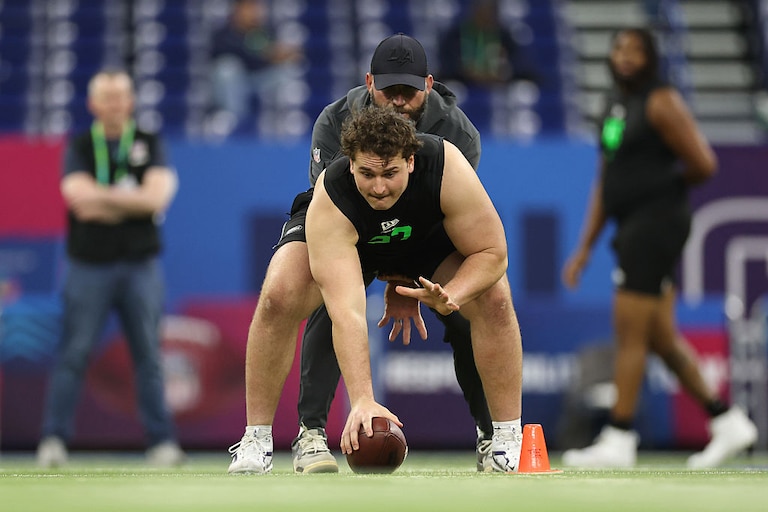 Sam Hecht of the Kansas State Wildcats participates in a drill during the 2026 NFL combine on March 1. (Stacy Revere/Getty Images)
Shaffer: At this point, it has to be center. The free-agent market has been nearly stripped clean of starting-level veterans. Brandon Thorn, an NFL draft analyst for Bleacher Report, has four prospects rated as high-level backups or potential starters, equivalent to a third-round grade: Kansas State’s Sam Hecht, Duke’s Brian Parker, Florida’s Jake Slaughter and Auburn’s Connor Lew.
The Ravens could also find a starting punter and a rotational blocking tight end on Day 3, where they have seven picks total.
Han: They could easily address tight end, but this draft class has a stronger selection of defensive backs. The Ravens can bring back Alohi Gilman to play as the third safety under Minter, his former Chargers defensive coordinator. But if they don’t, they could take their chances in the draft. With Minter’s creativity and the ability to move around cornerback Marlon Humphrey and safety Kyle Hamilton, the secondary has enough established pieces to give an inexperienced rookie safety time to get up to speed.
Goon: Tight end is the clear answer here. The Ravens have a great track record of finding guys who are either good in Baltimore or good elsewhere. Hitting on both Likely and Kolar, in their own lanes, is an indicator that the Ravens’ scouting department understands what kinds of tight ends can find success in their system. It’s kind of amazing that a three-headed tight end room worked this well for this long. With Mark Andrews coming back, it’s a great opportunity to draft a successor as a pass catcher, and perhaps another TE who can be the gritty blocker that Kolar became over his tenure. This is the position where the draft never really stops giving to Baltimore.