
“Jimmy Savile, he’s one of your own…”
At Leeds United football matches, the chanting about one of Britain’s most notorious paedophiles and rapists usually begins like this.
On Sunday, before an FA Cup fifth-round tie at Elland Road, Norwich City fans reminded their hosts that Savile was born, lived and died in the area they were visiting before the game had even kicked off.
While parts of the ground booed, the song — as it nearly always does — invited a response from Leeds supporters in the stadium’s South Stand, next to the Norwich enclosure, that described Savile committing a sexual assault.
It was shocking, but not surprising. Savile, once one of Britain’s most famous television and radio personalities, whose celebrity and charitable work allowed him to mix with royalty and powerful politicians, was posthumously exposed as a prolific sex offender.
A 2013 report by London’s Metropolitan Police and the National Society for the Prevention of Cruelty to Children found that Savile had committed at least 214 sex crimes, including 34 rapes between 1955 and 2009, with 450 people alleging they had been victims of abuse. Separately, Savile was found to have sexually abused victims — mainly girls and women — at 28 hospitals across the United Kingdom, including Leeds General Infirmary, where his victims ranged in age between five and 75, and Broadmoor, a psychiatric hospital.
While rumours had swirled around Savile while he was alive, the cascade of revelations after his death in 2011 at the age of 84 brought about a public reckoning in the UK’s police, health system and media, and led to the conviction of several other high-profile celebrity paedophiles.
Yet for all Savile’s ubiquity in life, in death, he has become largely invisible. The sites that once bore his name — from a popular viewing point in the Yorkshire seaside town of Scarborough, to a major conference centre in Leeds — have been renamed and his old dwellings have been torn down or gutted. Even the headstone of his grave was removed.
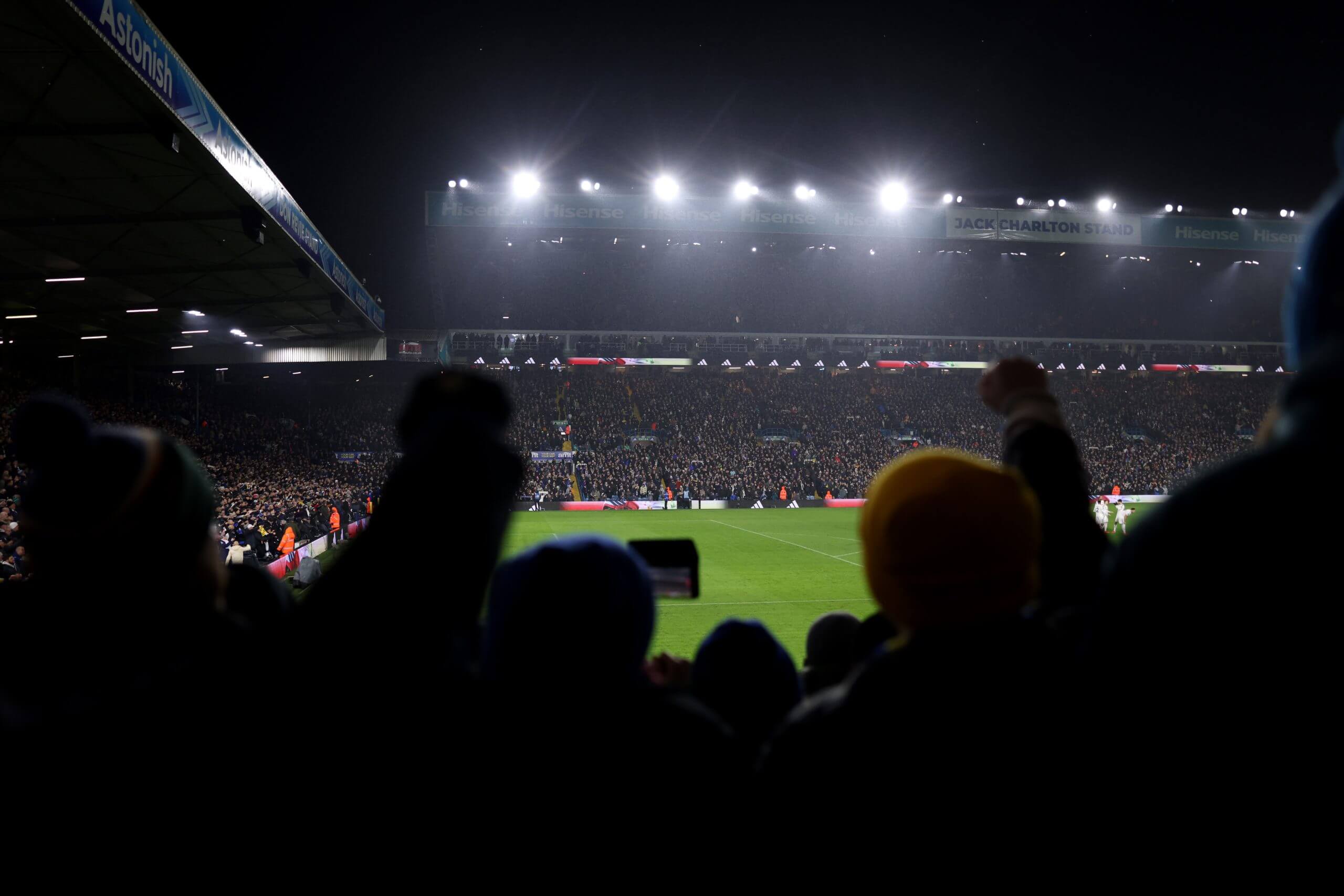
Matches at Elland Road often take place to a soundtrack of Jimmy Savile chants (George Wood/Getty Images)
With the exception of television dramas documenting his crimes, the only place Savile’s name is regularly heard these days is at Leeds United football matches, even though he had no ties to the club.
“It is the equivalent of followers of an American sports team singing about Jeffrey Epstein whenever they go to New York simply because he came from there,” says Dan Davies, a reporter who interviewed Savile many times and tried to unmask him when he was still alive.
When Graham Smyth, the chief football writer at the Yorkshire Evening Post, reported the Savile chants at the Norwich match on X, many of the responses shared his view that they were “absolutely depressing”. Yet others described them as “banter” and another suggested “no one was bothered”. As Smyth noted, the victims of Savile and other sex offenders might have a different view.
That reaction spoke to a sense that Savile chants have become normalised within football — just another expression of the ferocious tribalism that is, for many, the English game’s unique selling point. That is underlined by the fact that these chants have not been punished by the English Football Association as they are not deemed a public order offence by the UK’s Crown Prosecution Service (CPS).
For those unfamiliar with the often harsh world of English football fandom, it must seem odd that Savile songs attract relatively little public opprobrium or debate about how to stop them.
But for those who have grown weary of hearing the chants provide a poisonous soundtrack to matches, including Leeds United themselves, the time has come for change.
Jimmy Savile may not have been connected to Leeds United, but he was stitched into the fabric of the city.
He was born there and, for the last three decades of his life, he lived in a penthouse flat in Roundhay, a salubrious suburb north of the city centre. Locals would regularly see him strolling through Roundhay Park, once the biggest city park in Europe.
Savile used sport to burnish his fame, taking up wrestling in the 1960s and regularly running marathons for charity, but he showed little interest in football despite Leeds boasting one of the finest teams in Europe just when his own profile was beginning to skyrocket in the 1970s.
“Savile was the antithesis of a team player,” says Davies. “When he competed in sport, it was about him as an individual. Even though Leeds United was on his doorstep and emerging as famous in its own right, I am not aware of any connections between him and the club. If there are, it won’t have any deeper meaning — it would only be because publicity interests aligned at a certain point.”
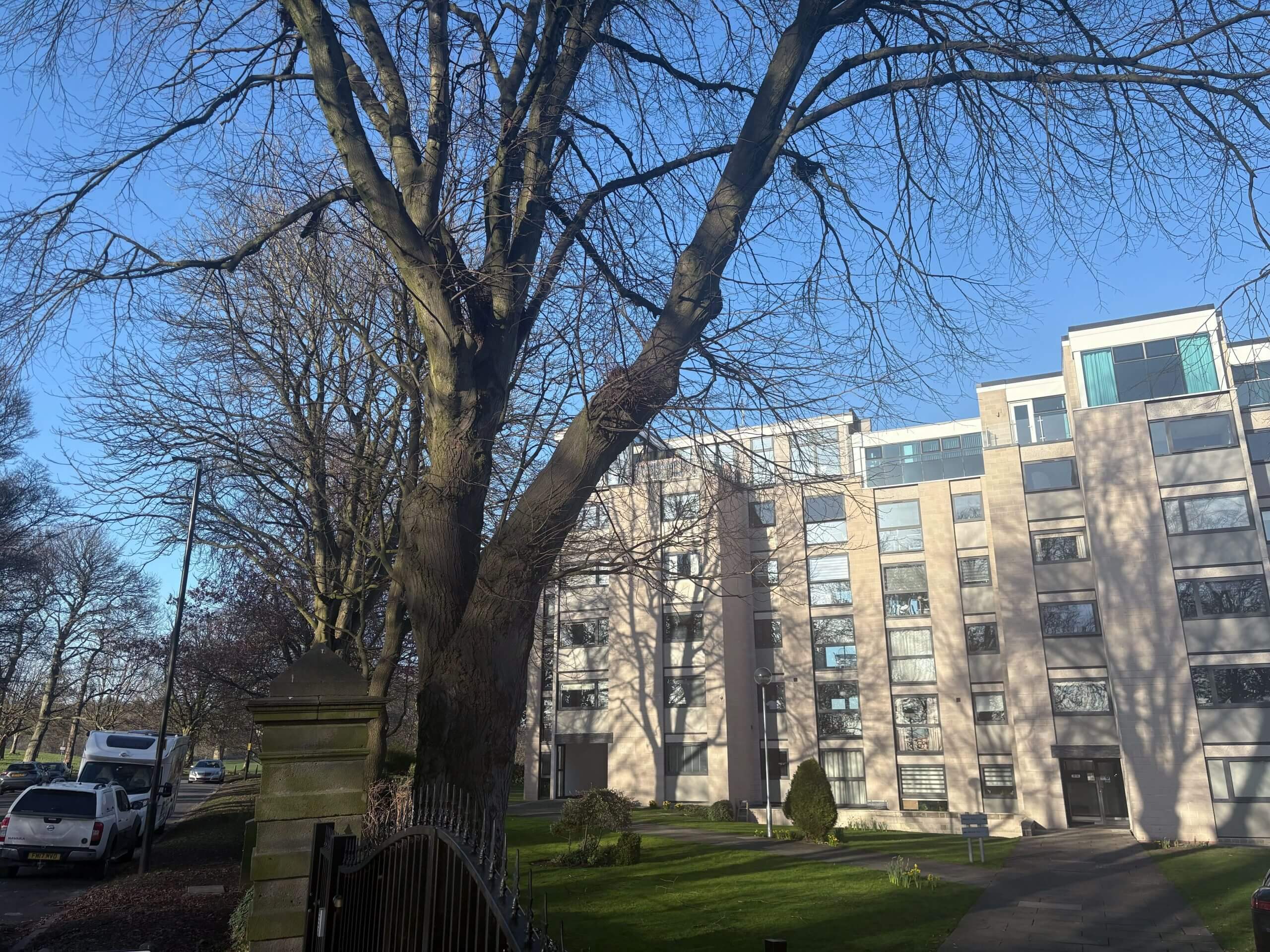
Jimmy Savile’s old apartment building in Roundhay Park (Simon Hughes/The Athletic)
There is similarly no evidence of Leeds United having sought endorsements from Savile while he was alive. Their fans, too, largely ignored him in life. A group did dress up in his trademark gaudy tracksuits and blond wigs for a crucial relegation match at Arsenal in 2003, but it was not a particularly unusual sight: given Savile’s status as a national treasure, he was a fancy-dress staple across Britain at the time, despite the rumours about him.
Things began to change when Savile died. The day after, following Leeds’ 1-1 draw with Cardiff City, their manager Simon Grayson was asked by local reporters to speak about what Savile had meant for the area.
In the city, Savile’s funeral was a three-day event that, according to Davies in his book In Plain Sight, “was marked with a combination of solemnity usually reserved for departed statesmen and the tawdry showmanship that had been his hallmark”.
Overnight, his gold coffin was placed in the reception area of the Queens Hotel and adorned with white roses — the symbol of Yorkshire. The next morning, thousands of mourners passed through the hotel’s doors before two hearses and five black limousines took the coffin on a tour of the city, past his childhood home on Consort Terrace, and the hospital where, under the guise of his work as a volunteer, he had targeted victims for more than half a century.
With porters forming a guard of honour, he was then carried into Saint Anne’s Roman Catholic Cathedral by six Royal Marines in full uniform, while huge crowds chanted “Jimmy, Jimmy!” outside. Through loudspeakers, they could hear a requiem mass where Monsignor Kieran Heskin said Savile’s “colourful and charitable life of giving” would surely earn “the ultimate award, a place in heaven”.
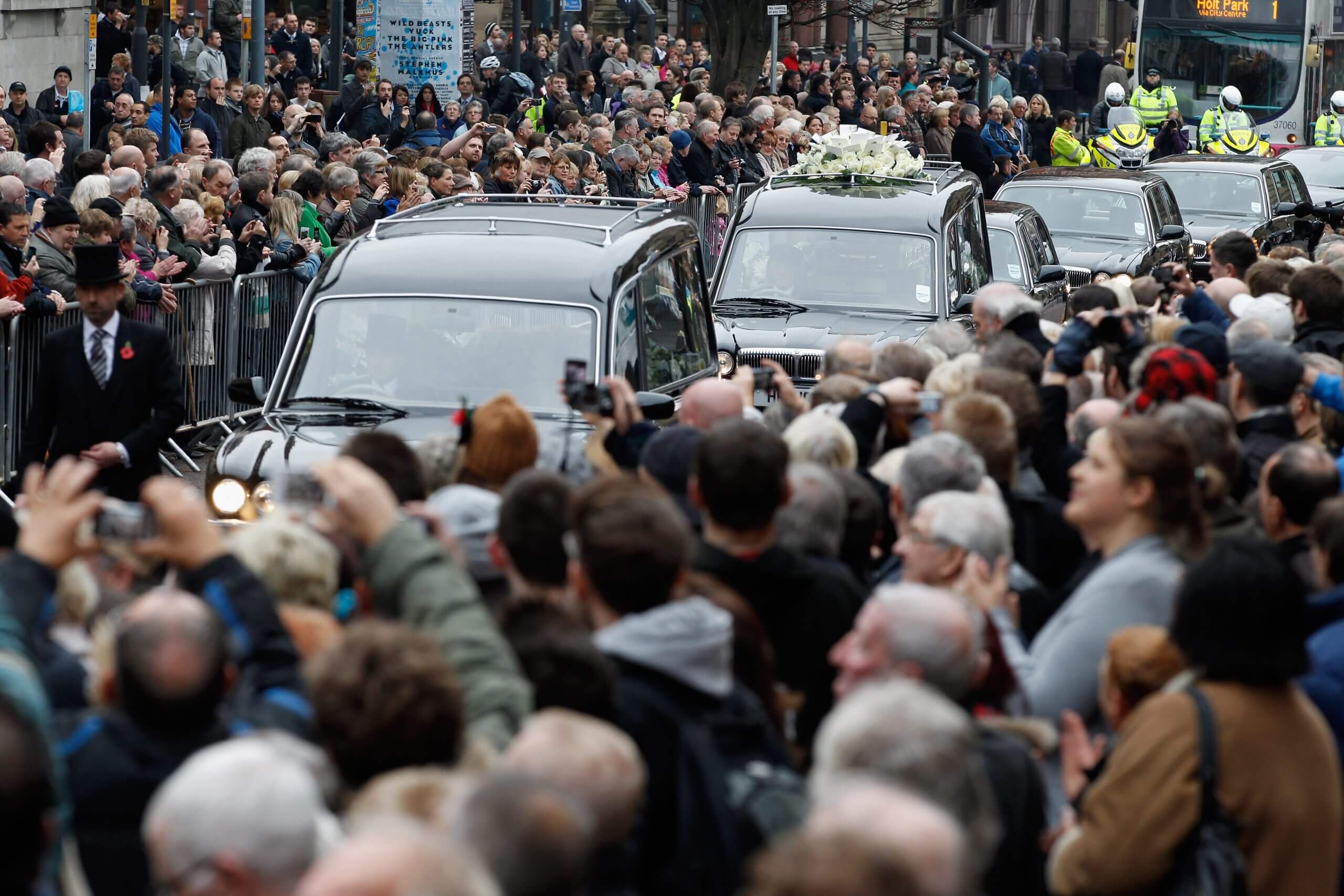
Savile’s funeral cortege passes through Leeds in 2011 (Christopher Furlong/Getty Images)
Mick Ward, a Leeds fan and part of the club’s Marching Out Together supporters group, was not one of the mourners standing in the rain on the day of his funeral, despite his employers telling staff they could take time off to join the procession.
Ward says Savile’s fame came at a time when there was little to celebrate either culturally or economically in Leeds. Even though the city’s football team were successful, some of their supporters’ predilection for hooliganism saw shops board their windows whenever they arrived for an away game.
Ward, who is from Leeds, agrees that there was a “darkness” around the city at that time, and this contributed towards pride in Savile before the truth about him became fully known. “The media was very London-centric, so a lot of people were happy to see a local person doing well,” he says.
That attitude, perhaps, helps explain why Savile was able to commit crimes on such an industrial scale, despite many harbouring concerns over his behaviour. “Many knew he would work his way through the sixth form, so to speak,” Ward adds. “Yet at the same time, he was massively celebrated.”
Nobody was willing to challenge the narrative around Savile, who, by the 1980s, was a dominant primetime presence on BBC television, and a friend of Prince Charles, now the king, and the then-prime minister Margaret Thatcher.
Ward thinks it was a reflection of Savile’s power that when a disabled rights group disrupted a ceremony that he was fronting at Leeds train station for the building of a garden for disabled people, his role was barely mentioned in the local press.
“The mainstream media regarded him as a figure who was much loved and the idea that someone — or a group of people — would run against him was a challenge,” Ward adds. “Savile was almost a royal-like figure. He was untouchable.”
St James’s University Hospital in Leeds was one of the many facilities where Savile committed his crimes.
Katie Watkin, an Elland Road season ticket holder, was a patient in the mid-1990s and she can remember Savile’s voice appearing across hospital radio, where he gave warnings to children about crossing the busy roads around Headingley cricket and rugby stadiums. Later, as a teenager, she heard rumours about Savile taking kids to dinner at a pizza restaurant in the north of Leeds.
Watkin believes that chanting about him at Leeds matches, 15 years after his death, has partly been enabled by the fact that he never faced justice and because his abuse went on for so long. The rumours about him were so ingrained that the truth was not as outrageous as it should have been when it was finally laid bare.
Watkin loves Leeds United and Elland Road, having first attended games there with her late father, but finds it “despairing” that it has become a setting for such “abhorrence”.
The stadium, situated on the city’s ring road, is a throwback to a less refined age in English football, with a facade that blends barbed wire and concrete in a way that has changed little since the days when Savile ruled the UK’s airwaves.

Elland Road is a throwback to a bygone age (Simon Hughes/The Athletic)
Plans to redevelop the stadium, increasing its capacity from 37,645 seats to 53,000, were approved by Leeds City Council in January. If this happens, it will be the first significant modification since 1993 when the towering East Stand was rebuilt.
“There are not many grounds like it left,” says Watkin, who, like Ward, wonders whether this influences the behaviour of visiting supporters.
“Away fans see a proper football ground,” adds Ward. “This is not the Emirates (the home of Arsenal, commonly held up as the epitome of ‘modern stadia’). Does it take fans back to a different time — does it tell them they can get away with more and do whatever they want?”
The chanting does not just happen at Elland Road, though. Type ‘Savile chants’ into YouTube and the search results include videos taken across the last 15 years at Sheffield Wednesday, Bristol City and Middlesbrough, as well as Elland Road.
Leeds supporters tend to agree that the Savile chants from the away end have increased over the last five years, as the club have spent longer in the Premier League after 16 years marooned in the lower leagues between 2004 and 2020. There is a sense that supporters of English football’s top division clubs, who had not been to Elland Road for a league fixture since the start of the century, wanted to make their mark.
On some occasions, Leeds supporters in the South Stand have apparently tried to pre-empt their visitors by singing about Savile first — usually in unfounded connection to a celebrity fan of the opposing team (examples involving Newcastle United and Watford have gone viral in recent years).
Ward makes the point that transgressive chanting at football grounds is nothing new. He can remember attending matches in the 1960s when a song about Harry Roberts — a violent criminal who murdered three policemen in London — was belted out by supporters of different clubs. There is also a culture of fans “owning” their misfortune or misery but as he stresses, “this usually relates to the threat of relegation or something like it: ‘We’re s*** and we know we are’.”
Savile chants come from a very different, darker place.
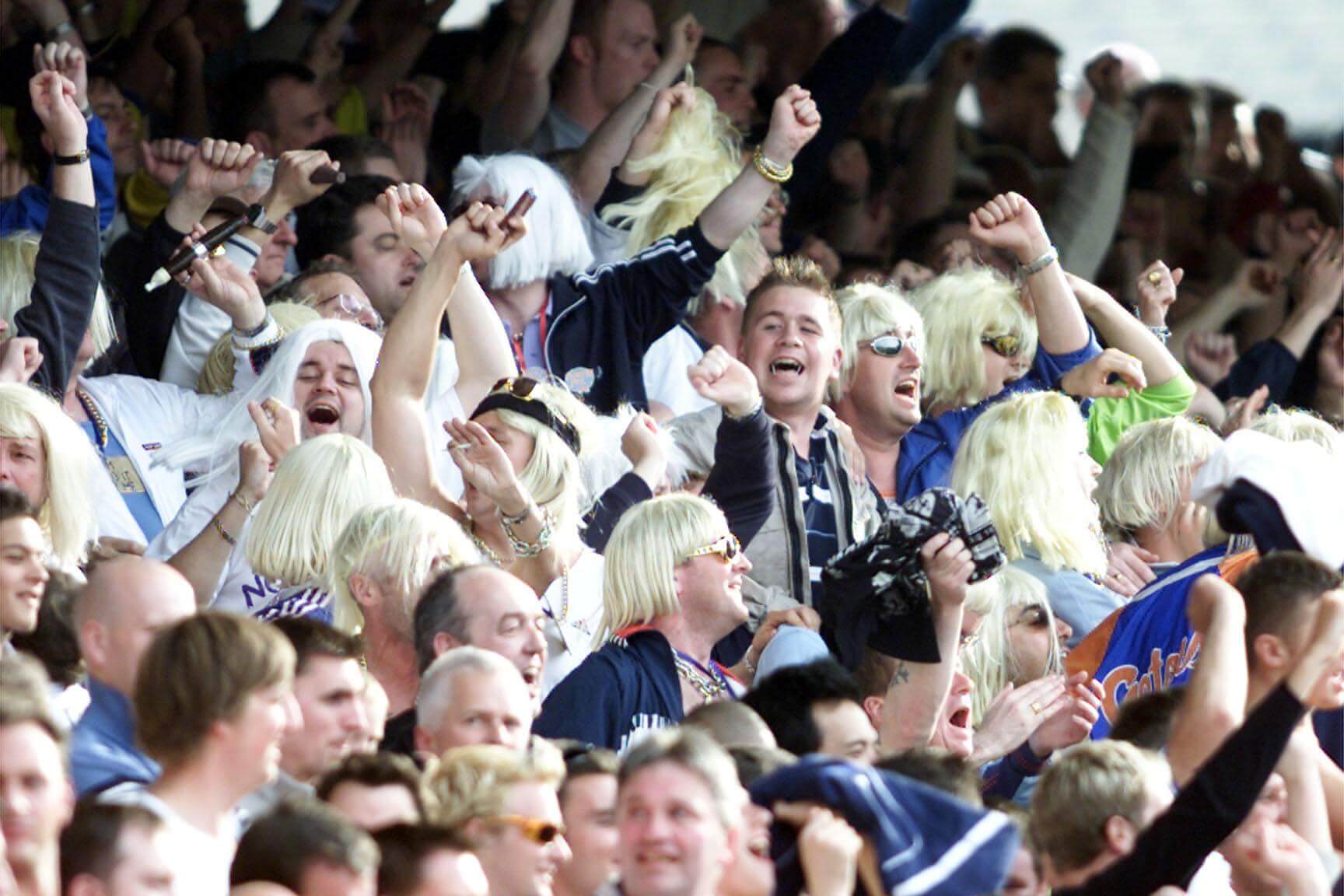
Leeds fans dressed as Savile at Arsenal in 2003 (Tom Hevezi – PA Images via Getty Images)
The question of how to deal with Savile chants is complicated.
In 2023, the CPS updated its guidelines around so-called ‘tragedy chanting’, outlining how supporters could be banned from grounds and prosecuted for a public order offence for “tragedy-related abuse”.
On its website, the CPS guidance states that this includes “when fans sing, chant or gesture offensive messages about disasters or accidents involving players or fans”. It cited stadium disasters such as Hillsborough, when 97 Liverpool fans were unlawfully killed before an FA Cup semi-final in 1989, the 1958 Munich air crash, when eight Manchester United players died, and the murder of two Leeds fans in Istanbul before a UEFA Cup tie in 2000, among other events.
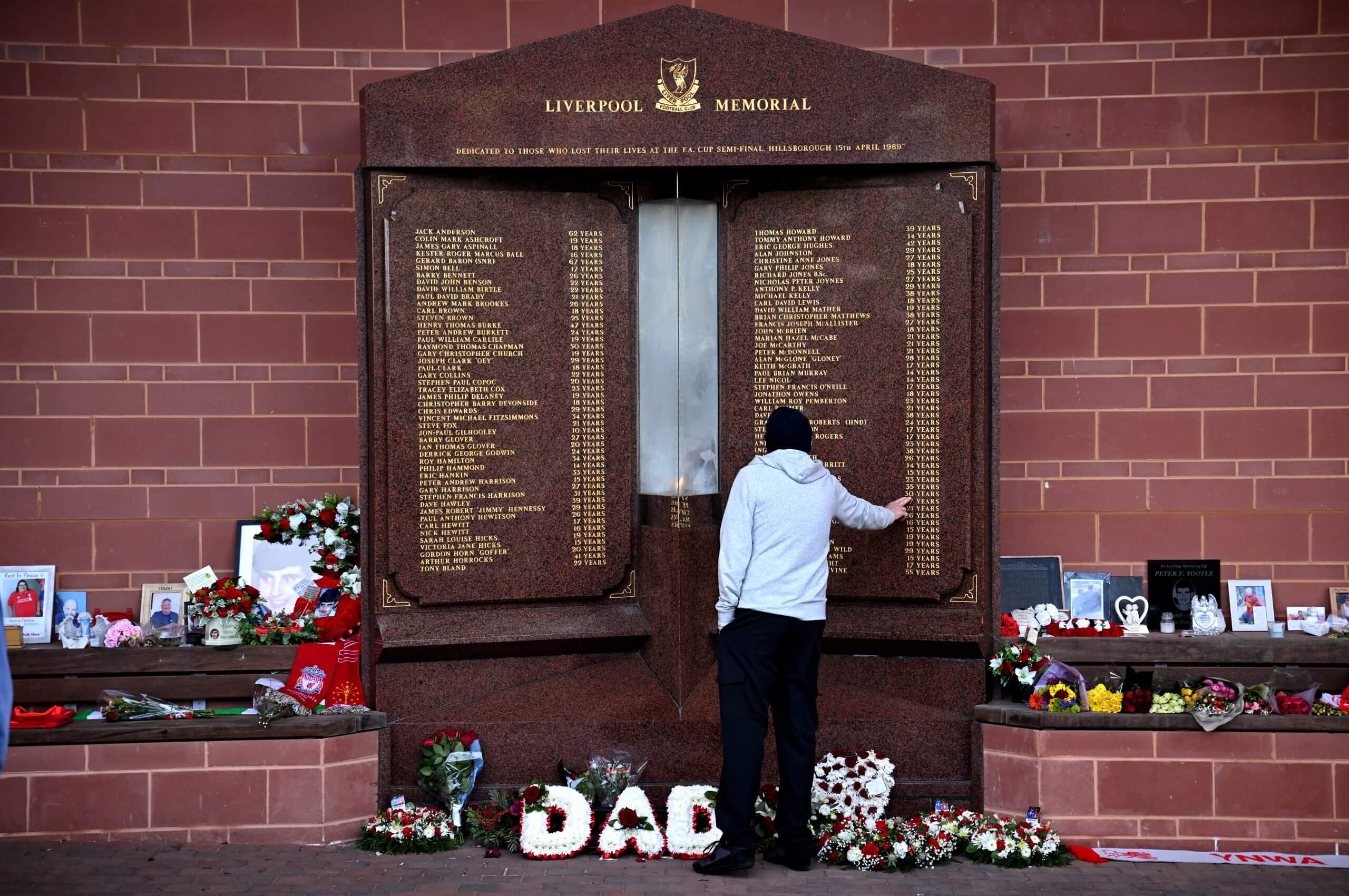
Chants mocking the Hillsborough disaster are now deemed a crime (Justin Setterfield/Getty Images)
Savile chants, however, are not covered by this legislation as they do not specifically refer to football.
Under current laws, crowd chanting and fan behaviour fall under the FA’s remit to investigate. It can charge clubs but does not have jurisdiction over individual spectators unless they are participants in football.
The FA has acknowledged to The Athletic that it is in regular dialogue with the UK Football Policing Unit (UKFPU), the body dedicated to reducing incidents of football-related anti-social behaviour and violence and which has considered the issue of Savile chants with the CPS, but it has been advised that singing them does not constitute a criminal offence. The FA would like the UKFPU to continue discussions about whether further legal action is possible.
It is a situation that has left many dissatisfied, not least the club.
Until recently, Leeds United had not publicly confronted the issue of Savile chants at matches. The first time it was referenced was in a statement on March 6, issued to demand that “respect be shown” to Muslim players breaking fast during Ramadan. The release mentioned wider problems facing the game, “including racism, homophobia, tragedy chanting and the sickening Jimmy Savile taunts our own supporters are subjected to at every match from opposition fans”.
Now, however, the club wants to go further. When contacted by The Athletic, a Leeds United spokesperson said: “Leeds United Football Club have lobbied and would be fully supportive of Jimmy Savile chants being classed as tragedy chanting and a hate crime.
“The club’s supporters are subjected to these sickening taunts at every match by opposition fans, which should not be happening in today’s game and are a disgrace to the victims of Jimmy Savile’s abuse. Equally, the club disapproves of retaliatory chants from our own supporters.
“The club is pleased this is finally being brought to the forefront by the media and hope that this can be the first step in helping to eradicate these chants, with the support of the relevant governing bodies.”
Those calls were echoed by Katie Russell, co-founder of Support After Rape and Sexual Violence Leeds (SARSVL), who believes fans cite Savile for the same malevolent reasons as the football-related tragedy chants mentioned in the CPS guidelines.
“By implication, they (the authorities) are clamping down on one type of tragedy and turning a blind eye to another and that is not good logic — in fact, it’s bizarre,” she says.
Such chanting, she adds, “trivialises male sexual violence” and is “triggering and distressing for survivors” while having the potential to enable further violence towards women.
“If it goes unchallenged, the chanting normalises that behaviour for vulnerable, impressionable children. There is an ongoing debate about whether misogyny is a hate crime. This type of thing could potentially be viewed as one in the future because chanting and joking about a prolific offender is going to make the average woman feel unsafe.”
Ward agrees. “What Savile did is not a tragedy in the classic sense but it is a tragedy due to the number of people affected,” he says. “Singing about him is done for the same purpose as tragedy chanting.
“The authorities need to crack down on it. What is it like to hear that if you are a victim of Savile? The police are quite capable of arresting people on demonstrations for holding up a placard. I’m sure they are capable of arresting someone for singing a song about a paedophile and a rapist.”
An FA spokesperson told The Athletic: “We strongly condemn any offensive, abusive and discriminatory chants in football stadiums. It is unacceptable and can have a lasting and damaging impact on people and communities within our game. We support any club and their fans who try to eradicate this behaviour from the terraces. We continue to work closely with our stakeholders across the game and the relevant authorities to proactively address this issue.”
When contacted, the Premier League and English Football League said that issues around fan behaviour fall under the remit of the FA to investigate, while the CPS indicated that incidents were judged on a case-by-case basis. The UKFPU was also approached for comment.
Nobody believes there will be a quick fix. To generate momentum, a more concerted effort from high-profile figures within football to call out the chanting is required.
This has rarely happened in the past. In 2023, when he was manager of Birmingham City, former England and Manchester United striker Wayne Rooney was taunted throughout a match at Elland Road: “The only chant I didn’t appreciate, really, was the Jimmy Savile one,” he told reporters afterwards. “I don’t think that’s acceptable.”
Nine years earlier, Ian Holloway, then the Millwall manager, tore into his own club’s fans after an opening day victory over Leeds at the New Den. “I don’t think the chants were right because they’re disrespecting (Savile’s victims),” he told a media conference. “What he did is an absolute disgrace. Let’s stop and think about what he has actually done, yeah?”
Media coverage of the issue, both locally and at a national level, has also been minimal. Since 2019, at least two different articles in the Yorkshire Evening Post have tackled what is happening around Leeds games. On the first occasion, a column written by the paper’s former Leeds United correspondent Phil Hay (now at The Athletic) followed the release of a video from a concourse at Blackburn Rovers where a Leeds fan was dressed as Savile and fans around him chanted, “He’s one of our own.”
Hay had previously attended Leeds General Infirmary with Leeds players as part of the club’s partnership with a children’s heart surgery fund. Savile committed many of his offences on patients at this hospital. “Having seen the sickness, the vulnerability and the professionalism there, the only conclusion you can draw is that it takes a rare type of degenerate to take advantage in those circumstances,” Hay wrote. “It is grim to think of Savile gleaning pleasure from his notoriety or the banter he is inspiring.”
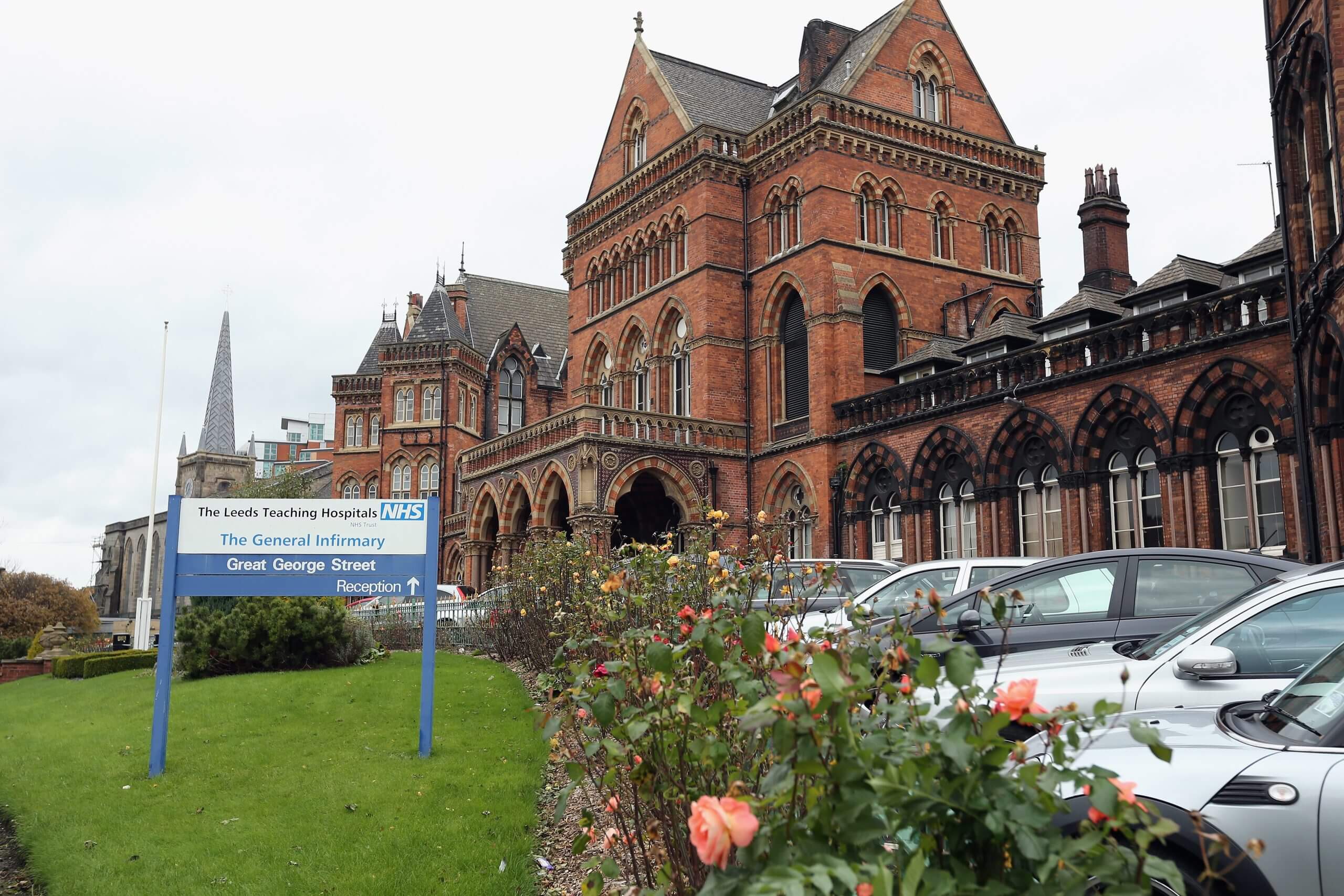
Leeds General Infirmary, where Savile committed many of his crimes (Christopher Furlong/Getty Images)
As Hay noted, it is inconceivable that victims of Savile’s offences — which took place across the UK — have not been present at stadiums where his name has been sung. “This is surely not something to be triumphant about,” says Davies.
Russell says that when Savile’s victims came forward in 2012, “it was a positive moment for survivors, who were seen, heard and believed for the first time after decades of being ignored.”
All these years later, it surprises her that Savile is considered relevant in any way. Songs about him have the potential to cow victims into silence. “Whether it’s men or women in a football stadium, a significant percentage will have their own experience with sexual violence,” she says. “Male survivors have their own barriers when seeking support and justice, among them dated ideas around what masculinity is.
“If you are a survivor at Elland Road, nothing about the experience of sitting through a Savile song will make you feel confident you can pursue justice, have counselling or speak to family about a trauma which is often described as ‘historic’ when the suffering is very current.”
People on the Leeds United Supporters Board are mindful of this but there is a limit to what they can do because any solution would involve the supporters of other clubs. There tends to be a view in Leeds that any impulse to sing about Savile would not exist if his name was not being thrown at them.
The bitter irony is that Savile should be a source of national, rather than local, shame. He used his power and privilege to exploit some of the most vulnerable members of society, but he never saw justice in his lifetime. He has not even been stripped of his personal honours — an Order of the British Empire award and his knighthood — because he was not charged or found guilty when he was alive.
Yet rather than being consigned to history, many football fans still see Savile as a bogeyman to be weaponised in the name of tribal point-scoring.
Unlike Munich, Heysel or Hillsborough, there is no footage or photographs that bring the reality of Savile’s crimes into focus. Perhaps this shaves off sharp edges around any conversation.
For now, many of Savile’s victims largely remain invisible, understandably reluctant to enter the debate about his toxic legacy.