
Usually when people go back and visit their old high school, they just kind of mill around. Lean against a few walls. Say hey to a few teachers. They don’t, you know, sit down in their old third-period history class to ace a pop quiz.
Someone ought to tell Tennessee Titans second-round draft pick Femi Oladejo this.
“We had our spring game. And we’re going through the warm-up process. And I saw (Oladejo) walking out of the locker room,” UCLA defensive coordinator Ikaika Malloe told The Tennessean. “I kind of take a second to process and I go ‘Wait a minute. What are you doing here?’ Femi was in his locker getting ready for the spring game. I go ‘You do realize you don’t play here anymore, right?’
“But that’s him. He’s so wired that he came not only to watch it, but he prepared for the game. He had his shirt off like he was about to put on pads. He had his earphones on. He was staring at the locker to get his mind right for the game. I said ‘Bro, you’re gonna have such a great career. You shouldn’t even be here, but your mindset is wired that way.’ At first I was laughing saying ‘What are you doing?’ But then I was like, ‘Man, he’s going to be successful for sure.’”
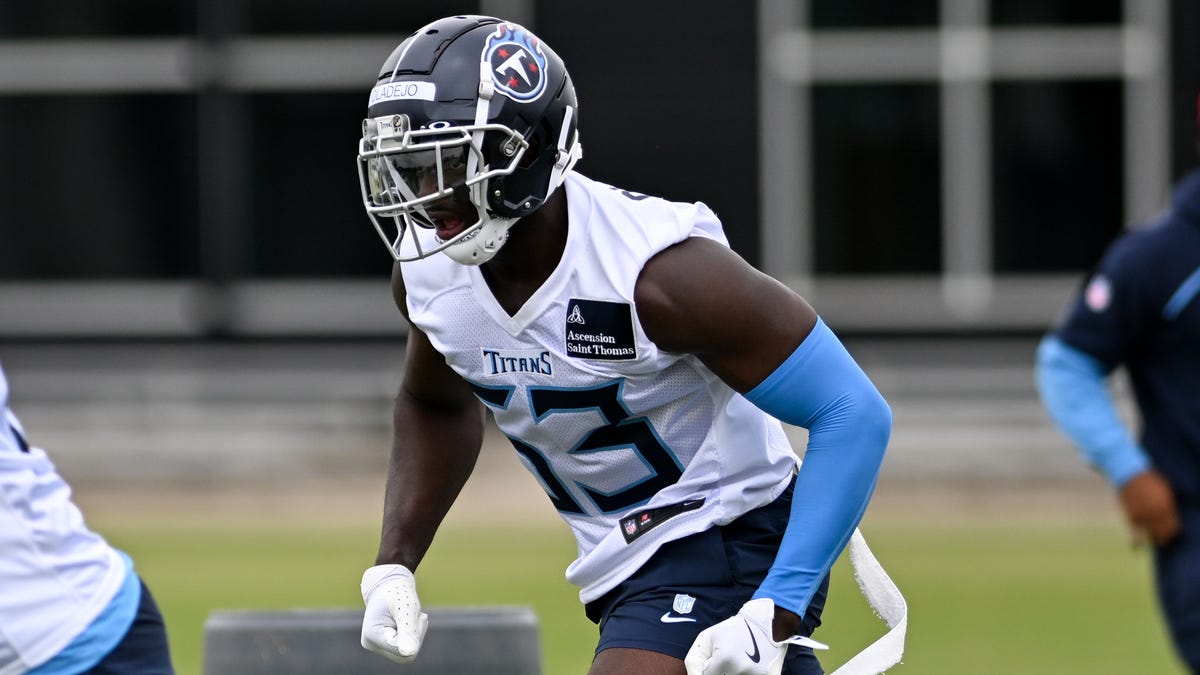
The Titans drafted Oladejo with the No. 52 pick in the second round of April’s NFL draft. A 6-foot-3, 259-pound outside linebacker, Oladejo is one of several Titans rookies who’ll be expected to play a significant role in the team’s ongoing rebuild. But it’s important to separate Oladejo’s long-term potential from the team’s short-term depth concerns at pass rusher. Oladejo is the first edge defender the Titans have drafted in the first two rounds since Harold Landry III in 2018. Not coincidentally, the Titans drafted Oladejo in the same offseason they parted ways with Landry.
But unlike Landry, who logged 25 sacks and 48 TFLs across four years as a college pass rusher, Oladejo has a whopping 10 games of experience playing the position. He spent his first three college seasons and the first couple weeks of his senior year playing inside linebacker before bumping outside. Not even a year after making that switch, Oladejo’s the symbol of youth and revitalization for a Titans’ pass rush that desperately needs a facelift.
“It’s intriguing,” says UCLA executive director of player development Durell Price, “because you’re like ‘Holy crap, what is this kid’s potential?’”
On May 11, the Titans’ social media team put out a 48-second video of Oladejo playing his way through a rookie minicamp practice. Oladejo’s either screaming or sprinting for about 45 of those seconds.
That’s not movie magic.
That’s Oladejo.
“I would say as a kid I was just always the extrovert leading team chants,” Oladejo says. “I’d say it’s just who I am. I try to help players in a positive way.”
It’s not hard to find proof of this. Malloe says Oladejo still calls him just to check in, inverting the conventional coach-player relationship. When Malloe used to go on his 5:30 a.m. meditative walks, he’d often see Oladejo, awake before dawn on his off days, making his way to a bible study group. Price remembers visiting a childhood leukemia patient at the UCLA Medical Center only to find Oladejo had already swung by to race go karts with the kid.
The natural impulse to be skeptical of Oladejo’s outward-facing identity. But the facade never cracks.
“His personality is very contagious,” Malloe says. “He’s always upbeat. And he’s energetic. Nonstop energy. In the first initial when we met, I wasn’t sure if he was trying to be energetic to show his personality or that’s who he was. It didn’t take long. By the end of the week I was like ‘This is that kid.’”
“It took me about three months,” Price adds. “It took me three months of seeing him every single day and nothing changed. It was always ‘Hey, how you doing coach!’ or ‘Hey, how’s it going?’ The enthusiasm just for being in the building and to want to be around the team, it never changed. You can see guys after a week or two who are ‘Oh, screw it, I’m not going to pretend anymore.’ But after three months I’m like ‘You know what, that’s just who he is. I never see him not. That’s just who Femi is.’”
What about Femi Oladejo, the football player?
If anyone in UCLA’s football offices knows what it takes to develop a pro defender, it’s analyst Clancy Pendergast. Before taking his off-the-field role with the Bruins, Pendergast spent six seasons as an NFL defensive coordinator with Arizona and Kansas City and seven more as a college defensive coordinator.
“If you walked on the practice field, you’d say ‘That’s an NFL defensive end or outside linebacker,’” Pendergast says. “That’s just what he looks like. We finally got him put in the right spot, but his ability to play the inside linebacker position is going to help him even more. I think all his football’s ahead of him.”
Pendergast draws a comparison between Oladejo and Bertrand Berry, the All-Pro defensive end he coached in Arizona. Berry played at 6-foot-3 and 254 pounds, almost identical to Oladejo. And just like Oladejo, Berry played linebacker in college before putting his hand in the dirt as a pro. By his late 20s, Berry developed into one of the NFL’s most fearsome pass rushers.
Malloe says he regrets not moving Oladejo to outside linebacker sooner. Malloe equates Oladejo’s present situation to one of a college freshman. He’s gotten by on power and hustle so far. Now he’ll have to hone techniques and actually learn how to rush the passer like a pro. That’s why Malloe says he’s encouraged that Oladejo spent a good chunk of his time during the pre-draft process at UCLA’s facility watching film and asking questions of his former coaches.
Price says Oladejo plays like his shirt’s on fire. He describes Oladejo as having a “calculated routine,” one that emphasizes learning and recovery. On a 1-10 scale for how close Oladejo is to being a fully-formed player, Price says he’s somewhere between a 7 and an 8.5.
“That last year he had, it was almost like he was programmed differently to see the game differently and to know that he could affect the game in a positive way for his team just by doing his assignment every play for his team,” Price says. “I felt like he was reborn on the end, there. It gave him new life. If he was a little down in the middle, he moved to the outside and became Superman for us.”
Nick Suss is the Titans beat writer for The Tennessean. Contact Nick at nsuss@gannett.com. Follow Nick on X, the platform formerly called Twitter, @nicksuss.