
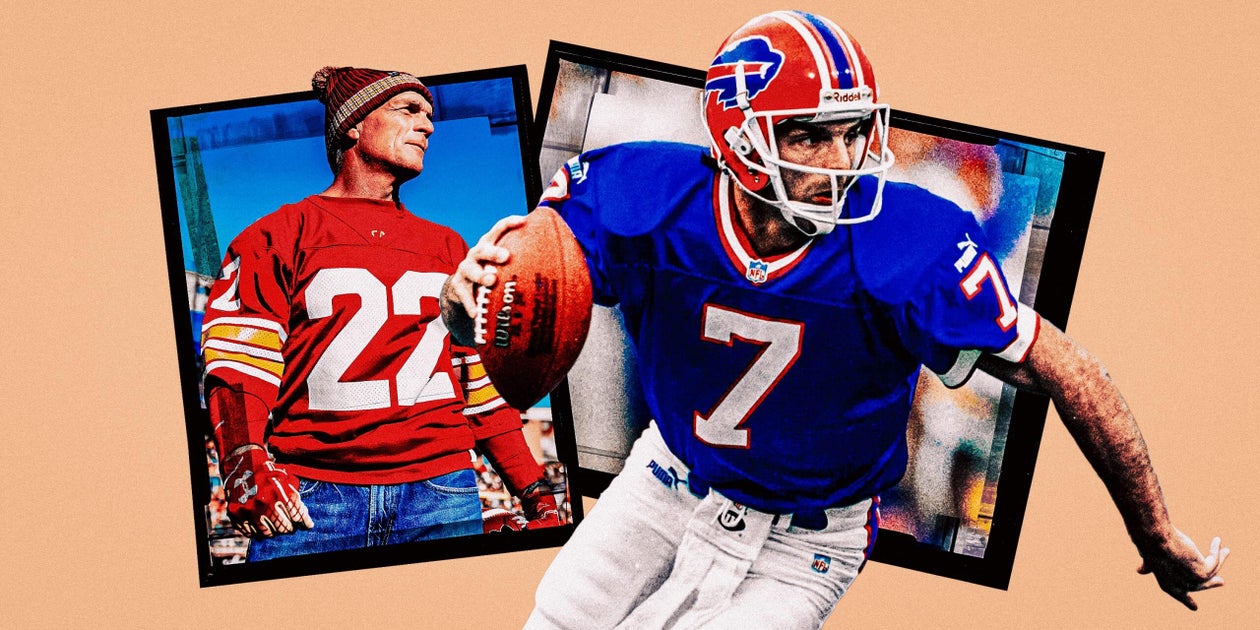
A bronze statue stands outside Gate D of Alumni Stadium in Chestnut Hill, Mass., where Boston College plays football. It depicts Doug Flutie, about to throw what became one of the most iconic passes in the history of Walter Camp’s great game.
Visitors clump around it before and after Eagles games. Going on 42 years after that play, some of them wear Flutie No. 22 jerseys, which, incredibly, are still sold at the campus bookstore. Many of those who come to pay homage weren’t born when Flutie launched the pass that traveled 64 yards in the air and landed in the arms of wide receiver Gerard Phelan for a 48-yard touchdown and gave B.C. a 47-45 victory over Miami with no time remaining. They are drawn to what became known as “Flutie magic.”
Here’s what hardly anybody realizes about the statue — bronze Flutie is about 6-foot-4, about the same size as Rob Johnson, the teammate/rival who represented everything Flutie was not. The sculptor followed instructions to make the statue 5-10 but apparently didn’t account for his bent knees.
It’s appropriate because everything about Flutie is larger than life.
Flutie’s father, Richard, made a growth chart for the closet door. By the time Doug was fully grown, the growth chart said he was 5-11. A good father, Richard knew how to boost his son.
The publicity people who decided the height of football players rounded up generously and said Flutie was 5-10. Then they arranged for him to take a magazine photo standing on a stool behind his offensive linemen.
Flutie, in his prime, was 5-9 5/8 inches. As the years passed and his legend grew, the man shrank. Flutie wasn’t 5-9 5/8 anymore. Let’s say 5-8 5/8. It didn’t help that all the cartilage had been worn away in his left knee and the leg had started to bow. But last June, he had a knee replacement, and it came with an unexpected benefit — his leg straightened, making him a little taller, even if only in his mind.
“Hey, I’ll take it,” he says.
Flutie’s football career was about proving his height didn’t matter.
But two decades after his last snap, it’s clear that his height did matter.
A lot.
And it does still.

High school sweethearts Laurie Fortier and Doug Flutie have been married for 40 years. (Courtesy of the Flutie family)
The kids were seated alphabetically when Flutie reported to homeroom class his sophomore year at Natick High. Next to him was Laurie Fortier. On June 12 the following summer, they went on their first official date to a Red Sox game, the jock and the cheerleader. Laurie saw some kind of magic in him, which partially explains why she’s been calling him her best friend since, and why she has been Laurie Flutie for 40 years.
“I always trusted Doug to give us the best chance to win in any game he ever played — over anybody else,” Laurie says. “And I would never give up on him because I always believed he would find a way to win no matter what the score.”
That fall, Flutie entered the season as a 158-pound safety, and his coaches were concerned about playing him in the opener against a rival featuring a 230-pound running back with crazy talent. On one of the first plays of the game, the big back broke through the line and headed straight at Flutie in the middle of the field. Instead of instigating a collision he couldn’t win, Flutie grabbed the runner and backpedaled several yards with him until he ripped the ball out of his hands and started running the other way.
Later that season, those coaches, noting how Flutie could outthrow all the other kids, tried him at another position. The player he replaced at quarterback was a returning starter, senior and co-captain — and his brother Bill, who, at 6-3, became a pretty good wide receiver.
Eventually, Flutie was selected all-conference at Natick, but college coaches were mostly skeptical. The big schools, like the big defensive ends, looked right over him. Flutie was excited when an Ohio State assistant visited. Then, sitting in the high school locker room before a basketball game, the coach told him, “Let’s face it, you’re not a Division I quarterback.”
He was recruited only as an “athlete,” which was code for anything but quarterback. Flutie had no offers from Division I schools until Boston College had some players back out of commitments late in the process. Flutie signed as an athlete, but coach Jack Bicknell decided to try him at quarterback after seeing Flutie play the position and win MVP in an all-star game that featured many highly regarded college prospects.
In his freshman season, Flutie began eighth on the depth chart. He moved up to fourth during camp. But other freshmen, including his roommate Phelan, were getting playing time and he was frustrated.
By the third week of the season, Flutie was ready to concede what that Ohio State coach told him — he was not a Division I quarterback. He was thinking of a move to wide receiver when, at the end of a game in which the Eagles were getting blown out at Penn State, Flutie was sent into the game at quarterback.
“When I first stepped on the field, I remember thinking to myself, ‘OK, I’m going to mess the bed here, but I get to tell my grandchildren someday that I played in front of 85,000 people at Penn State,’” he says. “In the back of my head, I could hear the Ohio State coach saying, ‘You’re not a D1 quarterback.’”
Then, on his first play, he completed a pass and everything changed. “This,” he thought, “is the same game I always played.”
The doubters remained, though. Even during the Hail Mary game, at least one opponent thought Flutie was fluky. Phelan recalls catching a pass and being tackled by two Miami defenders. As he lay on the ground beneath them, one looked at the other and said, “We’re not going to let an accountant beat us.”
Flutie became the NCAA’s all-time leader in passing yards and total offense, won the Heisman Trophy, was voted all-conference three times and All-American twice at Boston College, but NFL evaluators had the same hesitancy as college recruiters. One scout, under the cover of anonymity, told the Washington Post, “It could be embarrassing to take him.”
Flutie signed with Donald Trump’s New Jersey Generals of the USFL for $8.3 million over six years, making him the highest-paid player in football. In advertisements, Trump referred to Flutie as “The Miracle Man,” but Flutie didn’t produce any miracles for the Generals (he had a 67.8 passer rating in his only season).
“You had some of these guys coming out that had all the physical attributes that could throw the ball 100 yards and everything else, but they didn’t have his spirit,” Trump said, according to the autobiography “Flutie.”
Mike Ditka also saw the magic in Flutie. The coach of the Bears traded for Flutie’s rights at the trade deadline in October 1986. “I think,” Ditka said, “the little guy is pretty special.”
But some of Ditka’s players, coming off perhaps the most impressive Super Bowl victory in history, did not share Ditka’s faith. “America’s midget,” fellow quarterback Jim McMahon called him. McMahon mocked Flutie on his first day of practice by wearing an extra short jersey with Flutie’s number, kid-sized shoulder pads, a single-bar face mask and sunglasses with eyeballs on the lenses.
Flutie’s second NFL start was a divisional playoff game against Washington. Wearing a wristband with about 10 plays and struggling with the Bears’ atypical offensive system that assigned even numbers to the left instead of the right, Flutie completed 35.5 percent of his passes and threw two interceptions in a crushing loss.
“I don’t think he can see over the line,” Washington safety Curtis Jordan said.
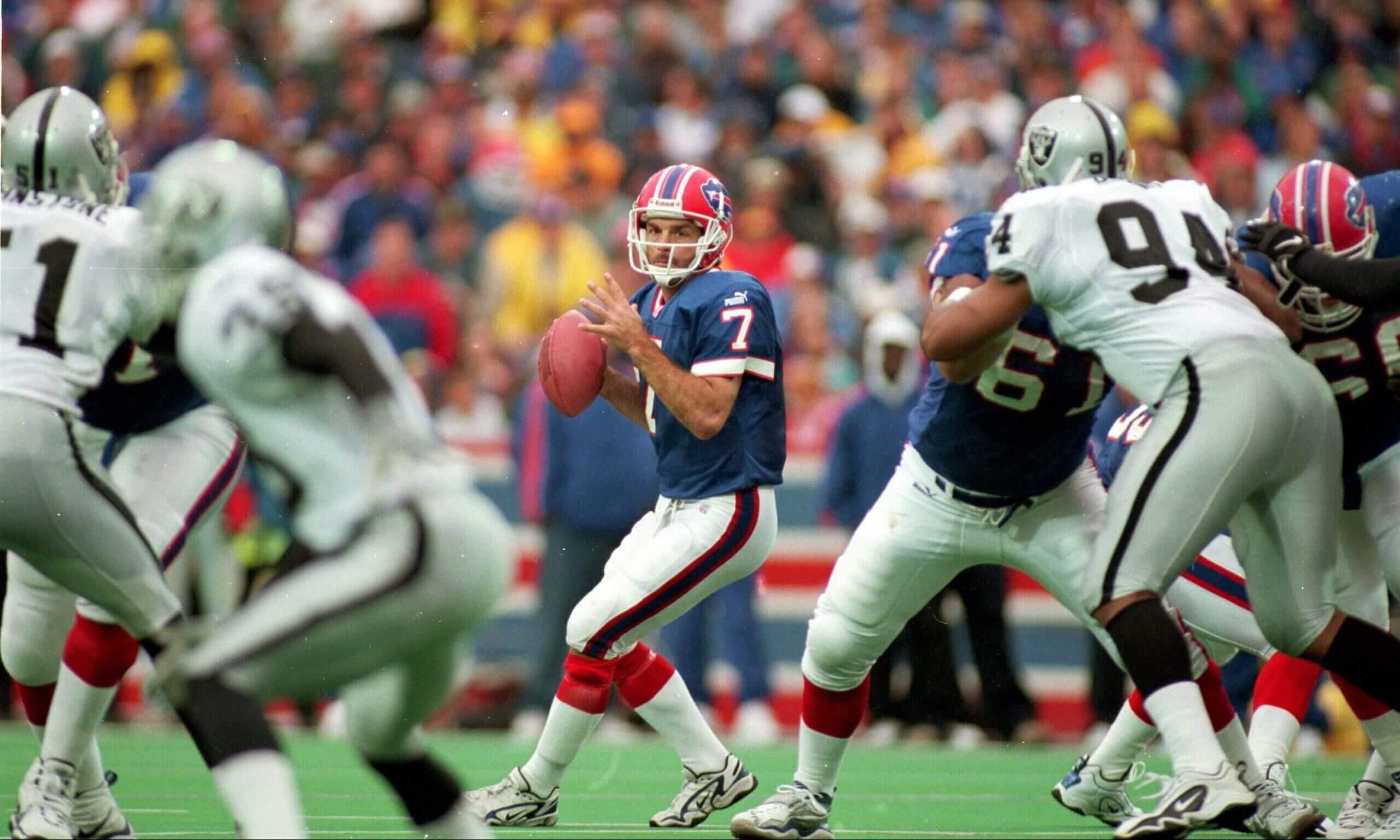
It wasn’t always easy for Doug Flutie to see over the line, but when he could play his way, he won, especially in the Canadian Football League and with the Buffalo Bills. (Rick Stewart / Allsport)
One day, Flutie drove past his old high school and saw the football team practicing. He got out of his car and watched. Some of the kids called him over. He jogged to the huddle, called a play, took the snap and dropped back. Then it hit him — he could see the whole field. Flutie playing behind high school offensive linemen was like a 6-4 quarterback playing behind NFL blockers.
“It was like cheating,” he says. “I was thinking, ‘How could you not be successful seeing the field like this?
The Patriots acquired him in a trade with the Bears, apparently despite the skepticism of their head coach, Raymond Berry, who later said Flutie should coach instead of play quarterback. In 1988, Flutie led the Patriots to a 6-3 record, but in December, Berry benched him.
Flutie says he was restricted by the Patriots’ game plans. “We ran the same damn passes over and over and over,” he says. “We never opened things up.”
Eventually, Flutie lost confidence and stopped trusting the instinct that inspired that statue.
So he went to Canada. His CFL teams ran spread offenses, had him take snaps from shotgun and used run/pass option concepts before anyone in the United States knew what they were, and soon he was pulling doves from a cloth and making silk handkerchiefs change colors.
Flutie won six Most Outstanding Player Awards, three Grey Cups and was voted the greatest CFL player of all time.
He still wanted to prove he could play in the NFL, though, so after eight years, he returned in 1998. In a training camp practice with the Bills in his first season back, Flutie was supposed to hit a receiver running a seam route, but his view was blocked by linemen, so he checked down. Offensive coordinator Joe Pendry was not happy.
In the CFL, coaches hadn’t harped about three- or five-step drops — it was more painting by inspiration than numbers. Flutie asked Pendry if, instead of sitting in the pocket and throwing the ball on time, he could shuffle back and maybe drift one way or the other, climb, spin, or fall away as he threw. Pendry told him he could do whatever he wanted. Flutie did it his way, backing out of the pocket, flowing away from pressure and delivering a laser to the receiver running a seam route.
It opened a new world for Flutie. His bold ask also gave him the confidence to trust his judgment more.
No NFL quarterbacks were doing it the way he was back then, but many are today. He relates to the way Patrick Mahomes floats around under pressure and throws from different platforms.
What held Flutie back the most might not have been his height — it was when he was born. If he had come along 35 years later, he believes he may have been the No. 1 pick of the draft as 5-10 Kyler Murray was in 2019, or 5-10 Bryce Young was in 2023. And he would have had a team buy into him like no NFL team ever did.
About a month after Flutie signed a two-year deal worth $650,000 with the Bills, Buffalo traded the ninth pick in the draft and a fourth-rounder for the 6-4 Johnson, who was given a five-year, $25 million deal. Still, Flutie found his way onto the field and played the best football of his NFL life, was voted to the Pro Bowl and won Comeback Player of the Year. He led the Bills to the playoffs that season and the next. Then Bills owner Ralph Wilson stepped in before a playoff game, ordering head coach Wade Phillips to bench Flutie and start the 6-4 Johnson.
Flutie stayed another year as the 6-4 Johnson’s backup, then the Bills released him. He signed with the Chargers as a placeholder for Drew Brees, playing four years in San Diego and then one more as Tom Brady’s backup in New England before retiring at 43.
As Flutie and 5-8 wide receiver Tim Dwight ran the hill behind the old Chargers’ facility, they often talked about constantly needing to prove they belonged because of their size. It was OK, though.
“Everybody needs something that motivates them every day to get better,” Flutie says.
Flutie didn’t have a 21-year professional career despite being 5-9 5/8. He did it because he was 5-9 5/8.
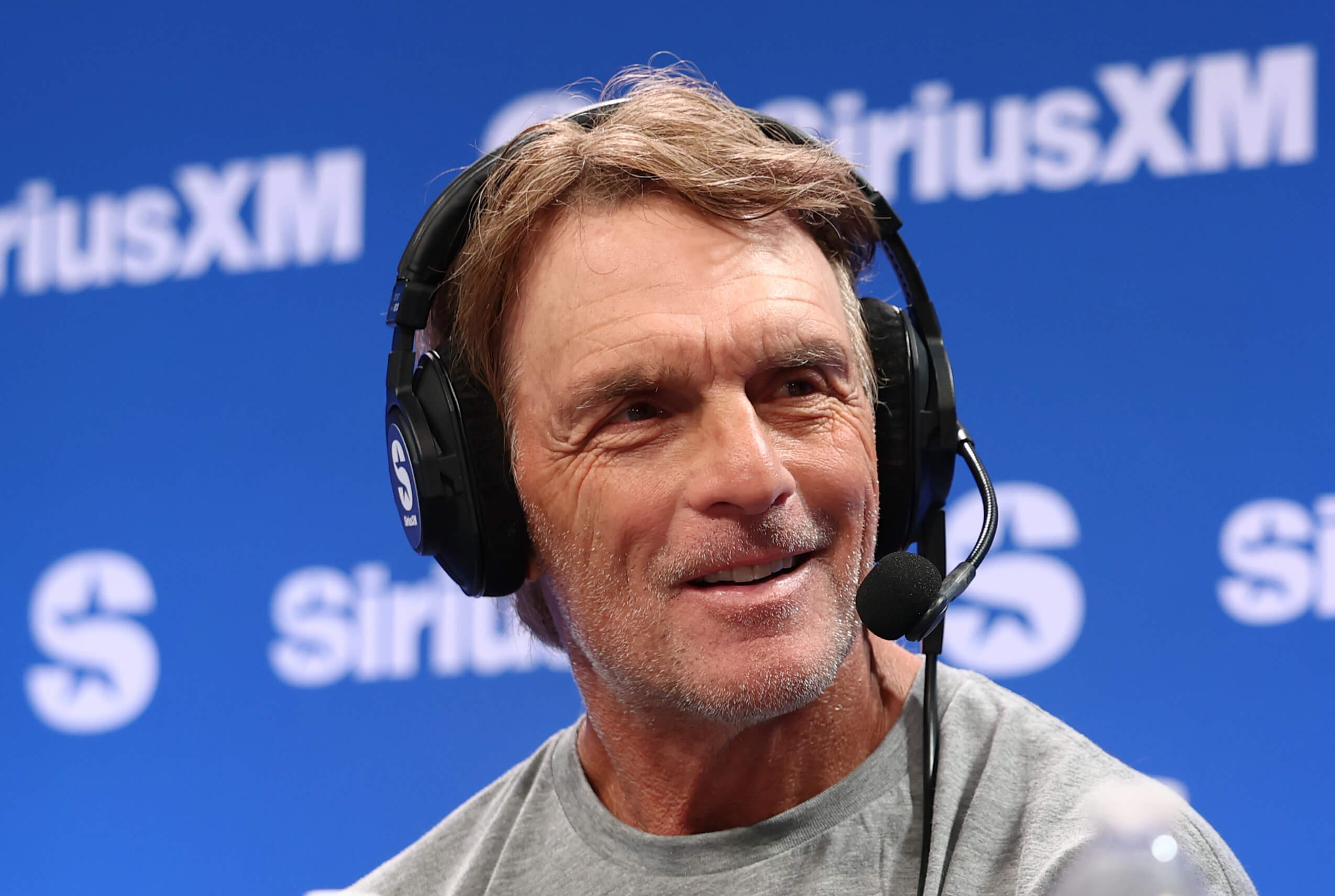
The 63-year-old Doug Flutie is as active as ever, surfing, playing hockey and baseball and planning to run another marathon. (Cindy Ord / Getty Images for SiriusXM)
The reason for that statue is that Flutie did something he wasn’t supposed to be capable of doing.
In a 2021 interview with Go Long, the 6-4 Johnson scoffed at Flutie magic. But to deny it is to cover your eyes. It helps explain why Flutie won 70 percent of his starts with the Bills while the 6-4 Johnson won 44 percent of his with the same team.
“I tell him he’s from off planet,” Laurie says.
Part of the magic was his towering will to prove wrong all who doubted, which is pretty much all of us, except some who knew him intimately.
“Inspiration” is the word Dwight uses to describe him. “I played better because of Doug Flutie because he showed me that he could play at a high level, not because he was tall, not because he had all the tools, but because he believed in himself. And that’s contagious. I felt every game that we played together, we had a chance to win.”
And there was more to Flutie magic.
Flutie played beyond his physical abilities partly because of his aptitude. It was as if he were born — or dropped from somewhere in the galaxy — to stretch our imaginations.
How else could it be explained that, as a 10-year-old, he watched NFL games and identified when coaches called timeouts correctly and incorrectly? As a member of the Chargers, Flutie stood next to Marty Schottenheimer, winner of more games than all but seven coaches in NFL history, and kept an eye on the clock for him.
Flutie and Celtics great John Havlicek once talked about making last-second plays. They discovered they were alike — and different from almost everyone else — in that they both felt the game went into slow motion at the most crucial moment.
“It’s like things are still at full speed, but I had all this time to make the decision,” Flutie says.
Phelan noticed something else in Flutie — the ability to see what would happen ahead of time.
“It’s not something you can explain or teach to somebody,” Phelan says. “You just have it, or you don’t. And he clearly had it. That was his unique talent.”
Flutie acknowledges he made completions without being able to see his targets. He says he could even throw with his eyes closed because he was confident knowing the coverage and the abilities of the players he was dealing with.
The play that inspired the statue was not an aberration. It was one of a string of improbables and barely explainables.
The center who snapped him the ball for the Hail Mary play, Jack Bicknell Jr., told him he knew Flutie would win the game when Flutie walked into the huddle. That’s when Flutie calmly told his teammates they had done this before. Earlier that season against Temple, Flutie threw a 51-yard Hail Mary touchdown pass to Phelan as the first half expired — the same play that was called against Miami.
In his CFL debut, Flutie threw another Hail Mary — a 37-yard touchdown pass with one second left that enabled his British Columbia Lions to tie the Calgary Stampeders.
More evidence that he’s from off planet came on the basketball court. After playing a season in the USFL, Flutie returned to Boston College’s campus, where he still had a year of athletic eligibility. Gary Williams, the basketball coach, had seen Flutie play in pickup games. He offered Flutie a roster spot on a team that wound up in the NCAA Tournament’s Sweet 16, but Trump wouldn’t allow it. Flutie believes he was better at basketball than the sport that made him a legend.
“I’ve never seen anybody hit 3-pointers like him other than Caitlin Clark or Steph Curry,” Dwight says.
Back then, Dwight asked Flutie if there was anything he couldn’t do. Yes, Flutie said. He couldn’t surf.
After he retired, Flutie became a dedicated surfer and a certified lifeguard.
“We rolled out to Pacific Beach a while ago, and he’s on a stand-up paddleboard dropping in on five-, six-, seven- and eight-foot waves, crushing these waves and leaving me in the dust,” Dwight says. “And I’m a good surfer.”
When he was 51, Flutie had never run more than about three miles in his life. Then a friend asked him to run with him in the Boston Marathon. The marathon was less than three days away, and his knee ached. Flutie got a cortisone shot in his knee and, without a single training run, showed up on race day in shorts and sneakers. He pulled a calf muscle during the run but walk-jogged down the stretch to finish in 5:23:54.
In his 60s, he took up hockey and played goalie for the first time with a team of men 45 and older. They won the championship.
Flutie still plays in baseball tournaments. Last year, he went to one, planning to take it easy and coach first base. He took an at-bat. Then played some second base. Then he played the position for the rest of the tournament. It was five weeks after having his knee replaced.
He recently decided he would become a better golfer. Last June, he lined up for a tee shot with an 8-iron on hole 17 at Spessard Holland Golf Club in Melbourne Beach, Fla., drove the ball about 125 yards straight into the wind and watched it take a short hop and roll about six inches before disappearing.
Hole in one.
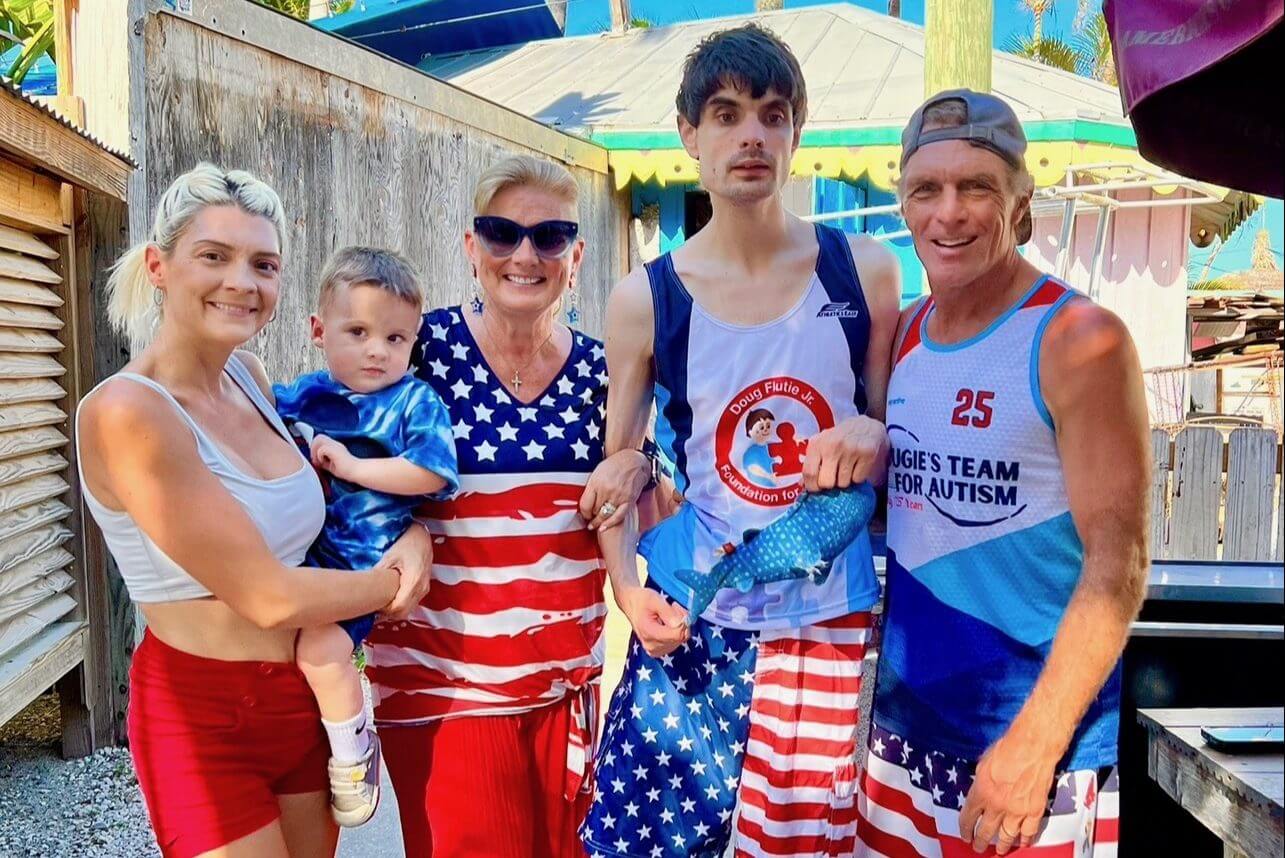
The Flutie family: Alexa, left with son Brady, Laurie, Dougie and Doug. (Courtesy of the Flutie family)
At 63, Flutie should have more lines on his face, more shadows around his eyes and more forehead between his hairline and eyebrows. Silver wingtips are swept back over his ears, and he still rocks a mullet.
Flutie lives close enough to the Atlantic Ocean in Melbourne Beach to be able to throw a football from his yard to the water. He drives his 1960s-replica Batmobile around town, stopping to pose for photos. He takes his three dogs, Lulu, Elsa and Rosie, for walks in a pink stroller. They are Yorkies. What were you expecting, Saint Bernards?
Elsa follows him everywhere. All three sleep with Doug and Laurie, snuggling through the night.
Laurie helps their daughter Alexa, a former Patriots and Chargers cheerleader, with her dance studio. Doug babysits Alexa’s 4-year-old son, Brady, getting on the floor and playing blocks with him.
Doug and Laurie’s son, Dougie, was a bright toddler. At 2 1/2, his attention span was such that he would watch an entire basketball game on television. He dressed himself and spoke in complete sentences. Dougie could nail a shot on his Little Tikes basketball hoop from anywhere in his bedroom, and when he did, he left his wrist hanging and said, “Money.”
One day, Laurie went into his room and called her husband. Dougie was staring blankly, and they couldn’t get his attention. Soon, sentences shrunk to phrases, then phrases to words, then he would repeat a word.
Then silence.
It’s been silence ever since, except for making sounds when he wants something.
Dougie, 34, understands but can’t communicate. He can’t feed or clean himself. He has been diagnosed with Childhood Disintegrative Disorder, a form of autism.
Well-meaning people have told Doug and Laurie that they deserve their autonomy and that they should put Dougie in a home. They won’t think of it. “He’s our son and we love him to death,” Doug says. “He’ll be with us for the rest of his life.”
Doug takes Dougie paddleboarding or on a jet ski. He runs the bases with him at Flutie Field. Once a week, Doug brings him horseback riding — that’s Dougie’s favorite. At night, after Laurie gets Dougie in his pajamas, Doug prepares a snack and they share either Eggos with butter and grape jelly or toasted cinnamon-frosted Pop-Tarts.
“They have a great bond,” Laurie says.
“It’s a beauty to behold,” Phelan says.
Twenty-eight years ago, Doug and Laurie started the Doug Flutie Jr. Foundation for Autism. He never dreamt he would come to think of it as the most important part of his life, but that’s what it is.
The Flutie Foundation provides support, grants and services to families affected by autism. It provides tracking bracelets and tablets and oversees a record label for autistic artists, a golf initiative, a watersports program and art classes.
“A lot of people would be devastated by a circumstance like this, and it would negatively affect their life,” Phelan says. “Doug considers it a privilege that he has Dougie, and he found a way to use his celebrity to help many people. I get goosebumps talking about it.”
Flutie sees Dougie as a gift. “His purpose in life is giving us this platform to make a difference,” he says.
The Flutie Foundation has raised about $50 million, Flutie says.
So we are back to Flutie magic.
And we are back to 5-9 5/8.
After the play that begot the statue, Flutie received so much fan mail — there were piles all over his apartment — that he needed help from all five of his roommates to answer it. In the two years that followed, applications to Boston College increased by about 30 percent. They called it “The Flutie Effect.”
When he signed with the New Jersey Generals, season ticket sales went from 6,000 to 33,000. The Bills went from selling seven club seats a day to 80 after Flutie arrived, which Bills assistant general manager Bill Munson attributed to “Flutiemania,” according to Sports Business Journal. The increase in ticket sales helped secure the Bills’ future in Buffalo.
They began selling a cereal called “Flutie Flakes” shortly after the Flutie Foundation was formed. They made 50,000 boxes, optimistically, they thought. Then they sold 4.5 million.
How can any of this be explained? Other quarterbacks, even much more accomplished ones, never had his impact.
But they weren’t his height. Flutie’s reach was so long because he was so short.
“The majority of the population is about the same size as he is,” Phelan says. “People saw him succeeding at a very high level and envisioned themselves in that situation. They cheer for him because they could see a little bit of him in them.”
Yes, we’re all like Flutie.
Except we’re not.
Flutie just returned from a three-mile jog. And he’s talking about running the Boston Marathon again. In past marathons, a group ran under the name “Dougie’s Team” and raised between $300,000 and $400,000 for the foundation. Maybe more could be raised now.
But wait. He wouldn’t even be a year removed from a knee replacement and his good knee is getting bad. He couldn’t run a marathon, could he?
Well, there’s a statue outside Gate D of Alumni Stadium that says Doug Flutie can do almost anything.