
Want more ways to catch up on the latest in Bay Area sports? Sign up for the Section 415 email newsletter here and subscribe to the “Section 415” podcast wherever you listen.
Let’s work backward and estimate that $20 million is the 49ers’ magic number.
That’s the amount of unused salary-cap space that the team carried over from 2025 to 2026. It’s reasonable to project that the 49ers will want to leave roughly that much left over this season to flow into 2027.
Entering the second week of free agency, which the 49ers kicked off by signing veteran receiver Christian Kirk to a one-year deal worth up to $6 million, we estimate the team has about $30 million in 2026 cap space. (opens in new tab) We also know that their 2026 draft class, if all six picks make the team, is projected to cost a cumulative $9.5 million.
On the most rudimentary level, then, we’re then left with this equation: ~$30 million — $9.5 million (cost of 2026 draft class) — ~$10 million (cushion for in-season 2026 costs) = ~$10.5 million of 2026 cap space left for the 49ers to work with.
That’s below our $20 million rollover threshold, which is imperative to consider, because the 49ers face significantly escalating future costs. As it stands, they have $342 million in cap liabilities stretched across only 37 contracts in 2027. That’s already $15 million over a projected $327 million salary cap. Rollover help will be very necessary.
So, with the future squeeze in mind, how much more spending can the 49ers realistically do to close a 2026 free agency spree that’s already included receiver Mike Evans, linebacker Dre Greenlaw, and a trade for defensive tackle Osa Odighizuwa? Is pass rusher Joey Bosa, or even former Cleveland Browns left guard Joel Bitonio (if he doesn’t retire), attainable?
While the surface-level math suggests the 49ers have maxed out their credit cards, the team does have two cap-freeing aces up its sleeve.
These will come in addition to three cap-freeing maneuvers that hit last week. The 49ers gladly accepted $20.7 million in salary-cap adjustments from 2025 — including $7.1 million thanks to a cap insurance policy they took out on Nick Bosa’s contract (paid out after the star edge rusher tore his ACL in Week 3) — and a simple contract restructure courtesy of Bosa himself, which opened another $17.2 million in 2026 space. Defensive end Bryce Huff also retired, freeing up all of the remaining $17 million that he was owed.
Moving forward, the 49ers can open up more than $6 million of 2026 cap space by parting ways with Brandon Aiyuk (a release or trade after June 1 would have the same financial impact). They can also free up more than $15 million with what has shaped up to be the financial linchpin this offseason: an extension for star left tackle Trent Williams, which is being negotiated.
And in the meantime, the 49ers can do what they’ve done more liberally than any NFL team aside from the Philadelphia Eagles: maximize near-term space with extremely aggressive cap prorations in new contracts. By rule, signing and option bonuses can be amortized against the cap for up to five years. And the 49ers are employing the financial gymnastics necessary to take full advantage.
“Base” is base salary, “PRTD SB” is prorated signing bonus, “OPT BON” is option bonus, and “OTH BON” is other bonus money — comprised of per-game roster bonus and workout bonus totals. “CAP” is annual cap hit.
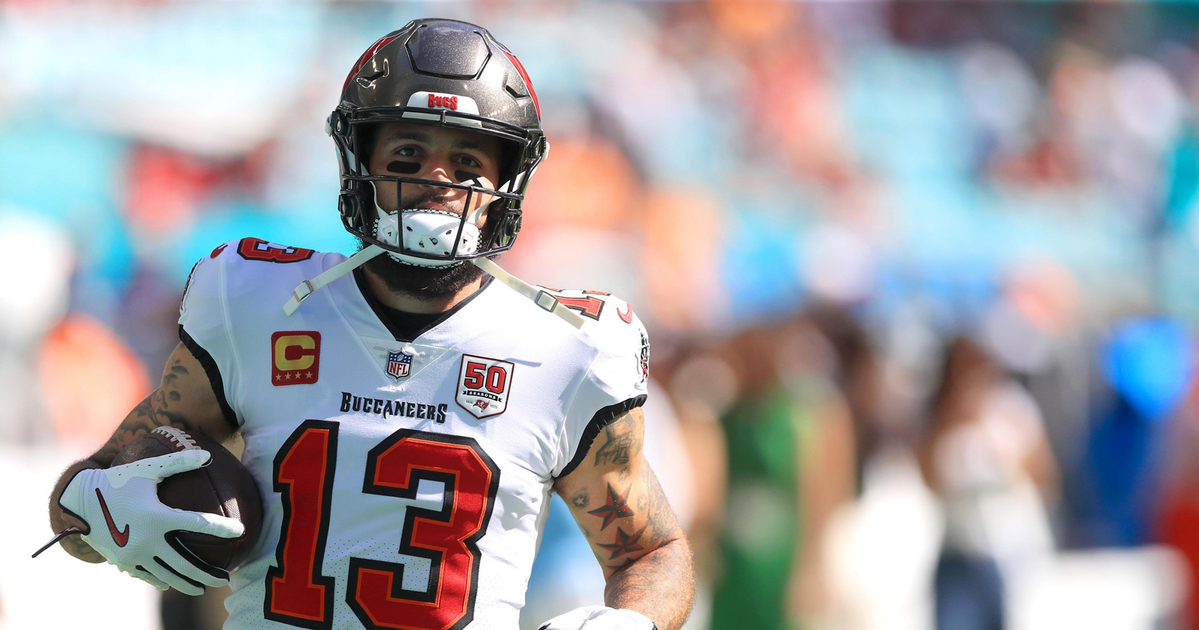
Yes, you read that correctly: That’s a 2026 salary-cap hit of only $4.25 million for Evans, who signed a three-year deal worth over $14 million annually with the team last week.
Evans’ contract can actually expand to $20 million annually with undisclosed incentives. But the 49ers were careful to make those “Not Likely To Be Earned” (NLTBE), a technical term that means they don’t count against the 2026 cap. Whatever incentives Evans achieves will be charged later to the 2027 salary cap.
Only the top row, featuring darker shades of red and blue in the “Base” and “OTH BON” categories, is guaranteed for Evans. That totals just over $14 million, less than even the 2025 deal between receiver Cooper Kupp and the Seattle Seahawks that featured $17.5 million in fully guaranteed money. Evans’ second two prorated bonuses will only trigger in 2027 and 2028, respectively, if he’s still with the 49ers for those seasons.
The deal is a bargain for the 49ers, who signed the much less reliable Aiyuk to more than three times as much guaranteed money back in 2024. They ended up paying Aiyuk, who took home $48.4 million from his mega deal after playing only seven games on it, nearly $2 million per catch. Even at 33, Evans will almost certainly give the 49ers astronomically better bang for their buck.
The future Hall of Famer’s willingness to play on an incentive-laden contract with only one year of guaranteed money has allowed the 49ers to defer the majority — all but that $4.25 million 2026 hit — of cap charges to future seasons.
2 days ago
5 days ago

Friday, Mar. 6

There is no tax for this tactic, which the 49ers continue to use to exhaustion. Think of it as zero-interest loan; the team would rather take cap charges in future seasons when they’ll represent a smaller percentage of the total limit.
Consider that the NFL’s salary cap, which is tied to league revenue, has grown a staggering 60% since 2019 — from $199 million to the current $301.2 million. In this economy, a team would be foolish to not backload contracts. The 49es just do it ultra-aggressively. They’re even willing to voluntarily take on millions of dead money in the future, when Evans’ deal voids and prorated cap money will accelerate to hit the cap, since operating room now is more valuable.
That mentality leads us back to the two pending financial maneuvers that can help finish this offseason for the 49ers.
The first is jettisoning Aiyuk, whose 2026 cap number sits at $14.6 million. No guarantees remain in that deal, so the 49ers can theoretically hold Aiyuk until Sept. 1, when they’d owe him a $25 million option bonus.
A release or a trade before then but after June 1 would allow Aiyuk to attend training camp for a new team like the Washington Commanders. It would also hold the receiver’s void-year accelerations — totaling $21.3 million — off to 2027 and open $6.3 million of 2026 space. That would mirror a classic 49ers financial strategy; they wouldn’t take on the rest of the money already paid to Aiyuk but not yet charged to the cap until the limit was higher.
Then, there’s the case of Williams, who’s entering the lame-duck year of his deal — with no more guaranteed money. It’s easy to see why the 49ers consider the left tackle’s 2026 cap number untenable.
49ers’ top 2026 salary-cap hits
1. Williams: $38.9 million
2. Brock Purdy: $24.4 million
3. Bosa: $23 million
4. Fred Warner: $17.9 million
5. Odighizuwa: $16.75 million
The goal is to find a solution that knocks Williams’ 2026 number into the low-$20 million range using more of the signing and option bonus techniques outlined in Evans’ deal above.
The fascinating twist: Only an extension can attain this. Even a cut or a trade would be pricier on the 2026 cap — Williams would carry a dead-money number of $34.2 million because the 49ers have prorated so much into the future, and all of that amount would have to accelerate to the 2026 books if he left the team.
A successful deal would leave Williams with newly guaranteed money, the 49ers with newly secured team control, and the roster with far more breathing room under the cap.
Spend money to free up money. That’s the NFL way, baby.
Given a new deal for Williams, the 49ers would be working with this amended rudimentary equation: ~$30 million (current cap space) — $9.5 million (cost of 2026 draft class) — ~$10 million (needed cushion for 2026 expenses) + $6.3 million (potentially added via Aiyuk’s departure) + ~$16 million (potentially added via Williams’ restructure) = ~$33 million in 2026 salary-cap space.
Assuming the 49ers want to carry over roughly $20 million of unused space — or even a little more — into next season, they could still have the flexibility to add to their 2026 roster.
So keep available veterans like Bitonio on the radar. Or, if you happen to see Joey Bosa, who played for $13 million Buffalo last season, ask him how much it might take to come play with his brother.
The 49ers are interested in Bosa, and they’ve set themselves up financially to at least make his addition feasible — assuming they thread the needle with Williams and make his 2026 cap number palatable.
That’s the John Lynch-pin.