
The minute an NFL team’s season concludes, mock drafts become all the rage.
For some teams, like the New York Jets, mock drafts are a fan base’s morning cup of coffee as early as October.
However, those mock drafts are extremely difficult to predict for a long while. We have no idea what a team’s pre-draft depth chart will look like until the opening wave of free agency crashes down.
Now that we have reached that point, we have a better idea of what the Jets’ NFL draft shopping list might look like.
With that in mind, here are three draft prospects whose odds of going to the Jets have dropped since the beginning of March.
Olaivavega Ioane, G, Penn State
Going into free agency, there was a chance that New York could go into the draft with a gaping hole at guard.
John Simpson, the team’s 2025 starter at left guard, was set to hit the open market. So was Alijah Vera-Tucker, New York’s penciled-in right guard until he suffered a season-ending injury in August.
Simpson and Vera-Tucker quickly found new homes on Day 1 of free agency. For two days, the guard position was among New York’s most pressing weaknesses on the depth chart.
Then, the Jets signed left guard Dylan Parham to a two-year, $16 million deal, solidifying him as the team’s 2026 starter. Still only 26 years old with an appealing resume of production, he has the potential to be a long-term answer at the position.
That should rule out the Jets from taking a guard in the first round of the draft. Penn State’s Olaivavega Ioane was often mocked to New York before free agency and after its opening day, but at this point, it would not be the wisest allocation of resources to take a guard 16th overall.
In a vacuum, it is already somewhat controversial to use that high of a draft pick on an interior lineman. Given the low positional value of a guard relative to, say, an offensive tackle or a wide receiver, the guard has to be downright special to justify that high of a selection, similar to Vera-Tucker (14th overall pick) when healthy.
Having a desperate need at the position would also help justify the investment. But since the Jets already have their starting guard spots locked up, it wouldn’t be a sound team-building strategy to select a guard who might not even start in Week 1 over a player at a more valuable position who would assuredly start in Week 1.
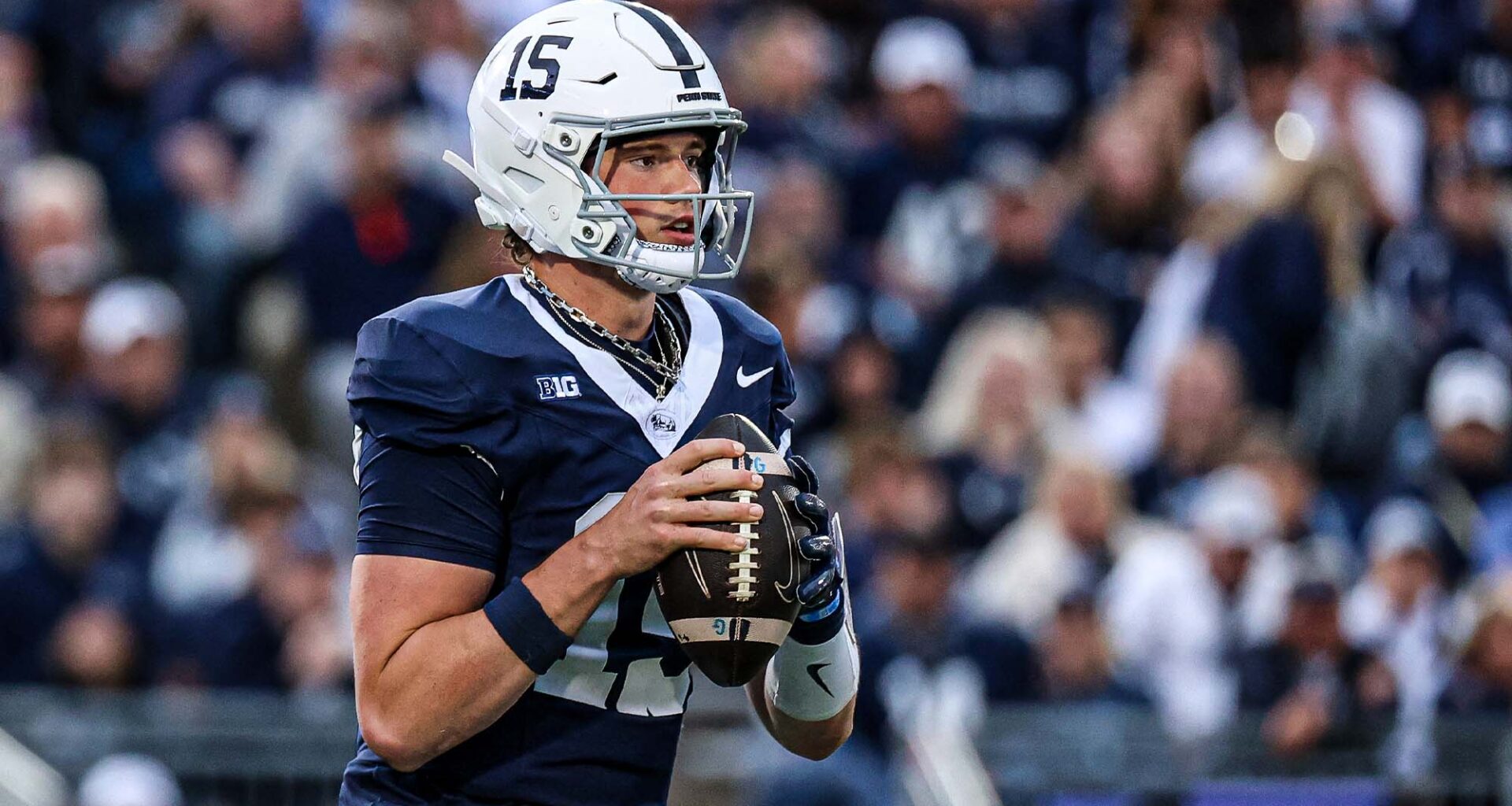
Drew Allar, QB, Penn State
It has long been speculated that the Jets will target a post-first-round developmental quarterback in the 2026 draft, while punting their pursuit of a first-round prospect to 2027.
That has led to quite a few “project” prospects, namely Penn State’s Drew Allar, being heavily mocked to New York in the second round, where the Jets have the 33rd and 45th overall picks.
Jets fans are all too familiar with taking a quarterback like Allar in the second round. He’s got all the tools that scouts love, standing at 6-foot-5 and 228 pounds with acclaimed arm strength, but his college production left a lot to be desired.
Allar averaged under 7.0 yards per pass attempt in three of his four college seasons, including a ghastly 6.9 across six starts for the Nittany Lions in 2025. He is also coming off a season-ending ankle injury that denied him the opportunity to make up for his bad tape early in the year.
It sure sounds a lot like another second-round Penn State quarterback prospect, no?
While the Jets still may end up drafting Allar or another post-first-round quarterback prospect, the odds are rapidly climbing that New York may go ahead and take an earlier, higher-percentage swing on Alabama’s Ty Simpson instead of settling for a total lottery ticket like Allar.
Why? Well, simply put, the Jets have come out of free agency with precisely zero long-term upside in their quarterback room.
There were some free agents available with at least a smidgen of long-term upside, including Kyler Murray and Malik Willis, but those players landed elsewhere. New York also explored trading for under-30 options like Mac Jones, Davis Mills, and Tanner McKee, but quickly abandoned those pursuits due to exorbitant demands.
That leaves the Jets with 35-year-old Geno Smith and a pair of practice-squad-caliber players in Brady Cook and Bailey Zappe. The chances of any of these quarterbacks leading the Jets to a championship in 2027 and beyond are zero-point-zero.
While the Jets never had and still do not have a chance to come out of this offseason with a slam-dunk franchise quarterback option, they can absolutely find someone with better than zero-point-zero odds of being their savior. In fact, they must. It would be a waste of a season to give yourself no chance whatsoever at discovering a franchise quarterback.
That’s why the Jets are becoming likelier and likelier to take the consensus QB2, Simpson, instead of settling for a project quarterback from the unappealing third tier, which is a wide gap away from Simpson, for all of the Alabama product’s faults.
According to NFL IQ, an analytics page on the league’s official website, Simpson remains among the five likeliest prospects to be drafted by New York. Now that we are sitting here on March 23 with the Jets’ quarterback room still lacking any semblance of long-term upside, Simpson’s odds of being a Jet are only trending up.
When that will happen is up in the air. The second overall pick would be a shock, but could it happen at No. 16? Could the Jets trade back into the late-first round? Will Simpson fall to No. 33?
Don’t be so certain that the Jets are prepared to settle for a project over Simpson.
Caleb Downs, S, Ohio State
Before free agency, Ohio State safety Caleb Downs ignited some passionate draft debates in Jetsland.
Some argued that it would make sense to take Downs, considered by many to be the draft’s best player, with the second overall pick, regardless of the positional value.
Others (a group that includes yours truly) argued that there is no world where a rebuilding team like the Jets could afford to take a safety second overall when they still have glaring needs at positions like quarterback, wide receiver, and edge defender.
Both sides of the argument can take it easy, though. Downs’ odds of becoming a Jet have decreased dramatically since those debates began.
Safety was one of the Jets’ weakest positions entering 2026. It has also been one of their worst-performing units on an annual basis throughout the 2020s.
Rapidly, though, it has ascended to arguably the Jets’ best defensive position. A trade for three-time All-Pro Minkah Fitzpatrick, coupled with the signing of Dane Belton and the re-signing of Andre Cisco, has turned this unit into one of the league’s deepest.
Given the state of the Jets’ safety position, drafting Downs over an edge defender like Arvell Reese would be incredibly difficult to justify.
Time will tell, though, which side of the debate won.
If Downs goes on to become a perennial All-Pro, while Reese does not reach the same heights, perhaps the Jets would have been better off with Downs, regardless of their current safety room. After all, Fitzpatrick will be 30 this year, so Downs may still be a star long after Fitzpatrick retires.
But if Reese lives up to his potential and becomes a dominant player, it won’t matter if Downs is equally as good at the safety position, because an elite edge defender trumps an elite safety any day of the week, and twice on Sundays.