

The Minnesota Vikings entered the offseason determined to avoid another year of uncertainty at quarterback. After a 2025 campaign defined by instability and limited experience under center, the organization reshaped its depth chart with urgency. The additions of Kyler Murray and Carson Wentz signaled a clear shift in philosophy to build depth, create competition, and protect the team from repeating past mistakes.
But amid the new arrivals and outside noise, much of the focus remains on 23-year-old J.J. McCarthy. The former first-round pick has started just 10 games across two seasons, yet the Vikings continue to view him as a key part of their long-term plans. In the 2025 season, he threw for 1,632 yards, racked up 15 touchdowns, and posted a QBR of 35.6.
Advertisement
McCarthy has taken his development to California, where he has spent significant time working with quarterback specialist John Beck. The sessions have centered on refining mechanical consistency and adding more touch to his throws, subtle adjustments that could shape his trajectory. According to The Athletic, Alec Lewis, “The Vikings are optimistic that McCarthy will show up committed to proving he’s made a major leap.”
That optimism comes within a much different quarterback environment than a year ago. At this time in 2025, Minnesota’s room consisted of McCarthy, Sam Howell, and Max Brosmer, a group with no meaningful starting experience. Now, the Vikings boast a unit with 198 combined starts, more than 90 wins, and nearly 45,000 passing yards, largely due to Murray and Wentz.
Advertisement
Head coach Kevin O’Connell made the organization’s stance clear earlier in the offseason. “We’ve learned that we’ve got to get a lot of guys ready to play (at that position),” he said. The approach reflects both caution and strategy. Minnesota is building competition, not as a replacement for McCarthy, but as a way to accelerate his development while maintaining stability.
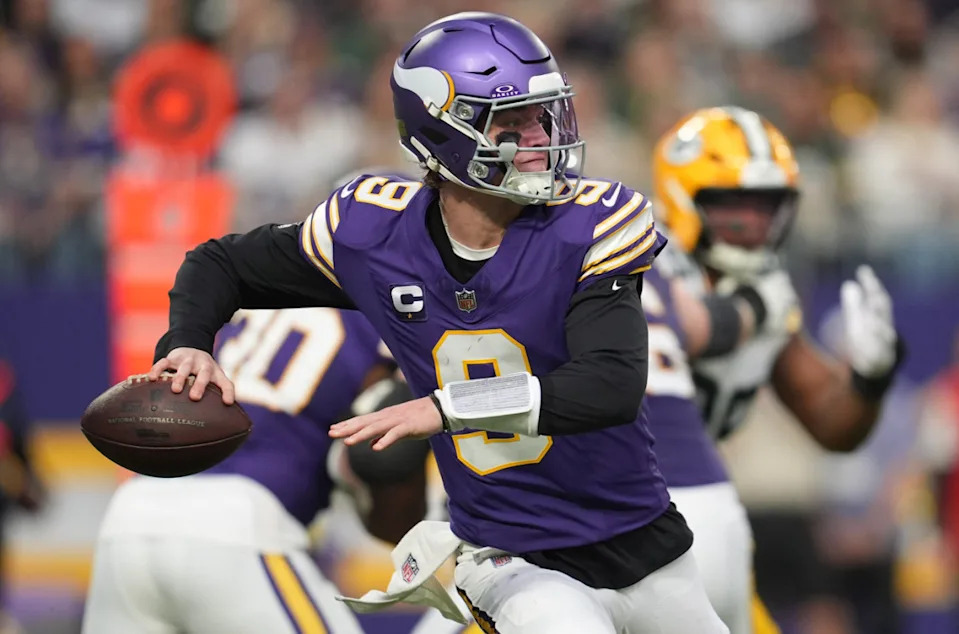
Minnesota Vikings quarterback J.J. McCarthy (9) throws a pass against the Green Bay Packers during the second quarter at U.S. Bank Stadium.Matt Blewett-Imagn Images
(Matt Blewett-Imagn Images)
Still, external skepticism remains. Some analysts have questioned whether McCarthy fits the system long term, suggesting the team could explore other options. Those discussions are being monitored, but internally, the Vikings have not wavered from their evaluation. The additions of Murray and Wentz are viewed as support, not signals of departure.
Advertisement
Financially, the strategy is efficient. Minnesota is projected to spend roughly $11 million on its entire quarterback room in 2026, balancing experience with cost control. That flexibility allows the team to invest in development while staying competitive.
As offseason programs approach, roles will begin to take shape. McCarthy could open as QB3, but preseason performance and injuries could quickly change that outlook. Both Murray and Wentz carry durability concerns, leaving the door open for opportunity.
For now, the focus remains on progress. McCarthy’s offseason work suggests a player aware of the stakes and willing to adjust. The Vikings, meanwhile, are betting that a stronger quarterback room will elevate everyone within it.
Advertisement
Related: Seahawks Make Major $168.6M Commitment Post Super Bowl
This story was originally published by Athlon Sports on Mar 23, 2026, where it first appeared in the NFL section. Add Athlon Sports as a Preferred Source by clicking here.