
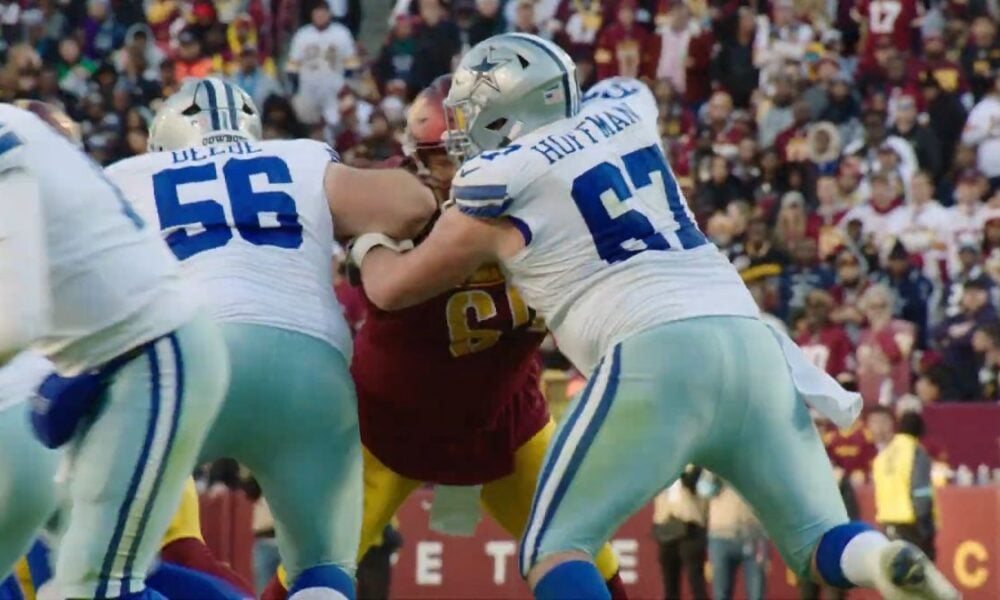
Brock Hoffman won’t be the next great Pittsburgh Steelers guard. He may only function as a backup. But his signing, which is now official for those wondering, signals the front office is making the smart play to address the hole left by Isaac Seumalo’s absence.
Don’t play the free agency game of signing overpriced linemen. Add experienced depth, create competition, and look towards the draft.
Pittsburgh could’ve taken a big swing at guard. Local pundits predicted it, and there were an array of options. Elgton Jenkins, Wyatt Teller, and Alijah Vera-Tucker were available. The Steelers let others pay good money for them.
That’s the correct move.
Free agency is always expensive. It’s hard to assess the full value of a player on the market. That’s doubly true for offensive linemen. Every team needs them. Few options exist. Simple supply and demand inflate the price well above true worth.
That’s how Jenkins receives $20 million guaranteed despite declining play and injuries. It’s how Vera-Tucker receives a $42 million deal despite missing 51 games the last four seasons, including all of 2025. It’s how Teller, at 32 with 26 games the last two seasons, lands a $16 million deal. I’m not mad at them for getting good money. I’m sure happy Pittsburgh didn’t pay it.
Targeting a player like Hoffman is the sweet spot, and his Dallas connection to Mike McCarthy made it even more logical. An experienced, versatile player with center and guard reps. He’s tough, strong, and stout along the interior. His cheap contract doesn’t make him a de facto starter. Financial terms on Hoffman’s deal are unknown, but it’s a one-year contract, and the initial retracted report slotted it at $2.5 million. That number may not be on the money, but it should be close. Even bringing back Ryan McCollum scratches a similar itch, though Hoffman’s roster spot feels more secure.
Adding a free agent doesn’t always spell doom. Seumalo worked out fine, but the offensive line market has drastically heated up since. It makes an already risky play more dangerous.
Pittsburgh can freely consider an early draft pick on a guard. They should. It’s a strong class loaded with Day Two options. The Steelers could even think about Penn State’s Olaivavega “Vega” Ioane at No. 21 overall in the way they took David DeCastro in 2012. NFL franchises are best at drafting and developing the trenches rather than throwing free agency money at the problem.
That’s how Pittsburgh developed the group of the 2010s: Alejandro Villanueva, Ramon Foster, Maurkice Pouncey, David DeCastro, and Marcus Gilbert weren’t high-priced March adds. Four of their five began their careers in Pittsburgh. Villanueva’s didn’t, but he was essentially homegrown. He switched from defensive to offensive line in Pittsburgh and was developed by Mike Munchak.
It’s how the current group is shaping up, too. Zach Frazier, Mason McCormick, and Troy Fautanu are all draft picks. Dylan Cook is sort of like Villanueva. A college position switch from quarterback to tackle, a brief stay in Tampa Bay, and development over the last three years in Pittsburgh. Don’t forget about Spencer Anderson, one of the team’s best seventh-round picks, whose career mirrors that of seventh-rounder Kelvin Beachum of the group from a decade ago.
Pittsburgh made two solid offensive line coach hires in James Campen and Jahri Evans. Campen has the track record, and Evans is the former NFL star whom players can connect with. Let those guys do their thing by molding the next left guard from the jump. That’s a draft pick. Not an overpriced free agent.
Assuming Pittsburgh doesn’t make me eat my words with an unexpected splashy addition, the Steelers are taking the right approach. Omar Khan and company should be commended for avoiding the temptation.