
The past week has been filled with breathless updates on Cinderella’s fate. Her absence from a second straight Sweet 16 has caused shock and concern, to the point where many onlookers have gone so far as to conclude she has suffered an untimely death. That may be a bit premature, but there’s no doubt she’s sporting a very different look in 2026.
For the second straight year, not a single team outside of the Power 5 conferences managed to reach the second weekend of the men’s NCAA Tournament. But if you look a little closer, you’ll see some of the same traits — and names — that we’ve seen from our familiar March sweetheart.
As doctors in the field of underdogs, we have been following Cinderella’s condition closely. For the past 20 seasons, we’ve studied the statistical signals that project NCAA Tournament upsets, first at ESPN under the Giant Killers label, and now here at The Athletic with our Bracket Breakers series. Let’s talk through Cinderella’s patient history and our prognosis for future tournaments.
In the spring of 2024, Drake hired Ben McCollum, a four-time NCAA champion at Division II Northwest Missouri State, as its new men’s basketball coach. He brought several players with him, including star guard Bennett Stirtz, and immediately found success. The Bulldogs finished 31-4, first in the Missouri Valley Conference, and upset Missouri in the first round of the NCAA Tournament. That move seemed almost quaint amid the upheaval in college sports.
What happened next, though, was a sign of the times.
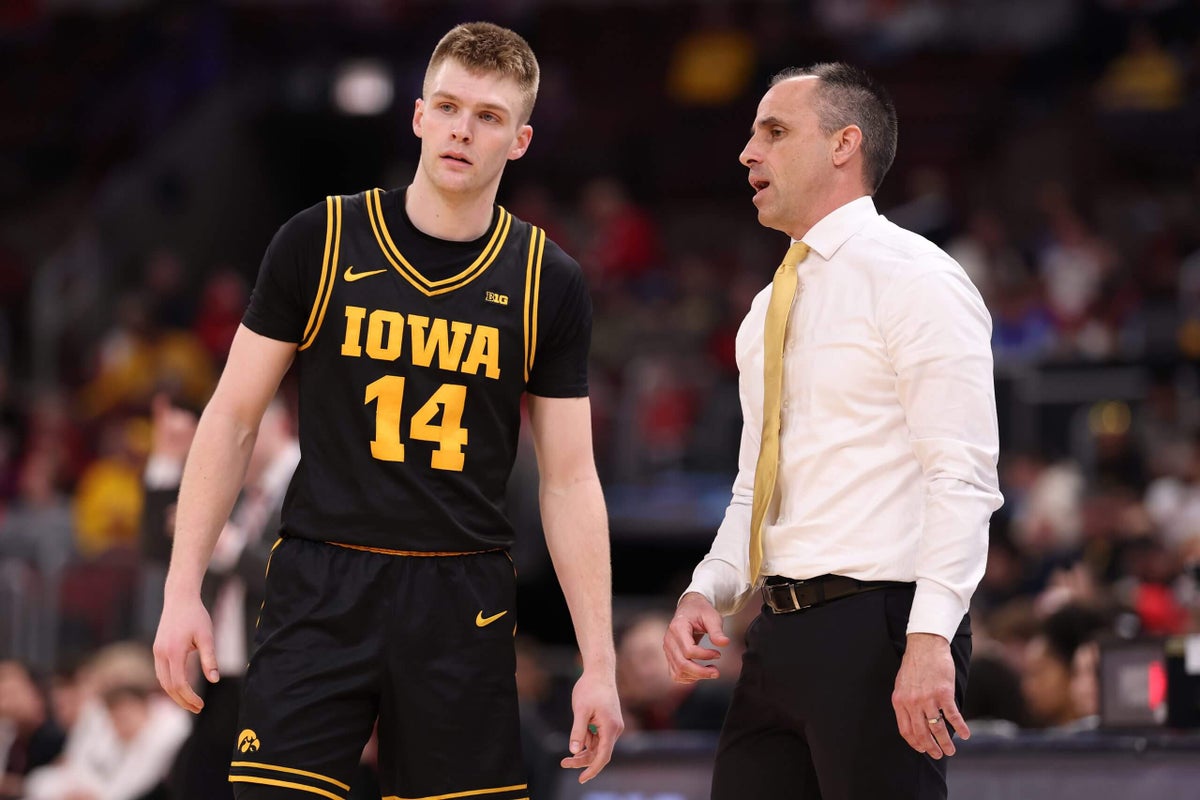
Iowa called, McCollum answered, and he packed up again, leaving Drake after a year. He took Stirtz and other key players with him. And those newly-minted Hawkeyes upset top-seeded Florida Sunday to reach the Sweet 16.
So Cinderella is still here. She’s just sporting some different threads. The Hawkeyes’ starting lineup featured four Drake departures — Stirtz, Cam Manyawu, Tavion Banks, and Kael Combs. Alvaro Folgueiras, who hit the game-winning shot against Florida, joined the program after two years with Robert Morris. This is not some group of high-profile recruits. The only difference between these Hawkeyes and a team like Drake is the name on the front of the jersey. But those familiar names from power conferences will be the ones authoring upsets going forward.
Last year’s NCAA Tournament featured only four games in which a team beat an opponent seeded at least five spots better, the second-lowest total in the 20 years that we’ve employed our statistical model, Slingshot, to project upsets. There have been five so far this year, but only two of the underdogs were from outside the Power 5 conferences (ACC, Big 12, Big East, Big Ten, SEC): High Point and VCU. Two power schools won the three other games — Iowa and Texas (twice). Overall, Power 5 teams have gone 28-4 against the rest of the tourney competition.
This is not surprising. In fact, we expected these results based on a study we conducted before the 2026 tournament tipped off. Our model includes a Simple Rating System (SRS) component — a schedule-adjusted measure of how many points per 100 possessions a team is better or worse than an average squad on a neutral court. Check out this chart that compares the average SRS of power conferences and the rest of the country before and after 2020:
As you can see, prior to 2020, smaller leagues were actually gaining ground on their big brothers in the ACC, Big 12, Big Ten, Big East, SEC and Pac-12 (RIP). The difference cratered during the weird 2020-21 season (you may recall pauses for Covid outbreaks, games played in empty buildings and the Ivy League skipping the season entirely) Since then, the gap continues to widen and this year features the highest SRS for the power conferences and the weakest one for the rest of the country.
The reasons for this shift should be obvious. First, realignment has pushed more good teams into the Power 5 conferences. In 2018-19, Houston, UConn and Cincinnati were still in the American Conference, and BYU was in the WCC. Now three of the four are in the Big 12 and UConn is back in the Big East.
Then there are everyone’s favorite factors – NIL and the transfer portal. Power programs can now pay players legally, further increasing their recruiting advantage. And if they miss out on a prospect coming out of high school, they can just grab him after he blows up at a mid-major, since college sports now allow annual free agency.
It took some time for the results to manifest: 2021 was the first year in which transfers didn’t have to sit out a year, and as recently as 2024, we saw tourney victories from Yale, Oakland, James Madison, Duquesne and Grand Canyon. But systems grow more efficient over time, and big schools are clearly becoming more effective in how they utilize the portal. That’s how Iowa built its team.
Power conference teams, then, not only are able to load up in the portal each spring, they also weaken their mid-major competition in the process. The results are glaring.
The aforementioned American Conference has seen its average SRS decline from 9.5 in 2022 to 1.9 this season. The CAA, which often used to be in the conversation for a second bid when it was home to the likes of VCU and George Mason, had a 1.9 SRS in 2015-16 and a -3.7 SRS this season. Meanwhile, the SEC has skyrocketed from an average SRS of 15 from 2016-2024 to 24 over the past two seasons.
The results are even more stark if you look at the top team in each mid-major conference, rather than the average. Those are the squads that typically make the NCAA Tournament, and they are getting weaker.
In each of the three seasons from 2016-18, the Missouri Valley produced a team with at least a 22.6 SRS. Since 2020, no MVC team has been better than 19.7, and the past two years its best team had an SRS of 14.6 and 14.7, respectively. The top team in the Ohio Valley had a positive SRS every year from 2015-16 to 2021-22; it has been negative in three of the past four years.
This has affected the type of teams our model identifies as potential successful NCAA tournament underdogs. Most of the highest-rated underdogs in our model belonged to a group of teams we’ve traditionally labeled “Wounded Assassins” — squads that take their lumps in conference play, limp into the bracket, and then pull off an upset (or more). You know, like Iowa and Texas. Part of the reason power conferences are separating themselves from the rest of the country is that their mid-range teams are better than ever. The bracket’s best giant killers are now hiding in plain sight.
But the top teams are getting better, too. Last season, four squads posted KenPom ratings of 35 or better, the first time that has happened in the history of that site (which goes back to 1997). And it was by a wide margin. All four — Florida, Houston, Duke and Auburn — made the Final Four. We have a similar scenario this year: Duke, Michigan, Arizona and Florida all entered the tournament above 35, and Houston, Illinois and Iowa State were all better than 32. The rich are getting richer.
As a result, they are pummeling the have-nots. The average margin of victory in this year’s first round was 17.4 points, the largest since the field expanded to 64 teams in 1985. For a second straight year, no team seeded 13 through 16 won a game, and only five of those 16 games were decided by fewer than 19 points. The average margin of victory in the first round for the top four seeds in the South Region was 38.5 points.
Still, a one-and-done tournament will always produce unexpected results. Texas and Iowa speak to that fact. But until and unless the NCAA introduces legislation that curtails the impact of NIL and the transfer portal, we’re just going to have to adjust our expectation of what an underdog looks like. Cinderella’s got a lot more brand-name fits in her wardrobe these days.