
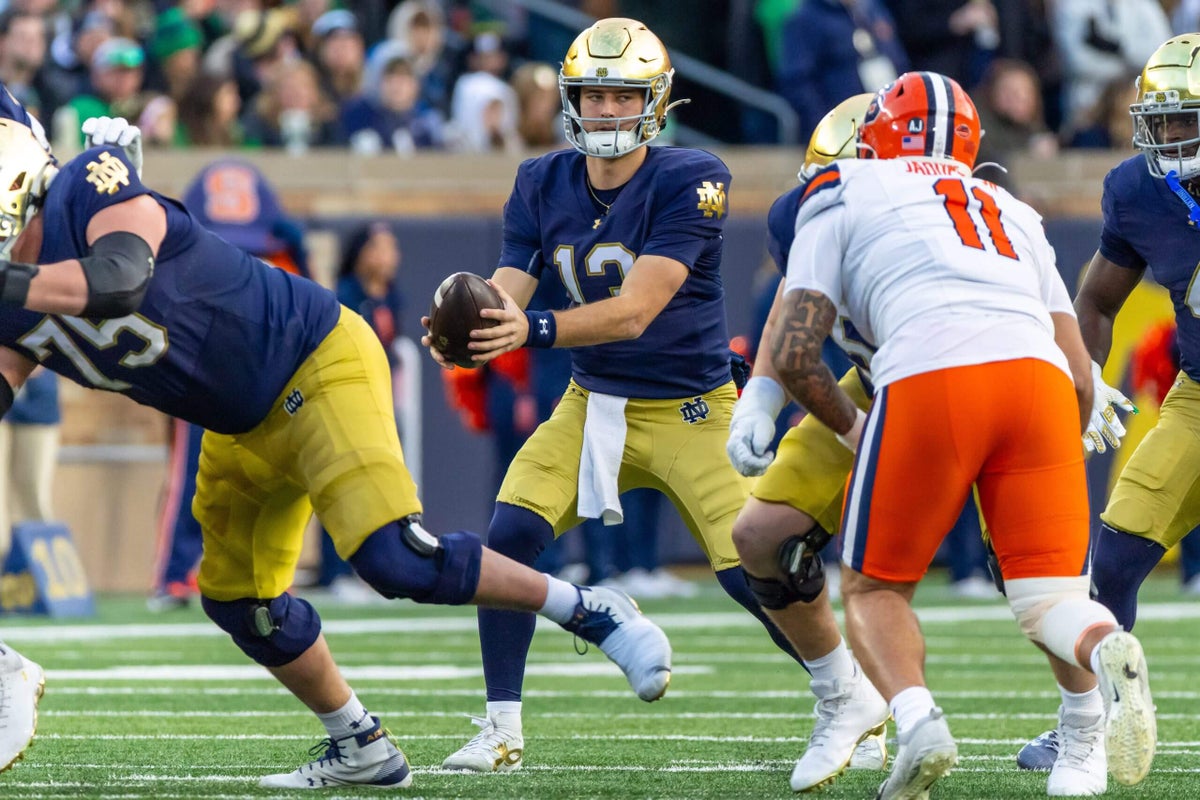
SOUTH BEND, Ind. — It didn’t feel right to CJ Carr in the moment, so Notre Dame’s quarterback made a mental note to come back to the route after practice.
Earlier in Wednesday morning’s hour-and-a-half workout, Carr had missed tight end Cooper Flanagan on a route where the quarterback escaped the pocket to his right, then threw back left toward the end zone. Flanagan had come open on the play. Carr saw him. He just didn’t get the ball where it needed to go.
So, as most of Notre Dame’s roster began to exit the Irish Athletic Center around 9:45 a.m., Carr got a couple more throws in to Flanagan, who’s never caught a Carr pass in an actual game. Two throws. Two completions. Two would-be touchdowns. That’s how Notre Dame’s quarterback and potential Heisman Trophy contender left no doubt before heading to the locker room.
“I haven’t taken all the No. 1 reps in a spring and a fall since I’ve been here. And so all of those reps are going to be huge for me,” Carr said. “Being able to come in and try different things, try different drops. OK, I missed one out here pushing up, rolling to the right, trying to throw back to Cooper on the left. And it stinks in the moment, but it’s also like, OK, this is something we need to work on now, and you go in and you rep it after.”
After throwing in front of an audience of NFL coaches and scouts during Pro Day, it’s easy to forget how much and how little Carr has done at Notre Dame. He set the single-season pass efficiency mark last season. He also got to play point guard within the offense instead of being a volume scorer. Carr will probably need to be more of a combo guard this season, playing point when the defense allows it, but taking over games when Notre Dame needs it. It’s hard to imagine Notre Dame thriving offensively if Carr throws for less than 200 yards (USC, Syracuse, Boise State) or tosses two picks (Pittsburgh).
A quarterback who finished fifth nationally in pass efficiency also finished 85th in passing attempts. That math worked last year because the threats of Jeremiyah Love and Jadarian Price were terrifying enough that nobody — except for USC — kept their safeties deep, gambling that Notre Dame’s backs wouldn’t beat them. With Love and Price gone, there’s a good chance defenses will give Carr a new problem to solve in what figures to be his final college season.
When Carr faced defensive looks other than Cover 2 (meaning two safeties stayed deep), he averaged 10.5 air yards per attempt on 277 dropbacks, according to TruMedia. Basically, if you gave Carr even odds in the pass game, he’d win. Carr’s air yards ranked eighth nationally. His EPA (expected points added) on plays against anything but Cover 2 ranked 12th. Carr went 168-of-262 (64 percent) for 2,457 yards, 23 touchdowns and five interceptions against those looks.
It was a different story when defenses kept their safeties back. Carr dropped back against Cover 2 just 37 times, which ranked 97th nationally. His air yards per attempt dropped to 6.0, which ranked 109th. He went 27-of-35 (77 percent) for 284 yards, one touchdown and one interception. Carr didn’t take a ton of negative plays against that defense, but he didn’t make many down the field either.
It’s fair to wonder whether teams will give Carr an annoying diet of two deep safeties this season, at least until the Notre Dame run game reinvents itself.
“I don’t know,” said quarterbacks coach Gino Guidugli. “People still wanted to load the box on us to stop the run. That was always the key. So, like, the only thing they could do differently is now decide that they’re going to play two-high, which we saw very few shots of last year. Defenses are built to stop the run all the time. So, I don’t know how much differently they’ll give us looks, and I think we’re going to have really good backs and we’ve got a really good offensive line that’s well-coached.
“I think teams still have to prepare for us the same way and come out and stop the run first.”
Maybe.
Regardless, Carr wants to use spring practice to test drive new ways to beat defenses. Sometimes that means pushing the envelope until he rips it. If that means throwing an interception to Tae Johnson on a deep ball, that’s fine. At least to a point. Unlike last spring when Carr was locked in a three-way quarterback battle or unlike last fall when every mistake felt like a potential death blow in Carr’s fight to be QB1, he can now stress-test his own game without much consequence.
“It’s really helped, actually. I think, being able to really test what throws you can make, what throws you can’t make, it’s gonna show in the season in games,” Carr said. “I came in, and it was always kind of like, you can’t just try things all the time. And I’m at a point now where I think I have a good base of what the defense is giving us. I know our offense inside and out.
“So now it’s, how can I tinker with my drop, or how can I maybe look off a defender in this coverage to rip a dig or manipulate our scheme and what we’re trying to do. I think of all that helps, and I’m excited to continue to grow in that area more.”
Carr went deep in the film room this winter, rewatching his own clips with a focus on the red zone, where Notre Dame struggled much of last season. He also broke down NFL tape, shifting his focus from Tom Brady and Aaron Rodgers to Matthew Stafford, who was coming off an MVP year in his 17th season.
“The things (the Rams) were doing schematically and the throws that he makes, it just was like, yeah, OK. That throw’s possible to be made,” Carr said. “And you’re seeing that up and down the tape. So now being able to see it and say, OK, well, this sucker’s making it. Let’s try it. Let’s go out there and try it, see what it looks like, and let’s get some under-center in and see how can we manipulate a flat defender. It was all great and good. I think it’s helped me for sure.”
If it sounds like Carr suddenly has more influence on the offense, that’s exactly how it’s supposed to seem for the returning starter whose football intellect matches up with his physical tools. It’s not that Carr is suddenly calling plays, but he’s done enough to influence how the Irish install the offense and where the playbook can expand or contract.
“I don’t know that there’s any film in our system that he did not watch,” Guidugli said. “I mean, he did film breakdowns on probably a dozen NFL teams, just watching different quarterbacks, creating cut-ups of concepts that they run that are similar to us that he’d like to implement, looking at under-center footwork.
“So, I think that was just an important time for him to be able to go back, watch the things we did, understand where we need to improve, and also the things that we are really good at and need to continue to be good at.”
Ultimately, this is how it’s supposed to feel for a program with a returning starter, which hasn’t happened for Notre Dame since Ian Book’s final season ended in the College Football Playoff. That was six seasons ago. Book had some control over the offense that season, but he didn’t spend that offseason trying to scout Sean McVay’s offense or figuring out how to throw no-look passes like Stafford. That was essentially how Carr’s first career touchdown pass happened at Miami last year, looking right and throwing back left to Micah Gilbert.
It’s all part of the reason why Carr may take Notre Dame to college football’s highest levels this season. But that starts in spring, drilling down on the details, even if that means staying back after practice to log a couple more throws, just to get everything right.
“Going into the building every day, not worried about a competition and really being able to focus on the details, what we’re trying to do with each play and what we’re trying to do on offense is a big help, I think,” Carr said. “And also being able to lead and see a bigger picture and think about more people than yourself is nice.”