
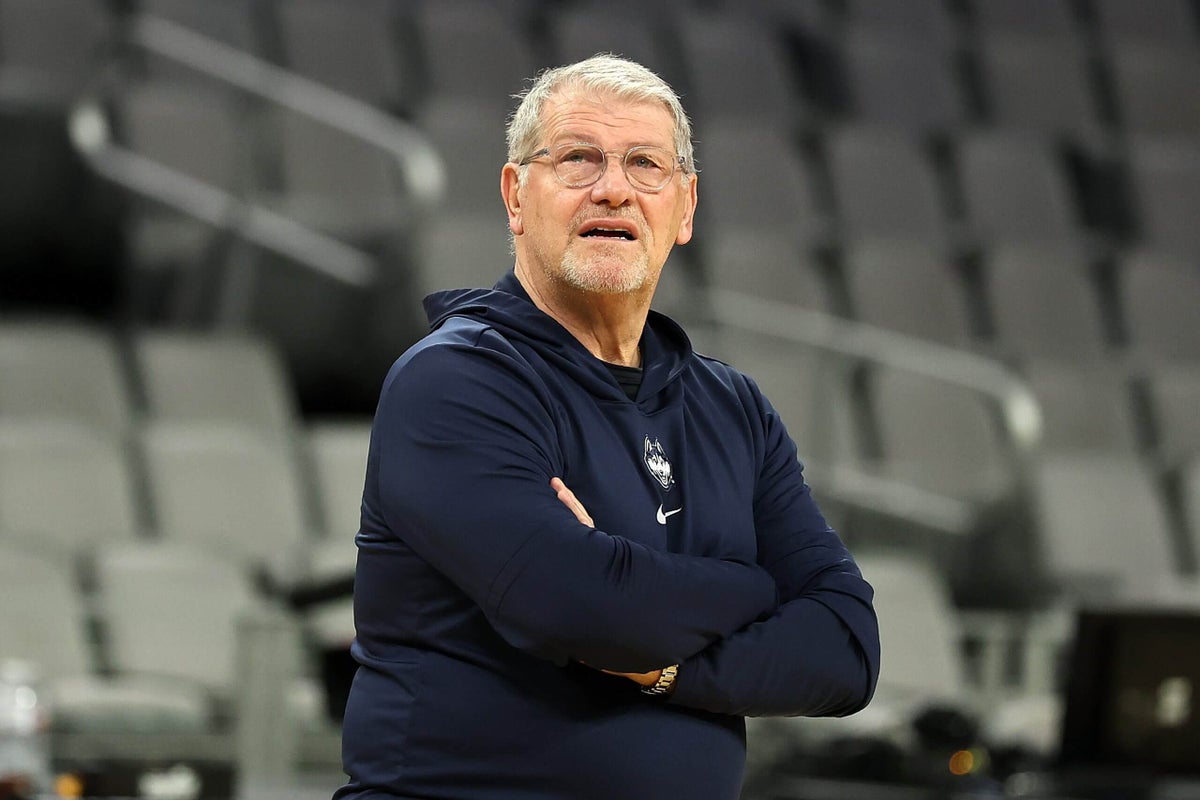
UConn coach Geno Auriemma had frustrations to air Saturday morning. Most notably, about the two-site regional format in the NCAA Tournament for the women’s bracket.
“I just don’t understand some of the decisions that are made about our game when we’re trying to grow the g—— game.”
The format, introduced in 2023, was implemented to increase attendance, which it did with average attendance topping 10,000 in 2023 and a total of 85,000 fans. It then rose to a record high of over 12,000 in 2024.
But stacking eight teams per region into one arena and one schedule for an entire weekend has created logistical and scheduling issues that have irritated the 12-time national champion coach and others around the sport.
Having so many different teams sharing the same arena naturally condenses the amount of time teams gets on the official court prior to the night’s games. It’s a diversion from the normal flow of pre-game activity for the sites, which was another point of contention for Auriemma.
“Know what time our shootaround was yesterday?” Auriemma asked. “(It was) 6:20, I think, for half an hour. This morning, I just saw Notre Dame leaving, so they had media this morning. Their practice time is tonight at 5:30. … You know what time our practice time is? 6:30 tonight.”
Auriemma also aired frustrations regarding new equipment in terms of fresh rims and balls being used in the NCAA Tournament second weekend.
“Does anybody who makes these decisions ever ask the coaches and the players, ‘Hey, does this work? Do you guys do this during the regular season? Is this normal?” Auriemma said.
In Sacramento, Duke coach Kara Lawson echoed Auriemma’s frustrations Saturday morning about court availability, the day after her No. 3 seed Blue Devils knocked off No. 2 LSU 87-85 with a game-winning 3-pointer by guard Ashlon Jackson.
“I think you should only get a half-hour the day before the game (at the arena) and you should get an hour the day of the game of the shootaround because that’s a normal shootaround for us,” Lawson said. “So on your game day, everybody kind of gets their normal thing.
“Everybody else might hate that idea. That’s OK, but that would be the only thing I’d change. … I think the arena thing is the thing that’s hard. It’s not that we’re in the same city, it’s that we don’t get long enough practice or shootaround times in the venue for your most important games of the season.”
UConn senior guard Azzi Fudd also acknowledged the discomfort in the schedule.
“I would just say it’s not ideal,” Fudd said. “The schedule is waking up early to do media, and then can’t come back to this arena until later, just little things like that. But everyone’s trying to figure that out right now. Every team is going through that.”
Another gripe Auriemma had was that the equipment and the practice of bringing in fresh rims and balls “straight out of the box” have created a challenge in terms of finding consistency in dribbling ability and shotmaking from deep.
He referenced six of the 3-point percentages from Friday’s Sweet 16 games: 4-of-20 (UConn), 4-of-22 (North Carolina), 1-of-17 (Notre Dame), 5-of-18 (Vanderbilt), 4-of-16 (UCLA), 7-of-26 (Duke) as evidence of the issue.
On Saturday morning, Michigan and Louisville combined to shoot 7-of-27 from 3-point range in the Sweet 16, which the Wolverines won 71-52. Louisville shot 34 percent from 3 on the season, while Michigan shot 33.7 percent.
“How many arenas are we going to sell out with that bulls—?” Auriemma said.
“I think they bring in new baskets, new basketballs right out of the box,” he later added. “Got people dribbling the ball off their feet. You got people missing layups all over the place. You bounce the ball, and it goes up to the ceiling. There’s just no concept of how basketball is played.”
Lawson was more jovial about the equipment after her Blue Devils’ offensive explosion Friday night.
“We scored 87 points last night,” she said. “When was the last time we did? We should keep these balls, you think? We don’t score like that, normally. Hopefully, we’re using these balls tomorrow.”
The NCAA did not respond to a request for comment about the conditions of game equipment.
The first weekend of the men’s tournament is situated similar to the women’s second weekend, with eight teams playing in one arena through two rounds. The teams practice at local surrounding gyms to supplement the time missed while having minimal preparation time in the arena.
UCLA women’s coach Cori Close was less forceful in her assertion against the two-region format, but she expressed a desire for a better structure to maintain an elite level of basketball and continue to elevate the game’s profile.
“I think we always have to look at that tug and pull of getting great coverage and then what sets up the game to be successful from a really high level of basketball being played,” Close said.
“I was in favor of going to the two regional sites when that happened. I think every year we should look and go, ‘Where are we in our game, how did this play out efficiency-wise, from a student-athlete wellbeing side?’ Are there some ways in which we can organize to make things a little bit more cohesive?”