
Every college football program preaches development. But never has that felt less true than at the quarterback position in this era of player movement.
Coaches choose recruits through the transfer portal over in-house options at nearly every opportunity. Quarterbacks frequently bounce around if they don’t play quickly enough. And there are times when programs do develop quarterbacks only for those players to leave for perceived greener pastures.
So we’re on a mission to find the last time each Power 4 program developed a QB?
Here are the strict parameters: The quarterback must have signed with the program out of high school, started at least one full season and left the school either via graduation or for the NFL Draft. No transfers or dismissals.
We will start with the ACC.
(All recruiting rankings are from the 247Sports Composite. The designation of pro-style or dual-threat was eliminated starting with the Class of 2021.)
Boston CollegeChase Rettig
Signed: Class of 2010 (No. 254 overall, No. 9 pro-style QB)
Final season: 2013
The Eagles haven’t won more than seven games since 2009, and their inability to develop a quarterback has contributed to that. Anthony Brown showed some flashes but transferred to Oregon. Phil Jurkovec and Tommy Castellanos transferred in, had some solid moments but eventually transferred out.
That leaves Rettig, who started for three full seasons (2011-13), as the last QB to sign with Boston College, become a full-time starter and finish his career there.
CalChase Garbers
Signed: Class of 2017 (No. 334, No. 12 pro-style QB)
Final season: 2021
If all goes well with current starter Jaron-Keawe Sagapolutele, this entry will look different in a few years. But for now, it’s Garbers, who threw for 6,582 yards, 50 touchdowns and 24 picks across four seasons as the Golden Bears’ primary starter (2018-2021).
Fernando Mendoza was a tremendous evaluation for Cal, but his transfer to Indiana disqualifies him from this list.
ClemsonCade Klubnik
Signed: Class of 2022 (No. 6, No. 1 QB)
Final season: 2025
Up until this year, coach Dabo Swinney pretty much avoided the transfer portal. He’s started only in-house options at quarterback since becoming the full-time head coach in 2009. Klubnik, who started for three seasons, is the most recent example in a group that includes Trevor Lawrence, Deshaun Watson and Tajh Boyd.
If Chandler Morris gains another year of eligibility and leaves Virginia, will Swinney change his approach? Morris’ father, Chad, recently returned to Clemson as offensive coordinator, and there’s been speculation that Chandler could join him.
DukeQuentin Harris
Signed: Class of 2015 (No. 1,248, No. 30 dual-threat QB)
Final season: 2019
Harris waited patiently behind Daniel Jones and became a starter in 2019.
Riley Leonard was a good find by David Cutcliffe and broke out under Mike Elko, but he transferred to Notre Dame after the 2023 season.
The Blue Devils, who are coming off an ACC championship, are squarely on the transfer QB carousel now. Coach Manny Diaz started transfers in 2024 (Maalik Murphy) and 2025 (Darian Mensah) and could potentially start another this year (Walker Eget).
Florida StateJameis Winston
Signed: Class of 2012 (No. 16, No. 1 dual-threat QB)
Final season: 2014
You could make an argument for Jordan Travis here. He spent five seasons at Florida State and truly developed in Tallahassee, but he transferred in after one season at Louisville. The reality is Jimbo Fisher mismanaged the position, Willie Taggart didn’t do much to improve it and Mike Norvell has lived in the portal and made some questionable evaluations.
Winston won the Heisman Trophy and led the Seminoles to the national championship in 2013.
Georgia TechTaQuon Marshall
Signed: Class of 2015 (No. 926, No. 18 APB)
Final season: 2018
Marshall signed as a running back under Paul Johnson, but transitioned to quarterback after his freshman season and started as a junior and senior.
Since then, Jeff Sims showed some promise but was too inconsistent, and he transferred to Nebraska (and then Arizona State). Haynes King played well, but he transferred in from Texas A&M. The Yellow Jackets could start another transfer, Alberto Mendoza (Fernando’s younger brother), this season.
If TaQuon Marshall gets open space, LOOK OUT.
This incredible run is for sure a top Must See Moment from 2017! #MustSeeACC
(@GeorgiaTechFB) pic.twitter.com/PLHzvoYcUX
— ACC Digital Network (@theACCDN) July 12, 2018
LouisvilleMalik Cunningham
Signed: Class of 2017 (No. 498, No. 33 ATH)
Final season: 2022
Jeff Brohm is on track to start his fourth different transfer quarterback, Lincoln Kienholz from Ohio State, in four seasons as Louisville’s coach.
Cunningham, who was listed as an athlete coming out of high school in Alabama, started for four seasons under former coach Scott Satterfield (now at Cincinnati).
MiamiMalik Rosier
Signed: Class of 2014 (No. 926, No. 27 dual-threat QB)
Final season: 2018
Mario Cristobal has found a successful formula by signing a high-end transfer quarterback every offseason. Cam Ward became a Heisman Trophy finalist and led the Hurricanes to 10 wins in 2024. Last season, Carson Beck guided Miami to the College Football Playoff championship game. We’ll see what Darian Mensah can do in 2026 after his transfer from Duke.
Before this recent string of QB success, though, the Hurricanes went through a rough patch at the position. Rosier started in 2017 and led Miami to 10 wins and an Orange Bowl appearance. He finished his career with the Hurricanes but was benched during one stretch of his final season in favor of N’Kosi Perry.
NC StateMike Glennon
Signed: Class of 2008 (No. 47, No. 4 pro-style QB)
Final season: 2012
Current quarterback CJ Bailey has started the past two seasons and will replace Glennon on this list if he finishes his career at NC State. Devin Leary did some good things in his four years with the Pack, but he transferred to Kentucky after the 2022 season.
Jacoby Brissett (Florida) and Ryan Finley (Boise State) transferred into the program.
North CarolinaDrake Maye
Signed: Class of 2021 (No. 56, No. 9 QB)
Final season: 2023
Former Tar Heels coach Mack Brown developed two quality starters during his second tenure with the Tar Heels — Sam Howell and Maye. Maye started two seasons (2022-23) and became the No. 3 pick in the 2024 NFL Draft.
The program has turned to the transfer market for a QB the past two offseasons under the leadership of coach Bill Belichick.
PittsburghKenny Pickett
Signed: Class of 2017 (No. 736, No. 33 pro-style QB)
Final season: 2021
Coach Pat Narduzzi has tried and failed with a few different transfer options after Pickett’s spectacular 2021 season, which culminated with an ACC championship.
Current starter Mason Heintschel showed a lot of promise as a true freshman in 2025 and should bring some stability to the position.
SMUKevin Jennings
Signed: Class of 2022 (No. 1,535, No. 95 QB)
Final season: 2026
It’s Jennings’ final season of eligibility, and he’s still at SMU, so he qualifies for this list. He led the Mustangs to a CFP appearance in 2024 and a nine-win season in 2025. Before him, you’d have to go back to Justin Willis in the 2000s, though that one gets an asterisk. Willis started in 2006 and 2007 but was moved to wide receiver by new coach June Jones in 2008 and then quit the team before his senior season.
StanfordTanner McKee
Signed: Class of 2018 (No. 46, No. 3 pro-style QB)
Final season: 2022
Stanford used to be one of the top destinations for blue-chip quarterbacks, but the program lost its luster at that position toward the end of David Shaw’s tenure. Quarterback play slipped even more under Troy Taylor, so we’ll see what new coach Tavita Pritchard does to address it.
McKee was the last in a good run of starting QBs — which started with Andrew Luck in 2009 — on The Farm.
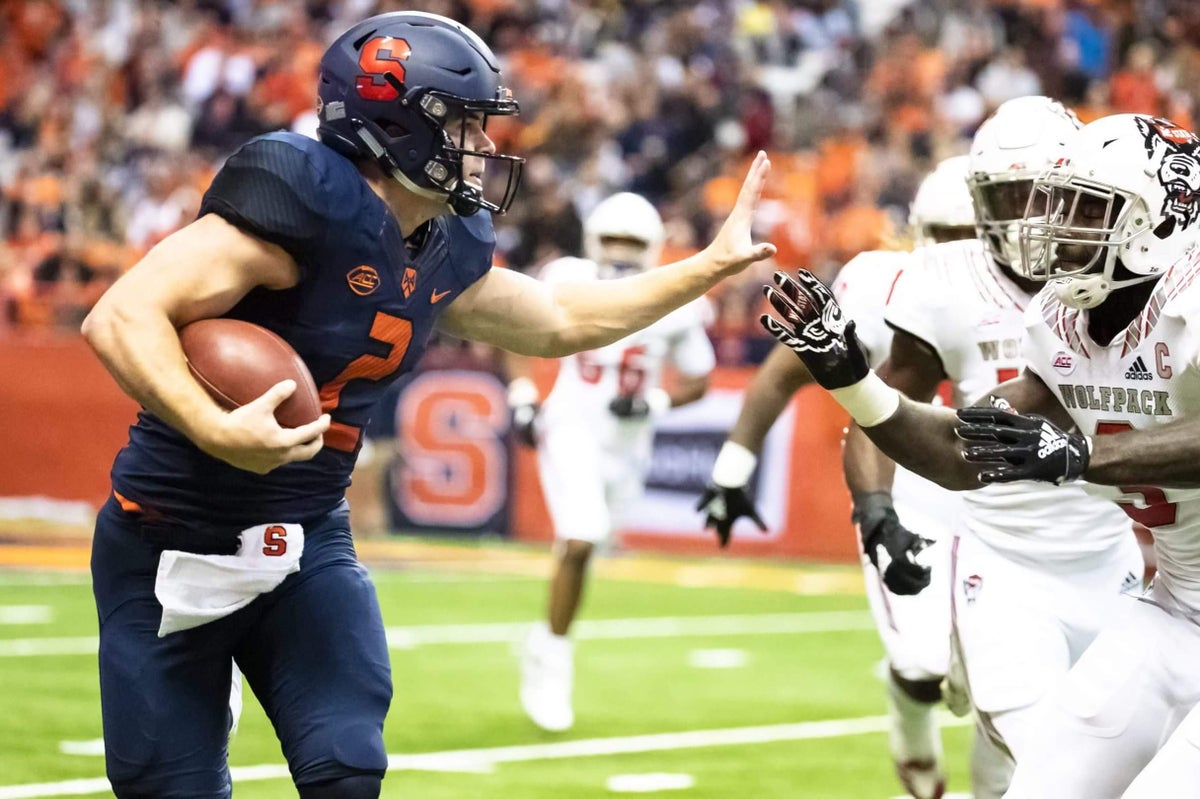
SyracuseEric Dungey
Signed: Class of 2015 (No. 639, No. 20 dual-threat QB)
Final season: 2018
Dungey thrived under coach Dino Babers and is Syracuse’s all-time leader in passing yards (9,340) and total yards (11,333).
Current coach Fran Brown has been committed to playing a transfer quarterback, and it doesn’t seem like that’ll change soon. Steve Angeli should be the starter if healthy this fall, and the Orange brought in two transfers — Amari Odom (Kennesaw State) and Malachi Nelson (UTEP) — for depth in case Angeli isn’t ready to go (Achilles tear last September).
Eric Dungey GETS. IT. DONE.
The @CuseFootball QB has become one of the most productive at his position in the ACC. 🍊
(@EricDungey) pic.twitter.com/vfPBFqeBl7
— ACC Digital Network (@theACCDN) May 22, 2018
VirginiaMatt Johns
Signed: Class of 2012 (No. 756, No. 36 pro-style QB)
Final season: 2016
Johns started in 2015 but lost the job when Bronco Mendenhall took over as coach in 2016.
Brennan Armstrong and Anthony Colandrea began their careers at Virginia and eventually became starters, but both transferred out. The Cavaliers are projected to start a transfer once again in 2026, either Beau Pribula (Missouri) or Eli Holstein (Pitt).
Virginia TechLogan Thomas
Signed: Class of 2009 (No. 52, No. 4 pro-style QB)
Final season: 2013
Thomas, a three-year starter, is Virginia Tech’s all-time leader in passing yards (9,003) and passing TDs (52). Since his departure, the Hokies have had a difficult time getting quality quarterback play — even when they’ve had capable signal callers on campus (like Hendon Hooker).
Thomas, the last QB who led Virginia Tech to a BCS/New Year’s Six bowl game, switched to tight end in the NFL.
Wake ForestJohn Wolford
Signed: Class of 2014 (No. 936, No. 38 pro-style QB)
Final season: 2017
Wolford led the Demon Deacons to two bowl games and got former coach Dave Clawson’s tenure at Wake Forest on track. Sam Hartman was a great development story, but he transferred to Notre Dame for his final season of eligibility.
Second-year coach Jake Dickert started a transfer last season (Robby Ashford) and brought in another transfer (Gio Lopez) this offseason, so that seems to be the path for the Demon Deacons now.