
NFL draft scouting is one of the most exhaustive processes in all of sports.
Film, data, scheme fit, measurables, character, age, injuries, pro days, interviews, off-field behavior—a seemingly endless number of variables are considered to quantify the stock of hundreds upon hundreds of NFL hopefuls.
Sometimes, though, it helps to simplify the process. That can apply to any daunting endeavor in life, so it stands to reason that it can be useful in a process as tiresome as draft scouting.
As the New York Jets prepare for the 2026 NFL draft, perhaps they can find value in highlighting one specific skill at each position that takes the cake as the primary trait they are looking for in a prospect.
Here is that one skill for each position.
Wide receiver: Contested catching
As we broke down previously, contested-catch rate has tended to be one of the strongest metrics for predicting the NFL success of first-round wide receiver prospects over the past decade.
Contested catches are one of the best ways for wide receivers to add value to their team. Most wide receivers can catch a schemed-open pass and pick up schemed-open YAC, but what do they do when they are placed in a difficult situation? That’s where the stars separate themselves from the average Joes.
If a receiver prospect couldn’t catch a high rate of contested targets in college, it’s not a good sign for his NFL outlook in that category, as opposing DBs will only get bigger and better. That’s why contested-catch rate should be a key qualifier for the Jets as they evaluate wideouts.
Makai Lemon (66.7%), Denzel Boston (76.9%), and Carnell Tate (85.7%) are three 2026 wide receiver prospects who check this box and then some.
Quarterback: Pocket presence
When a young quarterback fails in the NFL, it often comes down to poor pocket presence. He misses open receivers, holds the ball too long, and either takes unnecessary sacks (hello, Justin Fields) or chucks up reckless throws for turnovers (Zach Wilson).
This is why the Jets should focus on pocket presence when scouting quarterbacks. Forget about the flashy stuff: arm strength, mobility, and so on. Just watch his poise in the pocket. Does he confidently progress through reads? Does he stay calm when pressure arrives?
If the answer to those questions is “no” against college defenses, it probably isn’t going to suddenly be “yes” against NFL defenses.
Running back: Elusiveness
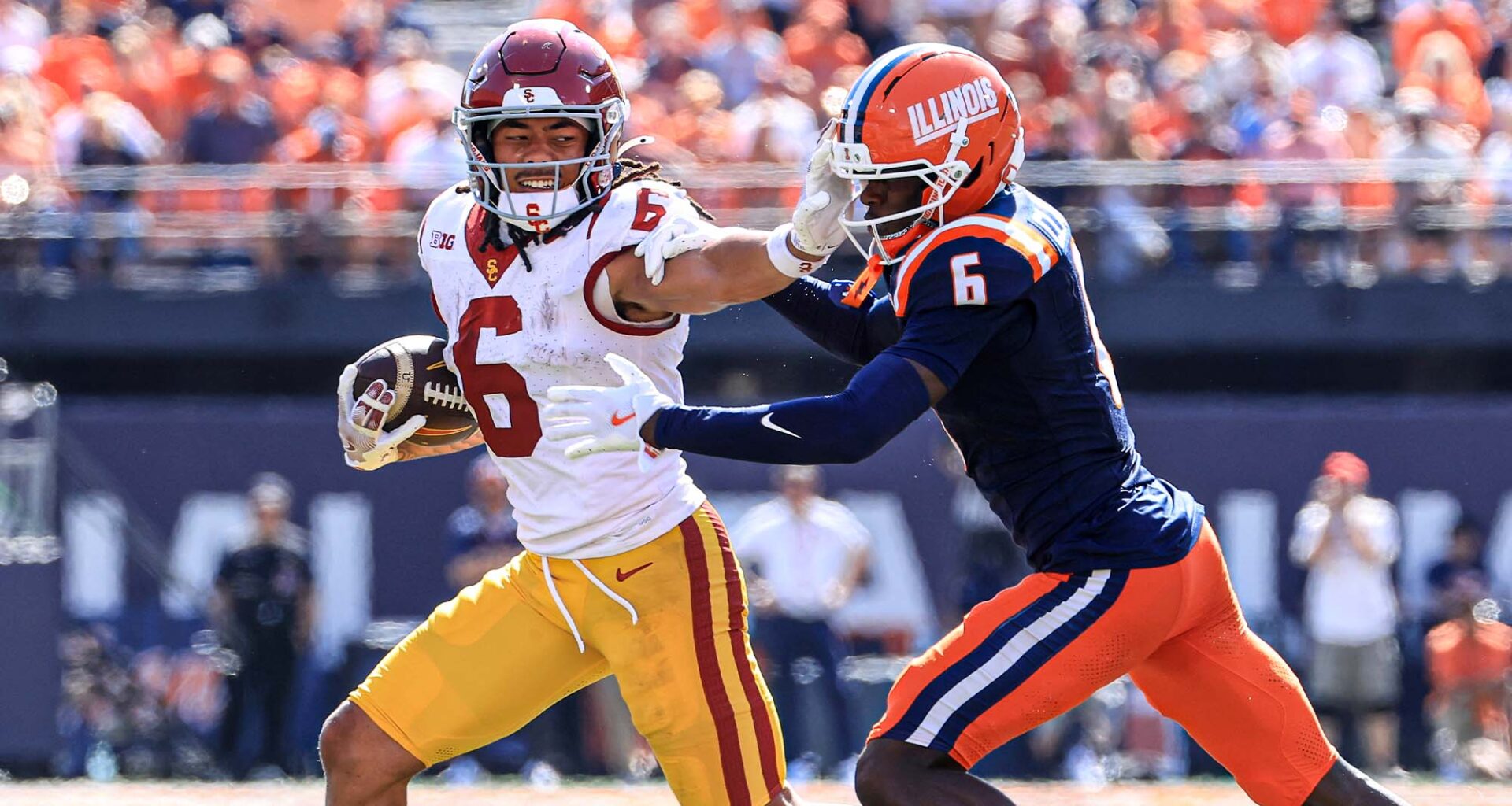
Home-run speed is all the rage when it comes to scouting running backs, but if you want a guy who helps your team from down to down, you need to be watching his elusiveness. How consistently does he make a man miss for extra yardage?
It’s up to the offensive line to create the lanes for home-run plays; the running back cannot generate those plays on his own. What the running back can always do is stockpile hidden yardage with his ability to consistently turn zero-yard gains into 3-yard gains and 3-yard gains into 6-yard gains.
Those little bonuses aren’t as sexy on the highlight reel, but they add up to massive value in the long run. It’s in the margins where star running backs truly change games.
Tight end: Blocking
In a fantasy sports-driven world, blocking at the tight end position has become an overlooked art. All anyone seems to care about when scouting tight ends is if they can be a jump-ball target in the red zone.
While it is nice to have a tight end with pass-catching upside, blocking remains as critical at the position as ever.
Why? Well, it’s because defenses have never been more versatile.
So, if you have a tight end on the field who can’t block, teams will not respect him as a blocking threat, meaning they will match him with a defensive back instead of a linebacker, knowing the defensive back can handle him in the run game. That negates any advantage the tight end might have in the pass game, as most DBs can easily stick with a tight end in coverage.
For a tight end to be a truly advantageous weapon in the pass game, he needs to draw matchups against linebackers. And to draw matchups against linebackers, he needs to be good enough as a blocker to make the opposing defense believe they must match with an extra linebacker on the field to account for the tight end’s blocking in the run game.
Offensive line: Pass protection
The Jets’ offensive line has had its moments in the run game across this 15-year playoff drought. Even this past season, the Jets ranked 10th in rushing yards per game.
What the Jets have not done since the early Rex Ryan days is build one of the league’s best pass-blocking offensive lines. Part of that is due to their horrid quarterbacks making the line look worse, but even after accounting for that, the Jets have not been elite in pass protection since at least 2011.
Run blocking certainly matters, but as the Jets continue their quest to field a high-octane passing attack for the first time in eons, pass protection must be the priority when scouting offensive linemen.
Cornerback: Overall coverage (don’t fall for ball skills)
This selection might be a hot take, given the Jets’ current predicament as a franchise that has not intercepted a pass in 452 days. However, it’s important for the Jets to stay disciplined with their scouting at cornerback.
After picking off zero passes in 2025, the Jets could easily be tempted to roll the dice on boom-or-bust corners who love gambling for takeaways. This might give them the immediate reward of an uptick in picks, but it would hurt in the long run.
Nobody embodies this more than the man who brought the 16th overall pick to New York.
For all of the vitriol directed at Sauce Gardner, he remains the cream of the crop at cornerback in today’s league. Sure, his three interceptions in four seasons are less than ideal, but it is well worth it for a player who has coughed up just five touchdowns and 1,224 yards in 59 games.
Think about how dominant that is: Per 17 games, Gardner gives up 353 yards and 1.4 touchdowns. Those are WR4 numbers (well, WR1 for the 2025 Jets, but that’s another conversation).
The ability to not allow yards and touchdowns is far less flashy than the ability to get interceptions—heck, it is hardly even visible, as much of the work Gardner does to achieve those numbers happens outside the broadcast view.
Nonetheless, in the long run, it makes a huge impact to eliminate hundreds of yards and bundles of touchdowns compared to the average cornerback. That impact just happens quietly and subtly in a cumulative fashion over a long period, rather than in short bursts of excitement that interceptions provide.
The Jets should remain focused on finding consistent cornerbacks, not flashy ones.
Safety: Tackling
It’s great to have a safety who can snag five picks per season. It’s also great to have a safety who flies around the box like a madman, taking people’s heads off and flexing afterward.
At the end of the day, though? Just make the tackle, man.
If all your safeties are good for is consistently wrapping up when called upon, your defense should be in good shape. They’re called safeties for a reason; they’re your safety net.
The negative impact a safety makes by failing to tackle in the open field outweighs the positive impact he could add by recording a few extra interceptions or tackles for loss. Those missed tackles as a last line of defense can lose games in an instant; making them can be looked back on as the turning point that saved a game.
Focus on tackling when scouting safeties. All of the extra skills are gravy.
Linebacker: Tackling
Not to be redundant, but I am going to essentially copy-and-paste the safety section here.
There are many fun things linebackers can bring to a defense. Some are uber-athletic and can be trusted to take on difficult coverage assignments. Some are old-school thumpers who establish a nasty mindset for the defense.
Ultimately, though, the mission is the same as safety: make the tackle.
No defensive position is involved in more tackles than linebackers. Most every-down starters are asked to make well over 100 tackles per season, with the league’s most actively involved linebackers soaring well over 150.
A high volume of tackles also means a high volume of chances to miss. As Jets fans know, nothing is more frustrating than watching a defense that can’t tackle. And, usually, if a defense has tackling issues, the linebackers are front-and-center.
It doesn’t matter how fast or aggressive a linebacker is if he can’t finish the play when he gets there. In fact, speed only makes a linebacker a greater liability if he can’t tackle, as it means he takes himself out of a play faster.
Finishing plays is priority No. 1 for linebackers. Like safety, all the extra skills are wonderful ceiling-raising bonuses if you can find them, but they shouldn’t come into play in the evaluation if the tackling isn’t there first.
Defensive line: All-around play
In a pass-driven league, pass rushing seems to be all that people care about with edge defenders. Sack or bust.
That mentality is the opposite of how football is coached.
Even if passes are more common and more explosive than runs, the two phases work hand in hand. If there were no threat of a run game, there would be no pass game.
Thus, edge defenders must be equipped to defend both phases. Players like T.J. Watt and Myles Garrett are as dominant as they are because they are a force to be reckoned with on every play, regardless of run or pass.
New York can’t look at pass rushing and run defense as separate when scouting edge defenders. They go hand-in-hand.
Defensive tackles can be grouped into this as well. Ideally, you want players who can make an impact in both phases.
Whether the opponent passes or runs, it’s still football, at the end of the day. The same principles apply in either situation. So, look for the best football players, and you’ll find the defensive linemen who make the best overall impact on winning.
Kicker: Putting the ball through the uprights
It shouldn’t be too hard to find somebody who can do this.
Right?