
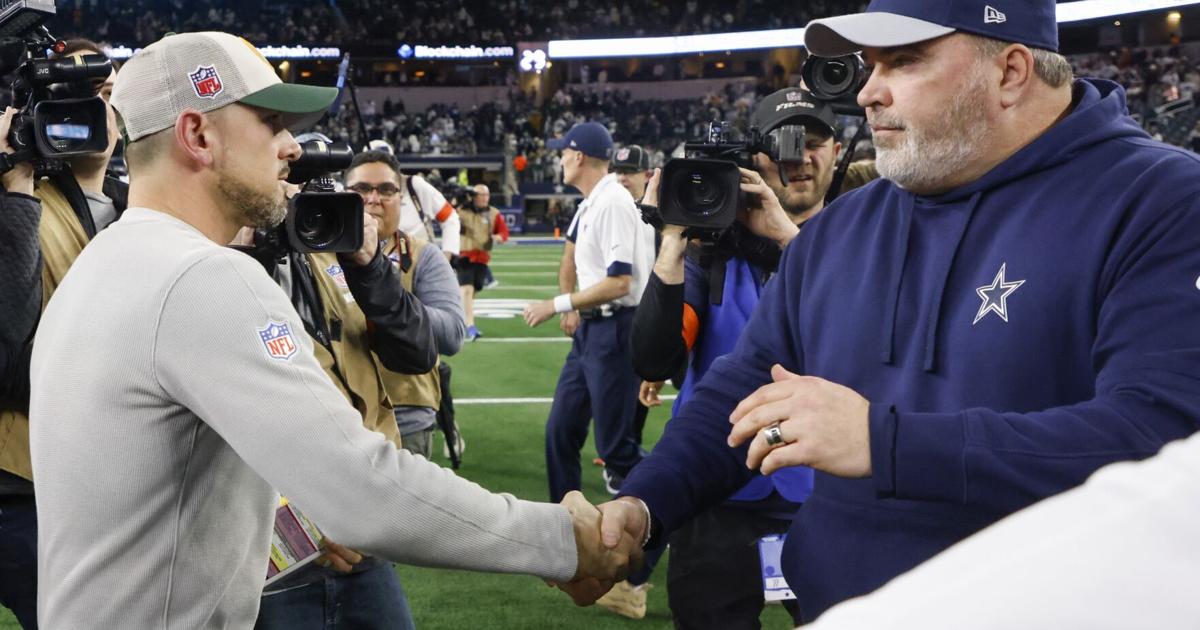
GREEN BAY — The last time a Green Bay Packers head coach said what Matt LaFleur said earlier this week at the annual NFL Meetings, it did not end well for him.
Speaking at the annual NFC coaches’ breakfast at the Arizona Biltmore resort in Phoenix on Monday, LaFleur said he plans to take a “Year 1” approach to the Packers offense in 2026.
“I think you’re always evaluating and trying to make the decisions that are the best for your football team — at least, what you believe are going to be best for your football team,” LaFleur replied when asked about his plans for the offense this season. “So, you always look at ways you can improve.
“And I thought the best way for us to move forward is, we’ve just got to strip everything down and start like it’s Year 1 all over again and really get to the detail of what we’re doing.”
If that rang a bell, it should have. Because his predecessor, Mike McCarthy, proclaimed similar plans for his system eight years ago, heading into the 2018 season.
Speaking at the 2018 NFL Meetings in Orlando, Fla., McCarthy was frustrated with a disappointing 2017 season in which a 4-1 start came to a screeching halt when future Pro Football Hall of Fame quarterback Aaron Rodgers broke his right collarbone in a Week 6 game at Minnesota.
Rodgers came back with three games left in the season and the Packers’ playoff hopes on life support at 7-6. A loss at Carolina in his return extinguished those hopes, and Rodgers was shut down for good.
After reaching the 2016 NFC Championship Game, the 7-9 finish was just their second sub-.500 season in McCarthy’s 12 years as head coach, and it led to an offseason staff shakeup: Mike Pettine replaced Dom Capers as defensive coordinator, Joe Philbin replaced Tom Clements as offensive coordinator and Gutekunst took over for Ted Thompson as GM.
And, it led McCarthy to reevaluate his offensive approach, leading to the decision to essentially start from scratch.
“This offseason resembles a Year 1 offseason,” McCarthy said at the NFC coaches’ breakfast at the JW Marriott Grande Lakes resort. “Obviously, the defense is going through that because they’re building a brand-new playbook, new coaching staff, new philosophy — [although] there is some carryover from our old defense.
“But offensively, when you have the same offensive system for 12 years, you’re playing late into the playoffs, you usually turn the page and evaluate and just try to evolve off what you did last year. We’ve taken a totally different approach.
“We’ve gone back to Page 1 in the playbook, and everything was open for discussion — every definition, every formation. So we’ve taken a scrub-brush approach to the whole system.”
McCarthy, of course, wound up not making it through the entire 2018 season. He was fired with four games to go, replaced on an interim basis by Philbin, and the Packers finished 6-9-1. Murphy hired LaFleur in January 2019.
Fast forward to this week, when LaFleur’s answer echoed that of McCarthy.
As had been the case in 2018, the Packers have a new defensive coordinator — Jonathan Gannon has replaced Jeff Hafley, who left to become the Miami Dolphins’ head coach — and the offseason focus from the outside has been on how things on that side of the ball might change, including with Gannon shifting to a 3-4 base system.
But in LaFleur’s eyes, even with Jordan Love heading into his seventh NFL season and fourth as the team’s starting quarterback, it’s also time for an offensive refresh.
The Packers finished the 2025 season ranked 16th in scoring offense (23.0 points per game), 15th in total offense (332.6 yards per game), 15th in rushing offense (119.8 yards per game), 17th in passing offense (212.8 yards per game), second in third-down offense (a 48.78% conversion rate) and tied for 14th in red-zone efficiency (a 57.63% touchdown rate).
“Certainly, are we satisfied? Hell no. Not even close. We always want more,” LaFleur said. “Until you’re hoisting that Lombardi [Trophy], you’re not going to be satisfied. And even then, you’re going to want to do it again.”
There is one potential difference between McCarthy’s lot in life in 2018 and LaFleur’s current situation: He seemingly has greater job security than McCarthy did back then.
Whereas then-team president/CEO Mark Murphy had signed McCarthy to a one-year extension during the 2017 season that meant he was under contract through the 2019 season, LaFleur — along with general manager Brian Gutekunst and director of football operations Russ Ball — got a “multi-year” extension in January.
Although Murphy’s successor as team president, Ed Policy, has refused to divulge how long those extensions are, it is widely believed that LaFleur is under contract for at minimum two more years, through 2028. And Policy was emphatic when discussing the extensions earlier this week at the NFL Meetings that the deals for all three men aren’t designed to quell talk about their jobs being in jeopardy.
“Certainly, accountability is a big part of any head coach’s job,” Policy told reporters covering the meetings in person in Arizona. “I won’t speak about any details of his contract, but I would reiterate: Yes, they are very real contracts. For all three of them.
“These were not one-year extensions. They were multi-year extensions. They were not prove-it contracts. They were very significant commitments to each of the three.”
With that security, perhaps LaFleur has more leeway to reinvent the offense. Still, it has to work for it to be worth it.
“I think that’s the beauty in coaching — you’ve got to find out what your guys do the best and then put them in the position to go out there and do that,” LaFleur explained after the Arizona Cardinals’ press conference introducing his brother, Mike, as their head coach back in early February.
“Certainly, [Los Angeles Rams head coach] Sean [McVay] does it as good as anybody in the game, in my opinion, just being able to adapt. Mike talked about being organic throughout the course of the season and how you evolve. And I think there’s so much truth to that. You can’t be rigid.
“I think the days of rigidness in this profession [of] coaching are long gone. It can’t be, ‘This is how it’s going to be, because this is the way we’ve always done it.’ It’s, ‘You got to find out what your guys do well, and then you put them in position. And it organically grows throughout the course of the season.”
COPYRIGHT 2026 BY CHANNEL 3000. ALL RIGHTS RESERVED. THIS MATERIAL MAY NOT BE PUBLISHED, BROADCAST, REWRITTEN OR REDISTRIBUTED.