
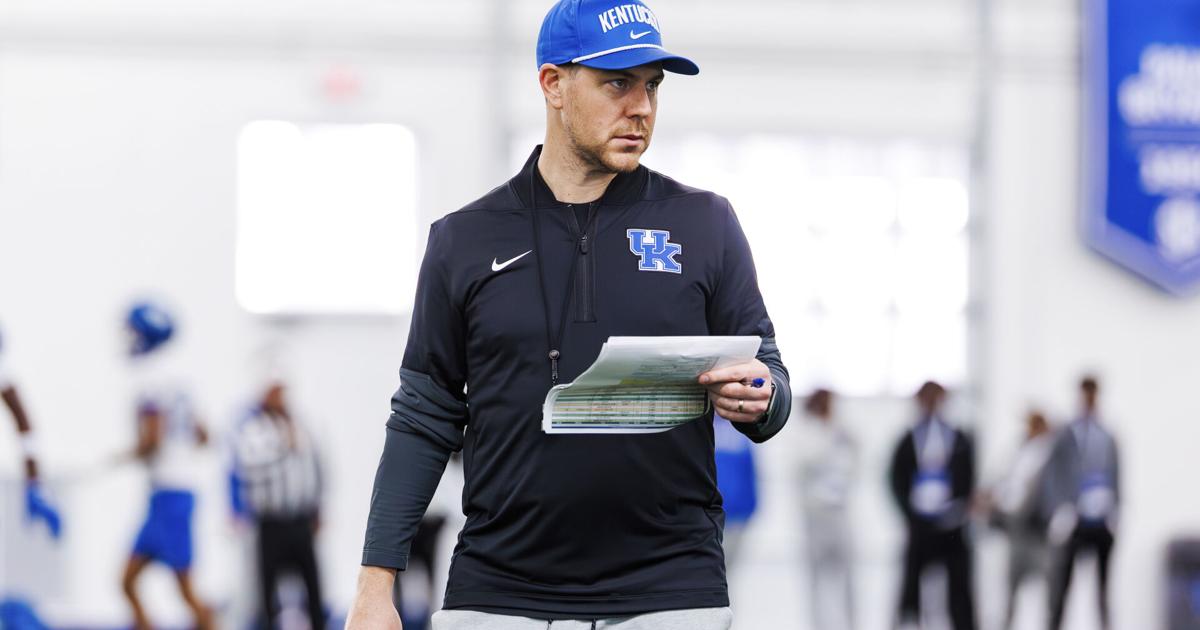
LEXINGTON, Ky. (WDRB) — Spring football is usually a beauty pageant for people in shoulder pads.
Somebody looks fast. Somebody looks polished. Somebody catches a ball in April and is briefly mistaken for a certainty in September.
At Kentucky this spring, first-year head coach Will Stein seems interested in something less glamorous.
He would like his team to think sooner.
Louisville | Kentucky | Indiana | Eric Crawford
Not on the field, where football has a way of making thought expensive, but before it ever gets there.
In meetings. In walkthroughs. In rehearsals for the rehearsal.
He calls it “practicing the practice,” which sounds at first like the sort of phrase a coach says because he has said so many other phrases already. But he means it. He wants players to understand the drill before the drill begins, to know the purpose before the whistle, to arrive at the field with the first layer of confusion already removed. If they do not, he says, that is on the coach. “Shame on you.”
Louisville | Kentucky | Indiana | Eric Crawford
This is a sensible idea. It is also an ambitious one.
Football has spent most of its life punishing late thought. The game is too quick, too crowded and too impolite to wait for a player to sort out what he has just seen. By the time he has identified the problem, the problem has usually introduced itself physically.
So Stein is trying to move the thinking out of the moment and into the preparation for it. Front-load the recognition. Pre-live the situation. See it on Tuesday so it does not surprise you on Saturday.
“It’s not like you can just go out and teach it on the field,” he said. “We do everything before we even get out to the practice field. So learning what this drill is called, and then taking it from the meeting room out onto the grass during a walk through scenario. … I’m big on efficiency, and if these guys don’t know the drill prior to practice, shame on you as a coach. So that’s been the biggest adjustment. But I’ll tell you what, from Day One, these guys have been receptive to coaching.”
Stein also does a great deal of situational work, third down, red zone, two-minute, even the final two plays of a game. He wants, as he puts it, to place players in chaotic environments now so that “when fall hits, there is no chaos. We’re calm within the chaos.”

Kentucky quarterback Kenny Minchey practices with a small camera attached to his helmet.
UK ATHLETICS
That is a very coach’s sentence.
It is also, if you are running a two-minute drill with one timeout and any points will do, a useful one.
Kenny Minchey, who wears a camera on his helmet at practice, can go home later, open his iPad and relive the day not as a spectator but as himself. He can see what he saw. More importantly, he can see what he failed to see. Where his eyes drifted. What he missed. Even how he sounded in the huddle.
This is no longer ordinary film study. This is self-surveillance with a football in it.
And Minchey says that when he starts seeing the game through the same lens as his coaches, “you feel like you’re in control.”
Control is a lovely word in football. Coaches use it the way sailors talk about weather.
They know better, but it comforts them.
Still, you can see what Stein is after. He is trying to build a team that does not spend valuable time discovering what is happening. He wants recognition to arrive early, maybe even before the snap, so reaction can arrive on time.
On defense, safety Ty Bryant is running the same idea from a different angle — and with a different purpose.
Bryant is in his senior year learning a new defense from top to bottom. So he goes home and studies it. Over and over, until he’s certain he has it right.
Not just for himself.
“I can’t coach anyone if I don’t know it,” he said.
Bryant has watched enough football to know that young players don’t always go to the coaches when they have a question. They go to a teammate. So he makes sure he’s ready to be that resource — the guy in the room who already has the answer.
Same principle as Minchey and his helmet camera. Same principle as Stein and his walkthroughs.
Do the thinking early. Be ready when it matters.
So this is the shape of Kentucky’s spring: not just drills, but preparation for drills; not just repetition, but rehearsal of recognition; not just learning what to do, but trying to know it early enough that doing it becomes the easy part.
It is a smart way to go about things.
The game, of course, reserves the right to be unimpressed.
Football will still show Kentucky something it did not rehearse. It always does. A formation dressed in the wrong clothes. A busted look. A bounce with bad intentions. Some new little emergency with no label on it.
But there is value in shortening the delay between seeing and answering.
That half-second is where football does some of its best work.
Stein, in his first spring, is trying to steal some of it back.
Copyright 2026 WDRB Media. All Rights Reserved.
Top Sports Stories on WDRB.com