
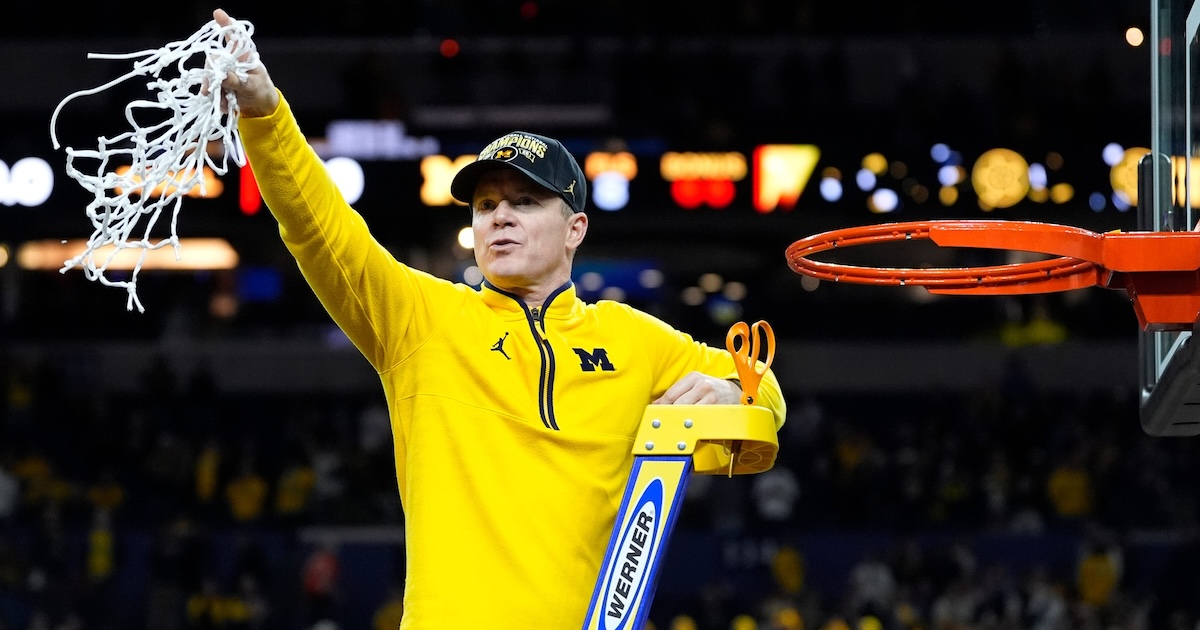
INDIANAPOLIS — The confetti had already fallen from the sky inside Lucas Oil Stadium as Michigan celebrated its new national championship on the podium after defeating UConn. Head coach Dusty May placed the Michigan placard into the champion’s spot on the large bracket, while DJ Khaled’s “All I Do Is Win” blared from the speakers.
A Michigan fan, still reveling in his program’s renewed success, hung a banner over the top row of the tunnel leading back to the locker room, waiting for the Wolverines to arrive. The banner, which featured a Michigan football helmet, displayed the famous Michigan motto coined by former football coach Bo Schembechler: “Those who stay will be champions.”
Here’s a new mantra for the Michigan basketball program: Those who come will be champions.
May, who arrived in Michigan in 2024 after leading Florida Atlantic to the Final Four, is like basketball’s Curt Cignetti, Indiana’s star coach who guided the Hoosiers to this year’s college football championship. Both achieved success in their second year. Why? Because they evaluate talent remarkably well, leveraging the transfer portal to maximize the potential of incoming players and build dominant teams.
Throughout the week, the talking point was that Michigan is what’s wrong with college basketball because its starting five players began their careers at different programs. Elliot Cadeau (North Carolina), Nimari Burnett (Texas Tech and Alabama), Yaxel Lendebord (Arizona Western and UAB) and Aday Mara (UCLA) were all newcomers this season under May.
Some will tell you that the spirit of college athletics are dead, that the mantra Schembechler uttered in 1969 no longer applies to Michigan or college athletics in general. Those people would be right, but the hate May and the Wolverines have received as a result of how this year’s team was assembled? Nonsense.
Michigan played by the rules and did what literally everyone else does, just better. If you’re going to exist in college sports in 2026 and beyond, you need to pay players and you need to take them out of the portal. Those stubborn enough to do things the old-fashioned way will perish, falling far short of what this remarkable Michigan team just did.
Michigan was a powerhouse this year. It played like a team all the way to the very end, beating up on opponents and overwhelming even the toughest teams — the latest being UConn — on the way to victory. What it did to an elite Arizona team Saturday night? A massacre.
The irony of all this? It’s not even like Michigan spent the most. Of the Final Four teams that made it to Indianapolis, Michigan spent the least. Less than Arizona, UConn and Illinois.
“It’s one of the better teams that I’ve played,” UConn coach Dan Hurley said after the game. “Certainly since I’ve been a college basketball coach.”
Who were Michigan’s top players? Lendeborg, for sure. And of all the players Michigan recruited from the portal, he was by far the most impressive. Instead of going into the NBA Draft, he chose to stay at Michigan, where he developed into a more complete player and now projects to the League better than he did last year. He also started the game injured, admitted at halftime, he wasn’t feeling well, and was playing passively, yet he still scored 13 points against the Huskies.
The other three transfers weren’t as sought after. Cadeau, who scored 19 points on Monday night, was a former top-rated recruit who didn’t succeed at North Carolina and was looking for a new opportunity. Mara, a 7-foot-3 dominant big man, was a bench player at UCLA before making a significant impact with the Wolverines. Johnson Jr. also came off the bench at Illinois last season.
All of these players came to Michigan and thrived, not only individually but together. Everything UConn, an incredibly tough team, tried to do on the hardwood Monday evening was contested. Michigan played tough, relentlessly frustrating the Huskies until the end. Some will say the game was officiated poorly because of the foul discrepancy, but that discrepancy existed because the Huskies didn’t have an answer for Michigan inside.
So save the “Michigan is what’s wrong with college sports” takes. It’s frankly not true.
“Look, I know this is going to set off a Twitter firestorm, but I think we all are better in certain situations than others,” May said before the game. “There’s an environment that’s right for me. There’s an environment that’s right for you. Sometimes you don’t choose the right environment from the beginning or sometimes as people we change and we need something different, for a number of reasons. The way we choose to look at it, we’re going to bring in really, really good guys that are high achievers, that want to do it the way we want to do it.
“And when the Oklahoma City Thunder won the championship last year — and I’m friends with Coach (Mark) Daigneault and a lot of people in that organization — I wasn’t judging them because Shai Alexander was drafted by the Clippers or because they signed Isaiah Hartenstein as a free agent. I thought, ‘wow, those guys played beautiful basketball, that’s a great team, that’s a real model for young players to watch, a group that obviously cared about each other, that played the game the right way, that represented their organization, their city, their families, their last name.’
“Whatever the rules are, we’re going to go at it, but our job is to put a competitive roster/team on the floor that represents Michigan the way we think they deserve to be represented.”
At some point, college athletics may reach a stage where players are collectively bargained and transfers become less frequent. The future of college football and basketball stays uncertain. But during this transitional period, we’ve seen that the coaches who evaluate talent effectively and allocate their funds wisely are the ones who will succeed. Michigan exemplified this, and now the Wolverines have ended the Big Ten’s basketball national title drought that has lasted since 2000.
May did exactly what Cignetti did at Indiana. Both were elite evaluators. Both are champions.
Ironically enough, in an alternate universe, Indiana could have actually had both Cignetti and May, an Indiana grad who got his start as a college staffer in 1996 as a Hoosiers student manager. It would have been unfair had the Hoosiers wound up with both. Ohio State, when it hired Jake Diebler, also had May as a finalist. There are a lot of people asking “what if?” tonight.
Cignetti’s secret sauce was identifying the right players in the portal, bringing them to Bloomington, and turning them into one of the best-coached teams in the country. Indiana went from one of the worst programs in college football to a national champion in only two years under his guidance.
Here’s an excerpt from a column I wrote about Cignetti days before the Hoosiers beat Miami to claim college football’s biggest prize:
The secret sauce? It isn’t just identifying good players. The tape tells the story, and everyone knows Cignetti has an eye for talent that may be unmatched by any of his peers. The real magic was identifying those like-minded players — the ones who would gel — within the culture he wanted to create in just a matter of days. It’s one thing to win in the portal. It’s another to avoid missing on personalities while assembling the roster. And again, you have to get to know players quickly. The portal pales in comparison to the time coaches can devote to relationships during the traditional recruiting process.
The same goes for May.
All of it.
The result? Those who came to Michigan are champions.