
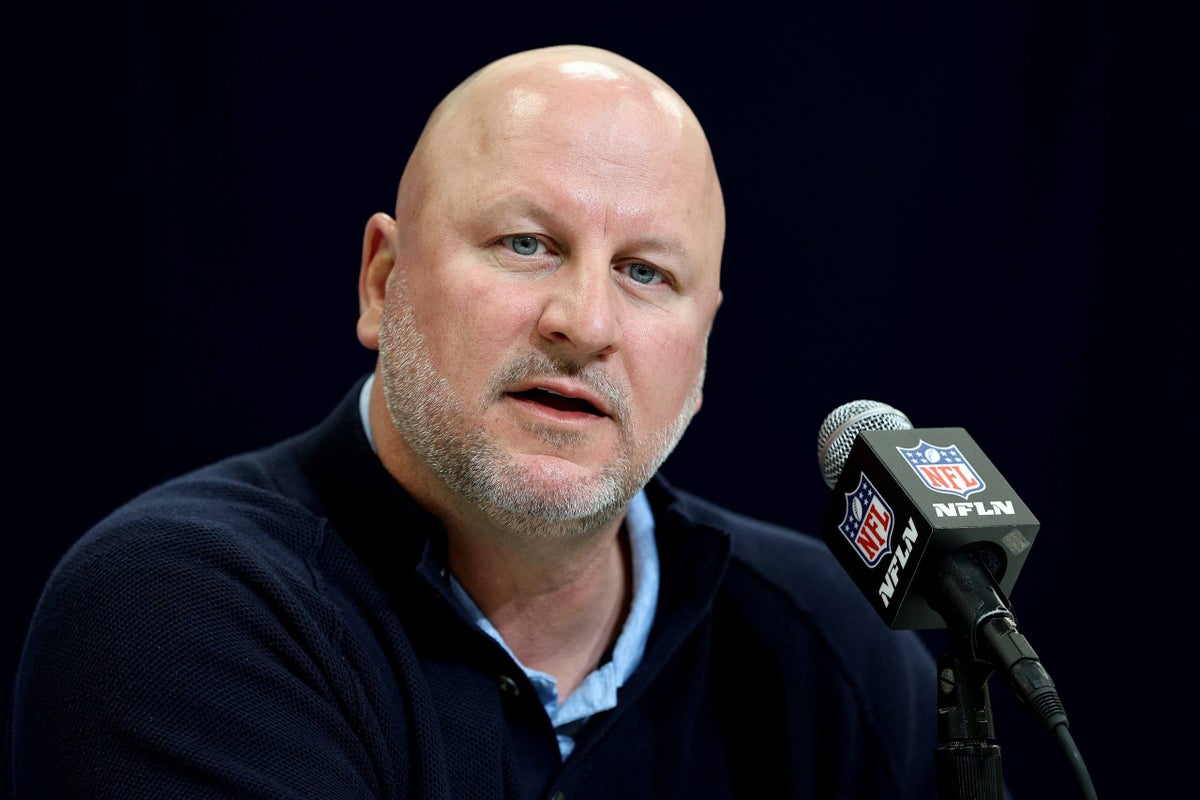
The Los Angeles Chargers currently hold the No. 22 overall pick in the first round of the draft, which kicks off April 23. General manager Joe Hortiz and coach Jim Harbaugh should be looking to trade down from that spot for two reasons.
1. The Chargers only have five picks in this year’s draft.
Hortiz’s draft philosophy, at its core, revolves around maximizing his number of picks. To use a baseball analogy, the Chargers want as many at-bats as possible in each draft. But that did not materialize this year.
The Chargers traded away their 2026 fifth-round pick in October to acquire edge rusher Odafe Oweh. The trade for Oweh was a resounding win for Hortiz, but it took away an at-bat for 2026. The Chargers also dealt their 2026 seventh-round pick in August 2024 for safety Elijah Molden. That trade was another win for Hortiz. Molden played well in 2024 and signed an extension that ensuing offseason. He is an important defensive piece because the Chargers like to move Derwin James Jr. around, including to the nickel position. Again, though, the Chargers lost an at-bat in 2026 as a result.
A trade down from No. 22 could net the Chargers additional draft capital in 2026 and help bolster a relatively limited cupboard — certainly more barren than Hortiz would prefer in an ideal world.
2. The top of this year’s draft is not as strong as other years
That means teams are going to have fewer first-round grades on prospects. The board unfolded well for the Chargers last year. They had a very high grade on running back Omarion Hampton. He was there at No. 22, and the Chargers brought in a long-term, high-level starter at the position. A similar scenario is unlikely to happen this year, given the nature of the class. However, there is still depth in this year’s class in the 30 to 55 range.
There might not be a huge difference in grade between the player the Chargers could get at No. 22 and the player they could get at, say, No. 34. Of course, much of this calculus depends on how the board falls and who is actually available.
Prioritizing a trade down is only one part of the equation. In order to successfully execute a trade down, the Chargers have to find a partner willing to trade up.
So there is one important question to consider when discussing a trade-down scenario: Which teams are going to be motivated to make a move up to No. 22 and part with draft capital of their own?
The obvious potential answers are teams in need of a quarterback.
The Arizona Cardinals have a new head coach in Mike LaFleur, and they cut quarterback Kyler Murray earlier this offseason. Their projected starter is Jacoby Brissett, who replaced Murray for the final 12 games last season and played serviceably. From Week 6 on, Brissett ranked second in the NFL in passing yards and 20th in EPA per dropback, according to TruMedia. The Cardinals also signed Gardner Minshew in free agency.
Indiana’s Fernando Mendoza is the consensus top quarterback in this year’s class, and he is expected to go No. 1 overall to the Las Vegas Raiders. The Cardinals have the No. 3 pick. They likely miss out on Mendoza, and No. 3 is too high to take Alabama’s Ty Simpson, who is Dane Brugler’s No. 2 quarterback and No. 34 overall player.
The Cardinals pick again at No. 34 in the second round. Could they try to move back into the late first round to take Simpson? The New York Jets have the first pick of the second round at No. 33. Though they traded for Geno Smith this offseason, the Jets need a long-term answer under center. They could be a threat to the Cardinals when it comes to Simpson.
Almost all the teams picking after the Chargers at No. 22 are settled at quarterback: the Philadelphia Eagles (No. 23), Chicago Bears (25), Buffalo Bills (26), San Francisco 49ers (27), Houston Texans (28), Kansas City Chiefs (29), Miami Dolphins (30), New England Patriots (31) and Seattle Seahawks (32). The Cleveland Browns have pick No. 24. They are bringing back Shedeur Sanders. And according to The Athletic’s Zac Jackson, Dashaun Watson has been medically cleared for competition. My sense right now is that the Browns will not be in the mix for Simpson at that spot in the first round.
Would the Cardinals deem it necessary to move up as high as No. 22 to draft Simpson? Or do they merely have to jump ahead of the Jets at No. 33? The Pittsburgh Steelers are also picking at No. 21. They have two rostered quarterbacks in Mason Rudolph and Will Howard. Are they a potential landing spot for Simpson? Or will new head coach Mike McCarthy end up re-signing Aaron Rodgers?
If the Cardinals want to move up from No. 34 to No. 22, there is a pretty direct comparison from last year’s draft. The New York Giants moved up from No. 34 to No. 25 and sent the Houston Texans a 2025 third-round pick (No. 99 overall) and a 2026 third-round pick. The Cardinals have pick No. 65 at the start of the third round. A package of that pick plus a later Day 3 pick — either in 2026 or 2027 — would present similar value to what the Giants gave up.
The Jets are also an option to move up from No. 33 to No. 22. However, New York has a second first-round pick, No. 16 overall, that it picked up in the Sauce Gardner trade at the deadline last season. The Jets could take Simpson at No. 16 if they are worried about the Steelers at No. 21.
A move from No. 33 to No. 22 for the Jets would fall in the same ballpark as the Giants’ trade up from 2025.
The Chargers have needs to fill on the first two days of the draft. They need a starting-caliber guard to add to their offensive line mix. They need a third edge rusher to add to the Khalil Mack-Tuli Tuipulotu duo. They could use some more talent in their cornerback room, and they should be keeping an eye on the receiver class to increase the competition in their young, ascending group.
If the Chargers can add an additional third-round pick in a trade down, they could address all of these needs on the first two days of the draft.
Hortiz has been interested in trading down in each of his first two drafts. He had offers to trade back from No. 5 overall in his first draft, but ultimately selected an elite player in tackle Joe Alt. The Chargers were close to trading down from No. 22 in last year’s draft, but that deal fell through at the last minute. The Chargers also had consensus and conviction in drafting Hampton, a pick that looks like another hit.
Hortiz, instead, has been more active in trading up in his first two Chargers drafts. He traded up in the second round in 2024 to select receiver Ladd McConkey at No. 34 overall. He traded up in the fifth round last year to select tight end Oronde Gadsden at No. 165 overall. Those have both turned into very positive moves.
In those drafts, though, Hortiz had more capital to use. The Chargers entered the 2024 draft with nine picks. They entered the 2025 draft with 10 picks.
They have half as many picks entering the 2026 draft.
A trade down is logical for multiple reasons. Can Hortiz find the partner to make it happen?