
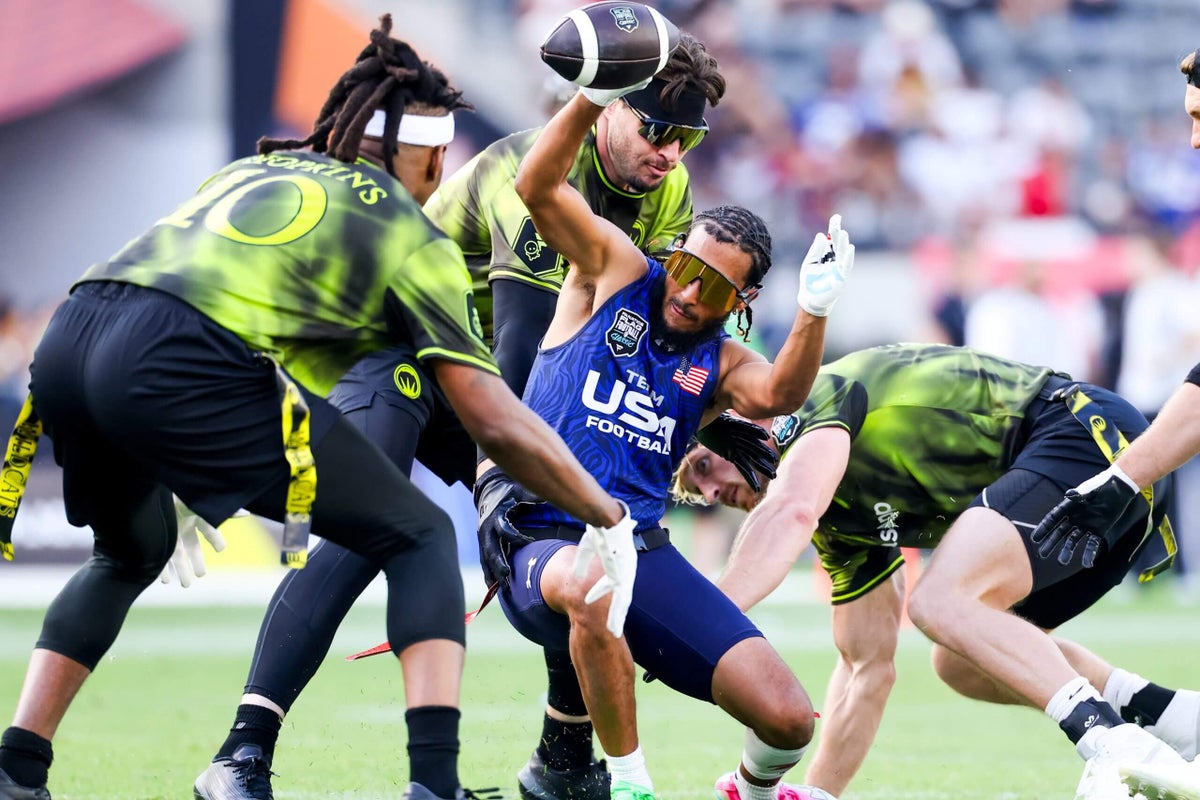
For NFL players enticed by Olympic gold, the Fanatics Flag Football Classic was a harsh reality check.
Two squads of NFL superstars, doomed by a skills discrepancy and lack of flag knowledge, lost all three games to Team USA by a combined 106-44 score.
The lopsided exhibition badly exposed the pros.
The only relief: For the most part, they didn’t hurt themselves.
“Everybody needs professional arrogance, but you better understand that you need professional humbleness too,” former NFL strength and conditioning coach Joe Kenn said. “There’s a whole package of things to think about.”
More disconcerting than humiliation for the NFL, if its players want to compete in flag football at the 2028 Los Angeles Games, is how the excursion could add injury to insult.
A wake-up call? NFL owners and general managers better have surgeons on call.
“I would be highly concerned with the amount of money that I have invested,” said Kenn, “that a catastrophic injury could happen with one cleat in the dirt. You watch the way they move, and it’s like that martial art, capoeira, with all the spinning and twisting and moving that almost looks like ballet.
“You’re better off training with a hula hoop than doing agility drills. You have to train your body to swiggle. That’s not the football those guys are used to playing.”
NFL decision-makers noticed the high-speed contortions.
Movements that are second nature for trained flag players — they can drop a knee to within one inch of the grass, duckwalk like Chuck Berry and explode back to their feet — to keep defenders from yanking their flags can send even the fittest NFL player to injured reserve.
When coaches gathered in Phoenix last week for the NFL owners’ meetings, flag football concerns were a prominent topic.
Atlanta Falcons running back Bijan Robinson might look sensational in a Team USA uniform, but his new coach doesn’t necessarily like the idea.
“I would definitely want to ask Bijan and some people in our building, ‘Is this in our best interest?’” Kevin Stefanski said. “Because anytime our guys do anything, I am always a little hesitant. But it’s a great game. It’s a game that we believe in, a game this league is growing.
“But certainly anytime our players are doing anything, I’m always a bit nervous.”
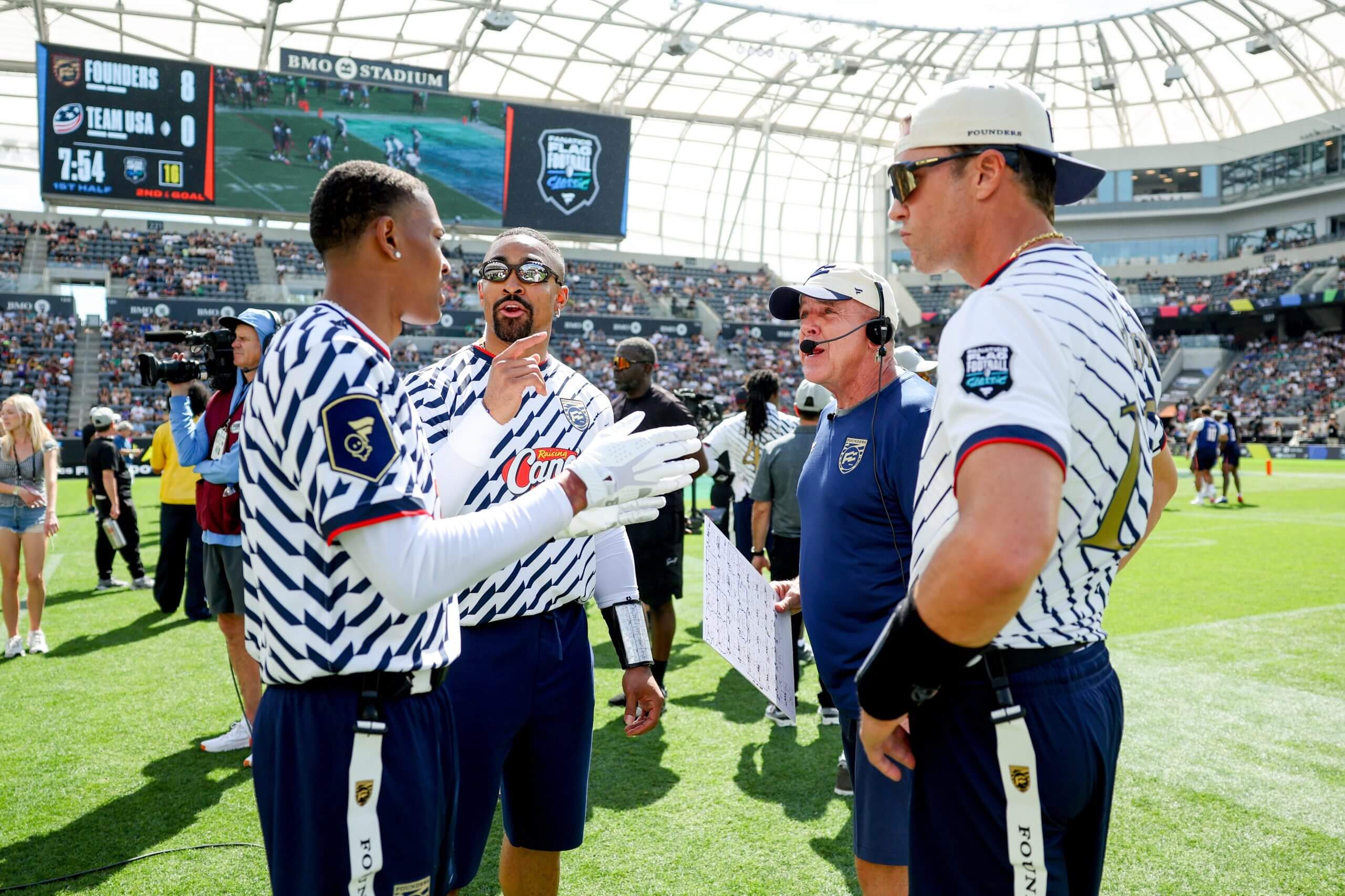
After coaching in the Fanatics event, Sean Payton (in blue) thinks NFL players are unlikely to end up in the Olympics. (Katelyn Mulcahy / Getty Images for OBB Media — FANATICS STUDIOS)
On its 25-by-50-yard field, flag football is a ricochet game of sudden, high-speed accelerations and decelerations. The latter causes significant noncontact injuries.
Torn or sprained knee ligaments, popped Achilles tendons, pulled hamstrings, rolled ankles, strained groins, sports hernias … that’s merely below-the-waist angst in a sport where being out of position by one step can cause an instinctive reach or rotational twist. Retired tight end Rob Gronkowski injured a hamstring on the only pass he caught at the Fanatics Flag Football Classic.
“Any time you’re starting and stopping, the more bouts you have, the more concern for a catastrophic injury to happen with one slight move,” Kenn said. “Or you lunge at a player the wrong way, or you try to make a juke that you’re not used to, and you’re playing at a level of speed because you’re competing for a gold medal? Things are uncontrollable in a game you’re still a rookie at.”
Without a physical element to compensate in those bang-bang moments — stiff-arming and shoulder-lowering and diving for a ball carrier’s ankles are prohibited — tackle football players also could end up on the ground, where shoulders become vulnerable. The Cincinnati Bengals must have held their collective breath while watching the Fanatics event each time quarterback Joe Burrow’s competitive juices sent him onto the grass of a flag football field.
NFL teams can lose only one player to the Olympics, and the Detroit Lions have candidates for multiple countries. Running back Jahmyr Gibbs is an electric playmaker, and at 5 feet 9, he possesses prototypical flag size. All-Pro receiver Amon-Ra St. Brown’s mother is German; he speaks fluent German and holds dual citizenship.
“That’s a little scary,” Detroit coach Dan Campbell said of the injury risk. “As a club, we’ve got to think through it.
“But, ultimately, to be honest with you, I don’t lose any sleep thinking about it.”
Kenn would advise Campbell to worry a little harder.
“I just don’t know what owner would sign off,” Kenn said. “If he does, do you think he’s sleeping good about it? I wouldn’t, and I’m a strength coach.”
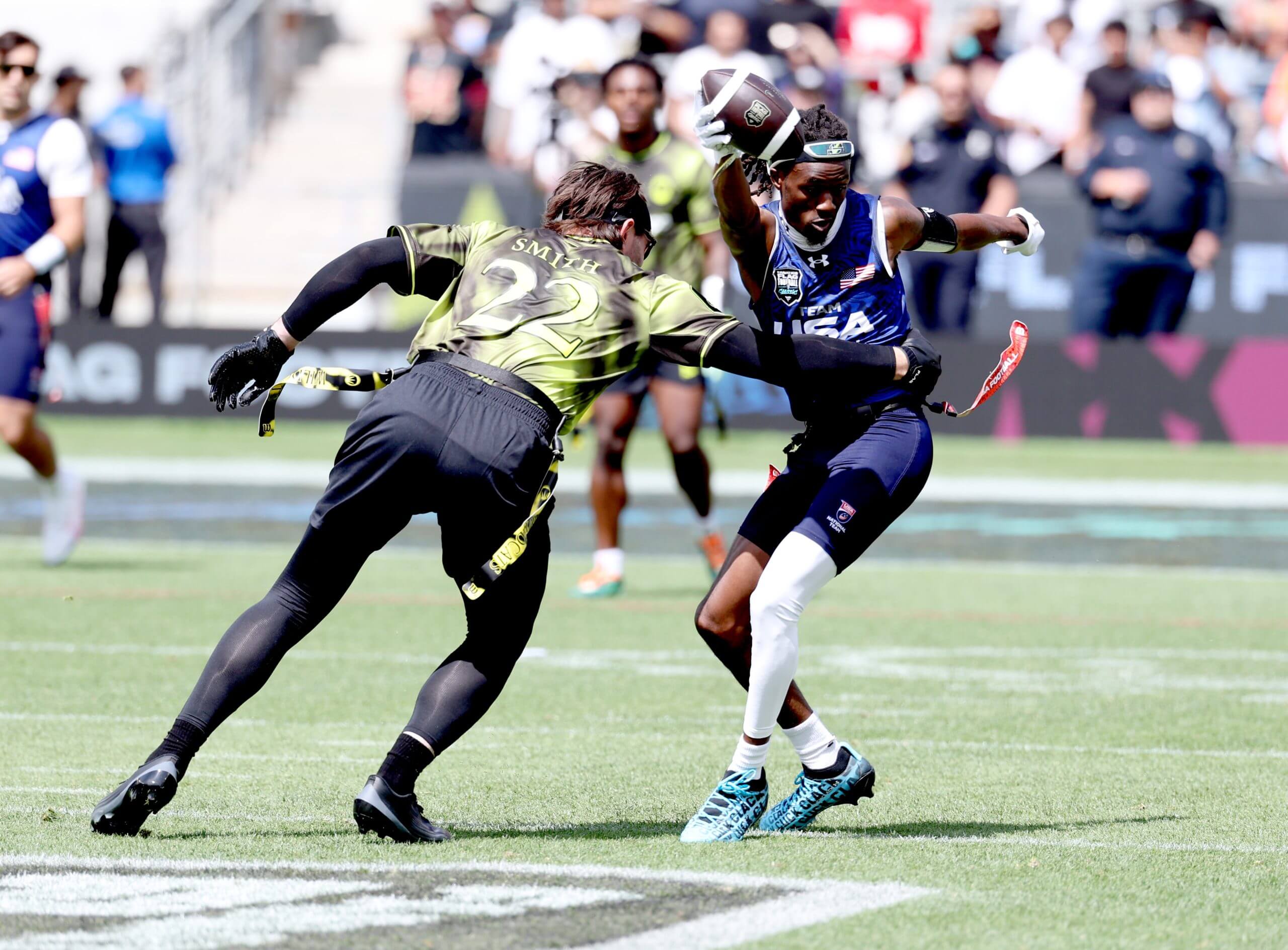
With hard contact prohibited, flag football places an emphasis on agility that NFL players typically don’t emphasize in their training. (Kevin C. Cox / Getty Images for OBB Media — FANATICS STUDIOS)
Kenn, known as “Big House” around the NFL for his gargantuan size, was the Carolina Panthers’ strength coach for nine seasons. Now, he’s a personal trainer who specializes in strong-man competitions but still works with NFL folks.
Former student and Pro Football Hall of Fame linebacker Luke Kuechly reached out to prepare for the Fanatics event, and Kenn acknowledged his guidance was insufficient. Kenn assumed Kuechly, a triathlete and fitness freak, would be OK based on peak conditioning. The biggest warning was about eye discipline and positioning.
Team USA shook Kuechly out of his shorts.
“When I saw (Kuechly) get juked, that’s when I know they don’t understand,” Kenn said. “Did you ever see Kuechly get juked like that in a real game? It’s a whole different game of angles and perception. How many future Hall of Famers were out there? And you got embarrassed. …
“Support the s— out of flag football, but support the people who play it and not try to make it another NFL property. You have enough money.”
NFL commissioner Roger Goodell said last week the league will be included on the 2028 Olympic roster, but Denver Broncos coach Sean Payton predicted no NFL player will make Team USA.
Payton called plays at the Fanatics event for a roster that featured current and former NFL players Tom Brady, Jalen Hurts, Ashton Jeanty, DeVonta Smith, Stefon Diggs, Antoine Winfield Jr. and Gronkowski. Payton said he studied game film and prepared in earnest. Their all-star team didn’t advance out of the tournament’s round-robin portion.
“There was this feeling that there would be 10 NFL players on that roster,” Payton said of the 2028 Olympics. “I’ll be surprised if there’s one.
“I think we have plenty of players who can acclimate, but it’s going to take a month or two, and if you’re one of those players, do you have a month or two? If you’re training for that, you’re not training, you know, (for the NFL season).”
Kenn doesn’t see total acclimation happening in only a couple of months.
Not only must an NFL player disengage with his tackle training to develop the muscle memory and instinctive reactions necessary for flag football, but he also will require time to wade back into the tackle realm. Flag football will be held July 15-22 at the 2028 Olympics. Team USA will hold a two-week training camp that leads into the Games, but there will be multiple other workouts beforehand.
“You maybe have to take six months or a year off from contact sport,” Kenn estimated to maximize the flag skill set. “You have to step away. It’s not happening in a couple months.
“You have to almost recondition yourself from the violence of football to the actual skill of football. These are unorthodox movements that aren’t being trained at any time of year for a tackle football player. When you’re not training on a day-in-day-out basis on certain, specific types of movements, you’re always going to be at a higher risk for injury.”
As soon as the Olympics are over, NFL players must report to training camp for their day jobs.
That doesn’t mean they can slide right into 11-on-11 drills and contact. Kenn said, “I’m putting them on PUP (the physically unable to perform list). That’s a non-negotiable for me.” He said his Olympic participant would fall under the club’s standard return-to-play protocols. The player would work on the sideline during practice, hit the blocking sled, go one-on-one against a scout teamer in controlled contact drills.
“Why do the first three weeks of NFL training camp suck?” Kenn asked. “Because no matter how much you’re in shape, you need to do it.
“I’ll take a little longer to get you ready because if I throw you out too early, now I’ve lost you for the entire season.”
Kenn noted the reacclimation process would be longer for, say, tight ends and running backs versus boundary receivers and cornerbacks, who don’t encounter as much contact.
He suggested a compromise to bridge the NFL’s wishes to be involved and Team USA’s desire to maintain a dominance that has propelled it to eight straight International Federation of American Football tournament titles, winning their games by an average score of 50-17.
Kenn’s solution would be for Team USA to onboard a couple of recently retired NFL players who are no longer under contract and willing to go through the required programmed agility work, re-creating flag football’s athleticism while unlearning the violence.
As for active NFL players, Kenn would advise them against the Olympics, although he said he would back their decision. If a client was determined to try, Kenn said he would support him and get him as prepared as possible.
“That would be a hard discussion,” Kenn said. “I could also understand them wanting the opportunity to represent their country when they never thought they might.
“But if I’m a billionaire owner, and Patrick Mahomes wants to play, I’m just letting you know, ‘You ain’t playing unless you want to retire and move in a different direction.’”
— Josh Kendall contributed to this report.