
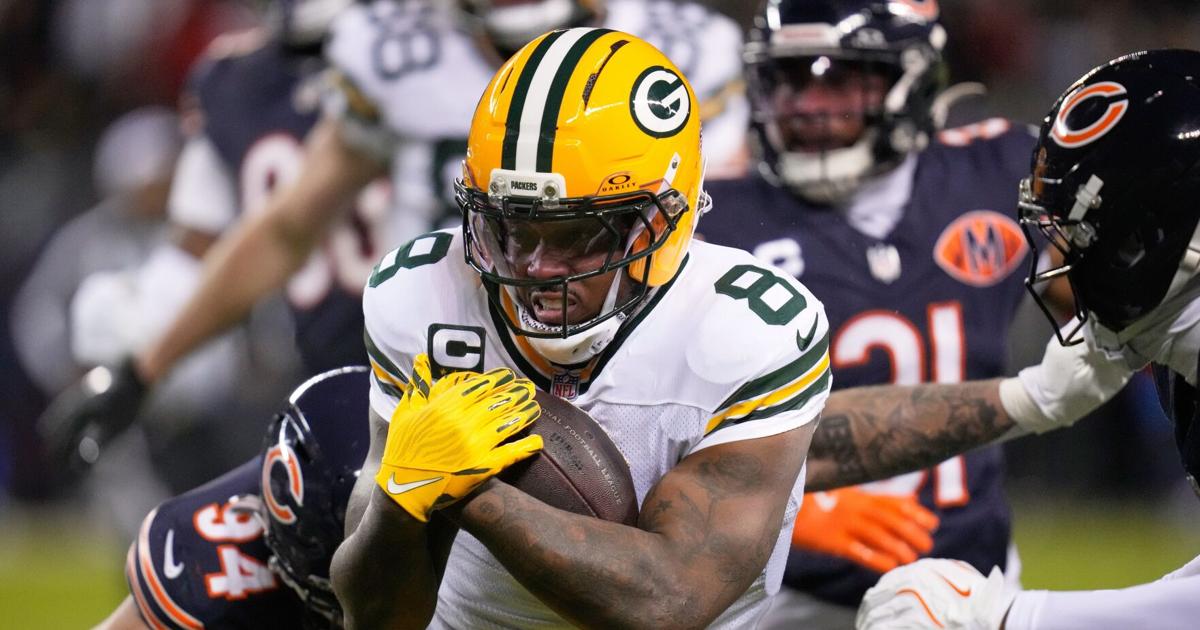
GREEN BAY — Josh Jacobs ran for exactly 400 fewer yards last year than he’d gained in his first season with the Green Bay Packers, and that dip in productivity could be traced to two causes.
One, the Packers’ often ramshackle offensive line, which ranked 23rd in the 32-team NFL in run-blocking efficiency (and 26th in pass-blocking success rate) based on Pro Football Focus’ metrics.
And two, Jacobs spent the second half of the season battling a myriad of injuries, with a bone bruise in his left knee being the most painful and problematic.
After rushing for 1,329 yards and 15 touchdowns in 2024, Jacobs missed two games and parts of several others with those injuries, sustaining the knee injury against the New York Giants in mid-November. Coupled with the inconsistent play up front, Jacobs finished the year with 929 rushing yards and 13 touchdowns.
While his teammates and coaches appreciated and respected his play-through-the-pain approach — Jacobs is such a we-not-me guy that he volunteered to return kickoffs in the team’s season-ending NFC wild card playoff loss to the Chicago Bears on Jan. 10 — the decreased production was concerning, especially for a player who turned 28 on Feb. 11 and whose bruising running style entails lots of contact.
“Josh always puts the team before himself every single time,” star edge rusher Micah Parsons said in November. “He’s always been that guy to be like, ‘I’m pushing through it. I’m putting my life out here for y’all,’ and let us know how much he cares about us. That shows you his mental toughness, what he brings to this team, what he brings to the game, and you see it in his play style. His play style is aggressive as hell.
“That’s how he attacks his treatment, that’s how he attacks his practice regimen. That means a lot having one of your leaders out there on the field. Knowing what he’s going through, that’s challenging as hell, but that’s kind of the guy he is, and I couldn’t be more happy to be his teammate.”
To wit: For the second straight year, Jacobs had more yards after contact (470) than he had before contact (459) for the second straight year. In his last two years with the Las Vegas Raiders before coming to Green Bay, he had more yards before contact than afterward.
“I feel like the big thing about me, and when it comes to the guys in this locker room, is there’s certain respect level that we have to have for each other and for our craft. And for me, man, it’s big,” Jacobs said. “It’s hard for me to be able to look at somebody in their eyes and quit on them — or look at them in the eyes and be like, ‘Man, I didn’t give it everything I had for you.’
“You know, we’re in this together, and that’s something that I always been a big stickler of because, even now, I’m taking less practice reps, and another guy’s got to get up and do more. And that affects him and his body and everybody else. So it’s not wanting to let nobody down, but it’s also having the mentality to still want to be great and excel in everything you do.”
Despite his heart being in the right place, Jacobs’ running style undeniably puts him in greater danger of injury than backs who shy away from contact or are able to limit the direct hits they take.
And after allowing Emanuel Wilson to walk in free agency — Wilson joined the defending Super Bowl-champion Seattle Seahawks, who are looking to replace Super Bowl MVP Kenneth Walker III, on a one-year, $2.1 million deal — the Packers’ plans for backing up Jacobs are unclear.
In his first NFL start, Wilson ran for 107 yards and two touchdowns on 28 carries in a win over the Minnesota Vikings, but the Packers made little effort to keep him.
The Packers did bring back veteran Chris Brooks, who signed a two-year, $4.85 million extension before free agency started. But Brooks is more of a third-down back and special-teamer, and had fewer carries (27) and rushing yards (106) for the whole season than Wilson had against the Vikings.
Then, there’s third-year back MarShawn Lloyd, whose first two NFL seasons have been completely derailed by injuries.
After starting his rookie training camp on the non-football injury list with an offseason hip injury, the 2024 third-round pick was sidelined for the back half of camp and the season opener against the Philadelphia Eagles in Brazil after suffering a hamstring injury during his one preseason game appearance.
Lloyd made his NFL regular-season debut in Week 2 against the Indianapolis Colts at Lambeau Field, but only played 10 snaps and carried six times for 15 yards before an ankle injury ended his day. The Packers put him on injured reserve two days later.
And then, on the verge of being activated from IR, he underwent an emergency appendectomy and never played again.
Then last season, Lloyd suffered a training-camp calf injury that put him on injured reserve to start the year, then suffered a hamstring injury in December and wound up missing the entire season.
As a result, he’s played in just one of a possible 36 games (including playoffs) during his time in the NFL.
“It’s one of those things that’s very, very, very unfortunate because this guy has worked his ass off to battle back,” head coach Matt LaFleur said at the time. “To be in that spot again, it’s just, what do you say to him?
“We’ll continue to investigate and try to figure out why this keeps occurring but it’s certainly unfortunate, and I feel bad — I really do. I feel extremely bad for MarShawn.”
While general manager Brian Gutekunst still spoke highly of Lloyd at the annual NFL Meetings in Arizona, he also made it clear that the running back room needs reinforcements.
“We’re certainly going to add competition to that room,” Gutekunst said. “There’s guys we really like, but I’m sure there will be more competition to come.”
Packers depth chart
8 Josh Jacobs RB 5-10 223 28 8 Alabama
30 Chris Brooks RB 6-1 219 26 4 BYU
32 MarShawn Lloyd RB 5-9 220 25 3 USC
22 Pierre Strong Jr. RB 5-11 207 27 4 South Dakota State
26 Damien Martinez RB 6-0 217 22 1 Miami
Best in class | Jeremiyah Love, Notre Dame.
Love figures to be the only running back to go in the first round, and with good reason. The Heisman Trophy finalist is coming off a 1,372-yard, 18-touchdown season in his third and final year in South Bend, and his speed (a 4.36-second 40-yard dash), explosiveness, cutting ability and balance make him the kind of big-time weapon offenses seek.
“I bring receiving ability, running ability, blocking ability, and just overall, I feel like I’m a pretty good player,” Love said in the understatement of the year at the NFL scouting combine in February. “I can do anything you need me to do, and I’m willing to do anything for any team asks since I want to make sure that I’m giving team my all.
“You name it, I’m willing to do anything for any team to have success. Running backs are very valuable. I feel like that’s just being more and more recognized as of today. I want to be used as a weapon.”
Next men up | Jadarian Price, Notre Dame; Mike Washington Jr., Arkansas; Emmett Johnson, Nebraska; Kaytron Allen, Penn State; Jonah Coleman, Washington.
Pick to click | Kaelon Black, Indiana.
While Black is pegged to go sometime on Day 3 of the draft, long after his quarterback, Fernando Mendoza, is expected to go No. 1 overall, the 5-foot-9, 211-pound Black might be right in the Packers’ wheelhouse as a potential fifth- or sixth-round pick.
That’s probably why the Packers used one of their 30 allotted visits to the team’s Lambeau Field headquarters on Black, who ran for 1,040 yards and 10 touchdowns for the national champion Hoosiers.
Somehow, Black wasn’t invited to the NFL scouting combine, so that likely factored into the Packers’ decision to bring him to Green Bay on a visit. At his pro day on campus, he ran a 4.45-second 40-yard dash — plenty fast to merit a Day 3 pick.
“I feel like I can do it all — pass protect, catch the ball and run the ball,” said Black, who played for Hoosiers coach Curt Cignetti at James Madison before following him to IU. “I’m just ready to go out there and ball and show all the teams what I can do.”
History lesson | Over the past 26 drafts, starting in 2000, the Packers have drafted only 15 running backs, with Lloyd being the most recent. Three of them — Jamaal Williams (fourth), Jones (fifth), and DeVante Mays (seventh) were taken in the same 2017 draft — and the Packers have taken as many in the seventh round (five) as they have in the first, second or third rounds combined (five).
Of the three second-round picks — Brandon Jackson in 2007, Eddie Lacy in 2013 and Dillon in 2020 — only Lacy managed to eclipse the 1,000-yard mark in a season, doing so in 2013 and 2014.
Jones, meanwhile, had three 1,000-yard seasons and averaged 5.0 yards per carry — the highest average of any running back in Packers history with at least 100 attempts — before the Packers pivoted from him to Jacobs in 2024.
Given Jacobs’ impressive first season in Green Bay and the investment they made in Lloyd in the 2024 draft, it’s hard to imagine Gutekunst investing in the position in this draft.
PACKERS 2026 NFL DRAFT PREVIEW SCHEDULE
Sunday, April 12 — QUARTERBACKS
Monday, April 13 — RUNNING BACKS
Tuesday, April 14 — WIDE RECEIVERS
Wednesday, April 15 — TIGHT ENDS
Thursday, April 16 — OFFENSIVE LINEMEN
Friday, April 17 — DEFENSIVE LINEMEN
Saturday, April 18 — EDGE RUSHERS
Sunday, April 19 — LINEBACKERS
Monday, April 20 — CORNERBACKS
Tuesday, April 21 — SAFETIES
Wednesday, April 22 — SPECIALISTS
Thursday, April 23 — DRAFT DAY PREVIEW
COPYRIGHT 2026 BY CHANNEL 3000. ALL RIGHTS RESERVED. THIS MATERIAL MAY NOT BE PUBLISHED, BROADCAST, REWRITTEN OR REDISTRIBUTED.