
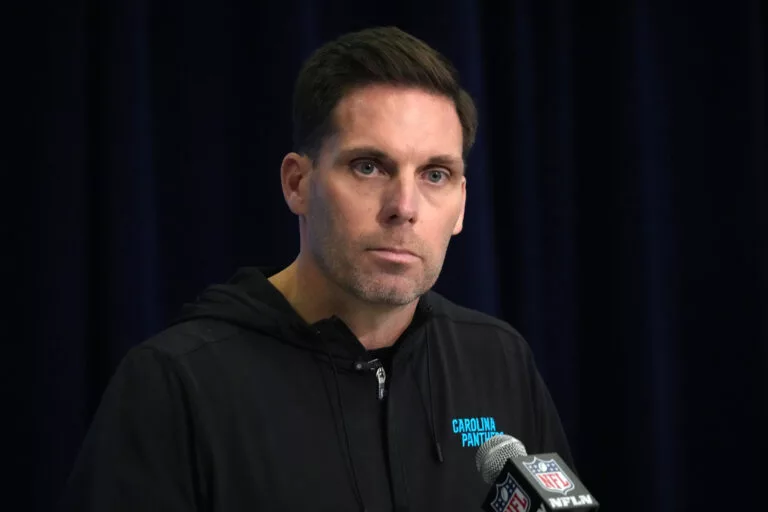
The Carolina Panthers’ roster build heading into 2026 hasn’t just been about adding talent but about adding the right talent.
If free agency is any indication, Dan Morgan and the front office have shown a clear willingness to address team needs with patience and targeted acquisitions. Now, with Bryce Young established as the franchise quarterback, every move must support stability, development, and immediate impact.
That means avoiding prospects who are high-risk, poor scheme fits, or redundant within the current roster.
In a draft class built on upside, the real advantage comes from discipline. Knowing not just who to draft, but who to avoid.
Top Needs Heading Into the Draft
Safety
Wide Receiver
Defensive Line
Carolina re-signed safety Nick Scott, but coverage limitations remain despite his 111 tackles (second on the team). At wide receiver, the team still needs a reliable complement to Tetairoa McMillan and Jalen Coker.
Along the defensive front, even after adding Jaelan Phillips, the need for a consistent pass rush remains. As Dan Morgan has emphasized, you can never have too many pass rushers.
This creates a key question early in the draft:
Do the Panthers continue building the defense or prioritize giving Bryce Young more weapons?
If Carolina stays at pick 19, positional value versus roster need becomes critical. Free agency leaned heavily toward defense, but safety remains a gap. Still, if a top offensive weapon like Kenyon Sadiq is available, the temptation to support Young becomes very real.
Prospects the Panthers Should Avoid
Akheem Mesidor (EDGE, Miami)
Mesidor is productive and experienced, but his ceiling is limited compared to younger edge prospects. Mesidor has 1st-round talent, but many teams have him lower on their boards because of his age. For a team needing long-term impact players, investing in a lower-upside edge rusher carries risk.
This becomes a bigger issue when you consider the Panthers already lack high-end pass rush production and need difference-makers, not rotational ceilings.
High-Risk Defensive Tackles
Zxavian Harris (Mississippi)
Harris brings rare size and length, but his pad level and leverage issues consistently show up against stronger interior linemen. As a result, he struggles to anchor in the run game and limits his early-down reliability.
Caleb Banks (Florida)
Banks flashes high-end ability, but inconsistency remains a concern. His impact varies too much week-to-week for a team that needs dependable production.
Panthers Fit Concern: Carolina needs stability, not projection. Drafting defensive tackles who require multiple years of development doesn’t align with a team trying to improve now.
This becomes a bigger issue when you consider how much pressure that puts on the rest of the defensive front to compensate early.
Running Back Overinvestment
Prospects like Le’Veon Moss, Kaytron Allen, and Rahsul Faison offer intriguing traits, but each comes with limitations in durability, explosiveness, or versatility.
Panthers Fit Concern:
With Chuba Hubbard and A.J. Dillon already in place, using valuable draft capital on another running back would be inefficient. League trends continue to show productive backs can be found later in the draft.
This becomes a bigger issue when you consider how valuable those picks are for positions with higher impact on winning.
Wide Receiver Risk Evaluation
Jordyn Tyson (Arizona State/Colorado)
Tyson is one of the most dynamic WR prospects in the 2026 class, showcasing elite route running, fluid movement skills, and strong ball tracking ability. At 6’2”, 203 pounds, he projects as a versatile receiver who can win both inside and outside the formation, consistently creating separation with nuance rather than raw speed.
He thrives as a smooth route technician who attacks leverage, snaps off breaks cleanly, and adjusts well to the football in the air. However, his effectiveness is heavily tied to timing and separation, as he can struggle when corners get hands on him early in routes. His ability to win against physical press coverage remains inconsistent, which can disrupt his rhythm at the line of scrimmage.
Panthers Fit Concern:
The biggest concern with Tyson is durability. A history of major lower-body injuries, including knee and collarbone issues, raises long-term availability questions for an offense that needs reliable targets for Bryce Young. While the talent is first-round caliber, the injury profile introduces significant risk for a team prioritizing stability and availability.
Tyson has clear WR1 traits, but in Carolina’s situation, the medical and physical concerns make him a high-variance projection rather than a safe foundational piece.
Tight Ends Without Complete Skill Sets
Eli Stowers (New Mexico State)
An athletic receiving threat, but limited as a blocker.
Michael Trigg (Baylor)
Flashes as a pass-catcher, but lacks consistency in the run game.
Panthers Fit Concern:
Carolina needs complete tight ends who can contribute in both phases. One-dimensional players reduce offensive flexibility and make play-calling more predictable. The use of motion will be increased this year, and because of that, Tight Ends that can block have to be added to the roster.
This becomes a bigger issue when you consider how much the offense relies on balance to support Bryce Young.
Redundant Quarterback Investment
Diego Pavia (Vanderbilt)
Pavia is a tough, mobile playmaker, but his game is heavily dependent on structure and improvisation that doesn’t consistently translate to the NFL. He struggles with timing-based throws, full-field reads, and operating within a structured passing system.
Panthers Fit Concern:
Carolina needs a quarterback who can function within the offense, not one who requires the offense to adjust to him. Drafting Pavia would introduce unnecessary risk and redundancy behind Bryce Young.
Developmental Offensive Tackles
Blake Miller
A solid prospect, but more developmental than immediate-impact.
Panthers Fit Concern:
Carolina cannot afford to wait for offensive line help. Protecting Bryce Young requires players who can contribute early and not be long-term projects.
This becomes a bigger issue when you consider how much pressure instability can place on a young quarterback.
Scheme-Mismatch Safeties
Emmanuel McNeil-Warren (Toledo)
McNeil-Warren is one of the more intriguing prospects in this class. At 6’4” with 214 tackles, five interceptions, and nine forced fumbles, his size and production stand out.
He thrives as a downhill, physical defender with strong instincts in zone and a clear ability to create turnovers. However, his limitations show up in man coverage, where quick receivers can separate, and in space, where tackling and reaction timing can be inconsistent.
Panthers Fit Concern:
In a 3-4 scheme, Carolina needs versatility on the back end, not a true box safety. His skill set is better suited for a role-specific defense rather than one that demands coverage flexibility.
McNeil-Warren has value, but not in this system.
Better Fits for the Panthers in the 2026 NFL Draft
Avoiding the wrong players only matters if you replace them with the right ones.
Edge Rusher – T.J. Parker (Ohio State)
A polished pass rusher with speed and technique. Parker provides what Carolina needs most: a consistent edge pressure.
Tight End – Kenyon Sadiq (Oregon)
A complete tight end with athleticism, blocking ability, and run-after-catch upside. He fits Bryce Young’s style perfectly.
Wide Receiver –Zachariah Branch (Georgia/USC)
A dynamic, explosive threat frequently used for YAC in the slot.
Safety – Dillon Thieneman (Oregon)
A versatile safety with range, instincts, and playmaking ability, an ideal fit for Carolina’s defensive needs.
Center – Logan Jones (Alabama)
Physical, experienced, and reliable. Jones adds immediate stability to the interior offensive line.
Quarterback – Haynes King (Georgia Tech)
Haynes King fits what Dan Morgan is looking for in a mobile quarterback, bringing toughness, athleticism, and value in situational packages.
Summary Strategy for Carolina
For the Carolina Panthers in the 2026 NFL Draft, the approach must remain disciplined:
Prioritize immediate contributors in the trenches
Add pass rushers who can consistently win
Target defensive backs with coverage versatility
Build around Bryce Young with reliable weapons
This isn’t about chasing upside but about minimizing risk while maximizing fit.
The Last Word on Avoiding Drafting Players
The difference between a good draft and a great one often comes down to restraint.
For Carolina, the goal in 2026 isn’t to win headlines. It’s to avoid mistakes that slow down progress. High-risk prospects, redundant positions, and poor scheme fits can quietly derail a rebuild just as much as missing on a top pick.
Instead, the Panthers must stay disciplined, trust their evaluations, and prioritize fit over flash.
Because at this stage, success won’t come from taking unnecessary risks.
It will come from making the right decisions, and just as importantly, avoiding the wrong ones.