
The Minnesota Vikings’ draft plans haven’t been too difficult to pin down in recent years. This one is different.
It’s not just that interim general manager Rob Brzezinski is leading the charge alongside coach Kevin O’Connell and college scouting director Mike Sholiton. It’s also that Minnesota needs depth at most positions. Unpredictability abounds, especially with the Vikings’ first-round selection and the lack of consensus blue-chip prospects.
That makes this all the more fun. It’s ripe for surprise.
Each year, we put together a final seven-round mock at the beginning of draft week. Here is our last go-around at the Vikings’ nine projected picks:
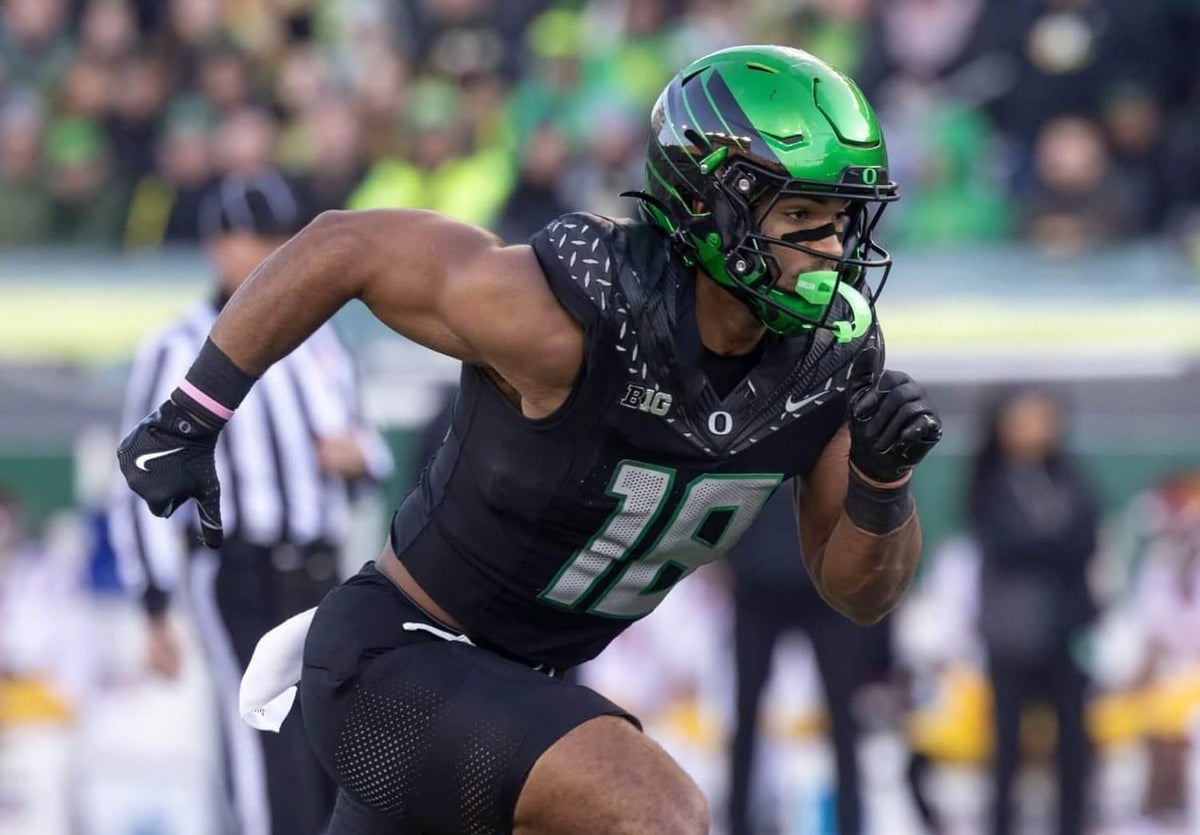
Round 1, No. 18: Kenyon Sadiq, TE, Oregon
Do the Vikings need another offensive weapon? No. Would Sadiq bring a unique skill set to the Vikings? Absolutely.
The 21-year-old is a special athlete. He reached 23.24 miles per hour at the NFL Scouting Combine, according to Next Gen Stats, the fastest of any tight end in recent years. Vertical speed matters. Sadiq can reach areas of the field that others couldn’t. It opens up more intermediate and underneath spaces for other pass catchers.
In recent seasons, NFL teams have been trending toward heavier bodies. Sadiq will give any team 12 personnel and 13 personnel versatility because of his willingness to block. His ability to sift through traffic and snatch defenders in space also provides flexibility to line him up in the backfield as a quasi-fullback.
Vikings tight end T.J. Hockenson might have more feel in zone pockets. This team, though, has an evolving offense. And Hockenson is only under contract through the 2026 season. Sadiq would offer a big-bodied target for Kyler Murray, a quarterback who has thrived throwing to the position since he entered the NFL in 2019. Pair his positional flex with superstar receiver Justin Jefferson for the next five seasons, and the Vikings will have two unique body types and movers who would feed off of one another.
Nothing is a guarantee at No. 18. A coveted defensive player could fall, or the Vikings could trade back into the late first round, where there are multiple prospects they hold in high regard. We’re taking the stick-and-pick route throughout this exercise.
Round 2, No. 49: Treydan Stukes, CB/S, Arizona
If the Vikings select an offensive player at No. 18, it makes sense to move to the other side of the ball at No. 49.
The only question here is whether Stukes will reach this spot. While prospects don’t tend to rise, Stukes’ name has emerged more and more as defensive staffers around the NFL have raved about the toolsy defensive back.
Stukes played in 52 college games at Arizona. He has the traits to line up as a nickel corner or a split-field safety in defensive coordinator Brian Flores’ scheme. This flexibility matters. There is uncertainty around Harrison Smith’s status. Meanwhile, Josh Metellus thrives as a box player. Stukes’ presence would allow the chess pieces to move around with ease.
Stukes tracks the ball like he has the passing coordinates. He also recognizes route concepts and screens from depth. The combination of intangibles and fluidity makes him a no-brainer candidate if he’s available. Take a defender at the top, and a receiver like Ole Miss’ De’Zhaun Stribling or Alabama’s Germie Bernard becomes a realistic option here. Another fascinating scenario features Notre Dame running back Jadarian Price being the pick here.
Round 3, No. 82: Kaleb Elarms-Orr, LB, TCU
Why would the Vikings take an off-ball linebacker with one of their premium picks?
The team has yet to extend Blake Cashman and is lacking depth behind him and Eric Wilson. Teams can find value with off-ball linebackers in the middle rounds, and Elarms-Orr led the Big 12 last season with 130 tackles. He can drop into zones and converge on the football. There is still upside, considering the 22-year-old didn’t begin playing the position until 2023.
And he is like all of the other picks here in that he passes the character tests the Vikings look for. Dane Brugler, The Athletic’s draft expert, quoted an NFL scout who said, “He was the hardest worker on the team. … Big ‘extras’ guy — film, lift, training, everything.”
This is an interchangeable pick, depending on what happens earlier. Opt to wait to take a defensive back, and USC’s Kamari Ramsey and South Carolina’s Jalon Kilgore could be available in this range. Finding a defensive tackle here isn’t out of the question, either. Florida State’s Darrell Jackson Jr. is massive, experienced and productive.
Round 3, No. 97: Emmett Johnson, RB, Nebraska
The Vikings have a choice to make as they explore the running backs in this draft. Go for the hyper-explosive, change-of-pace player? Or go with the more well-rounded skill set?
Arguments can be made for both, but Johnson fits the latter category. The 22-year-old’s addition would mean long-term stability as well as insurance for running back Aaron Jones in the short term. He is a stellar receiver out of the backfield. In 2025, he ranked second among FBS running backs with 46 receptions. Lose Jones, and the Vikings would not have to remove any of their game-plan-specific passing concepts.
Johnson isn’t a perfect prospect. His pass protection will require work, and the top-end speed is lacking. Neither of those, however, matters as much as making sure the Vikings have a baseline at the position in the present and future.
Wait for a running back later on, and the Vikings could seek a prospect like Washington’s Jonah Coleman or Wake Forest’s Demond Claiborne.
Round 5, No. 163: Parker Brailsford, C, Alabama
What would be the biggest surprise of the draft for the Vikings? If they completely pass on a center.
This class is loaded with potential starters at the position. Brailsford isn’t the most prominent name, but the Vikings are transitioning to a more wide-zone-based offense, and that’s why Brailsford makes sense.
He fires off the ball and plays with elite vision when climbing to the second level. His 6-foot-2, 289-pound frame is a bit of a concern, but two of the game’s best in Tyler Linderbaum of the Las Vegas Raiders and Aaron Brewer of the Miami Dolphins entered the NFL with similar statures. Brailsford is intelligent enough to control some of the pre-snap operation of O’Connell’s offense.
In making this pick, the Vikings would be betting on the coaching and development of assistant head coach Frank Smith and offensive line coach Keith Carter. Opt for a center earlier, and Iowa’s Logan Jones, Kansas State’s Sam Hecht, Florida’s Jake Slaughter or Auburn’s Connor Lew could all be candidates.
Round 6, No. 197: Jalen Huskey, S, Maryland
Safety is one of the Vikings’ primary needs, but that doesn’t mean they have to fill that hole at the top of the draft. There are plenty of intriguing late-round options with awareness and smarts. Huskey is one of them.
He began his career as a cornerback at Bowling Green, then transitioned to safety at Maryland. Huskey has played 45 college games. He snatched at least three interceptions in each of the last three seasons.
Minnesota will also have exceptional intel on Huskey. The team’s new assistant special teams coordinator, Chili Davis, held the same role with the Terrapins. He will offer perspective on Huskey’s role as the signal caller on the back end of Maryland’s defense. Huskey offers what Flores looks for in safeties: interchangeability, reliability and smarts. If Huskey is plucked from the board, similar high-floor prospects — like Indiana’s Louis Moore, Oregon State’s Skyler Thomas and USC’s Bishop Fitzgerald — could emerge.
Round 7, No. 234: Nick Barrett, DT, South Carolina
NFL staffers don’t love this defensive tackle class. Brzezinski has said the team won’t manufacture something that’s not there, so it doesn’t make sense to force the issue at the position simply because it’s a need. Barrett is a worthwhile late-round flier. He has standout traits to play on the interior. Specifically, his 33-inch arm length and lateral quicks are worth building on. His college playing experience pales in comparison to most of the prospects on this list, having only started 12 games. That said, this is an easier bet to make at this late stage.
Receivers coach Keenan McCardell has a knack for studying wideouts in the draft. Seventh-rounders are like penny stocks. Why not let McCardell take a chance? Wallace, soon to turn 23, held a pivotal role in Lane Kiffin’s offense in 2025, leading the Rebels in receiving with instinctiveness and savvy.
Round 7, No. 244: Jalen McMurray, CB, Tennessee
Undersized cornerbacks haven’t scared Flores in the past. Tennessee has two potential first-rounders in Jermod McCoy and Colton Hood, but McMurray is as feisty as those two. His 5-foot-10, 179-pound frame may limit him, but he’s the type of player who would push the rest of the pack for a roster spot during training camp.