
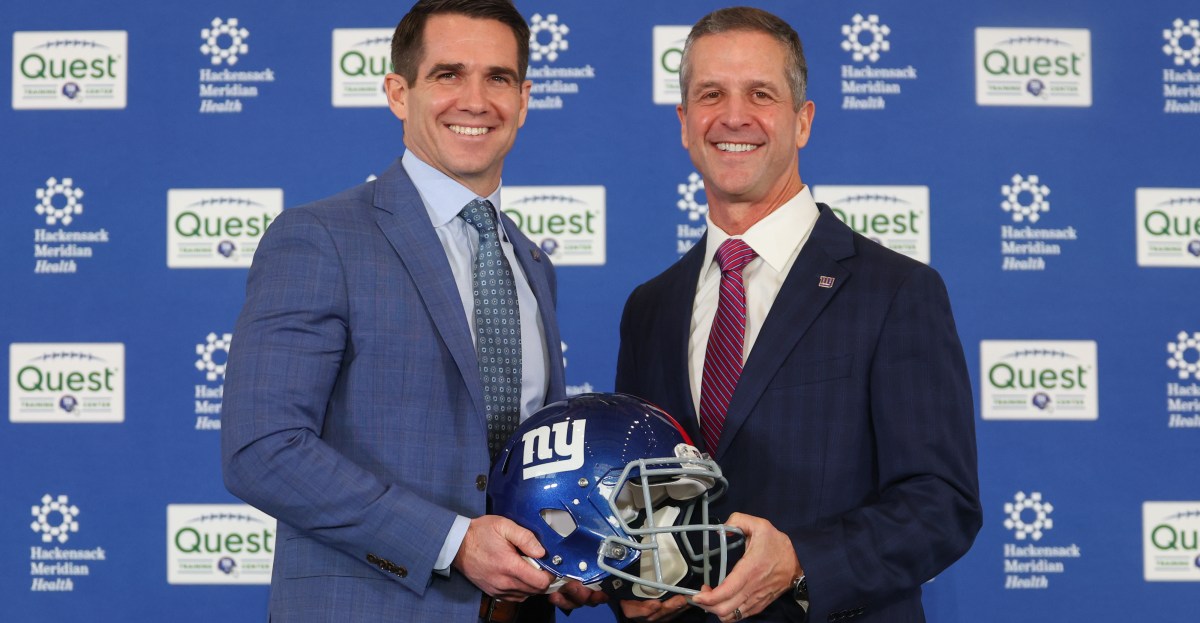
We’re almost at the end of a long, winding, and surprisingly wild path to the 2026 NFL Draft.
The path for the Giants started when Brian Daboll was fired in November, and continued through the stunning hire of former Baltimore Ravens coach John Harbaugh. Since then, the Giants have given their organization a much-needed facelift and navigated a free agency period that was more about “tinkering” with a roster Harbaugh believes is ready to compete.
Now we, and the Giants, are on the eve of the 2026 NFL Draft, and a new era of New York Giants football.
Nothing happens in a vacuum, and the draft is no different.
(Note: Please read this before jumping to the picks. This is essentially a “Philosoraptor’s Corner” and a mock draft in one. I’m incorporating a lot of piece-fitting with regards to the Giants’ coaching staff and free agent additions.)
The Giants’ free agent signings appeared to be more about plugging holes and setting the stage for the draft.
So before we get to my mock draft, I want to look at how the stage was set.
Team needs: WR, iDL, OG depth, CB depth
Defensive tackle depth was always a need for the Giants, however the trade of Dexter Lawrence promoted it from a need to a priority. I am, and have been, of the opinion that wide receiver is the single biggest need on the roster, even after signing Darnell Mooney and Calvin Austin III.
Any faith in the Giants’ receiving corps rests upon the return of Malik Nabers. However, the fact that he needed a full meniscus repair in addition to repairing his torn ACL complicates matters. He should be cleared to return in time for the season, but we just don’t know whether he’ll have the full measure of his athleticism back. Likewise, we don’t know if the damage to his meniscus impacts his long-term prognosis.
In my view, the Giants can’t simply assume Nabers will return and everything will be fine.
Turning to the cornerback and interior offensive line positions, I suspect the Giants may be more confident in their work there than many on the outside seem to be.
The Giants signed former first-round pick Greg Newsome II to compete with fellow former first rounder Deonte Banks for the starting cornerback job. One-year contracts can’t be viewed as fliers in the modern NFL. Players and agents have realized just as well as teams that the salary cap is rising, and players preferring short-term contracts to give them greater access to a market that keeps rising.
I also want to call attention to the fact that Dennard Wilson is a disciple of what Cody Alexander (of the excellent MatchQuarters substack) has dubbed the “Baltimore 2.0” defense, perfected by Seahawks head coach Mike MacDonald. One of the hallmarks of that defensive scheme is aggressive cornerback play and a high rate of “step coverage”. That is, coverage in which the cornerback is just a step or two away from the receiver and the goal is to force tight window throws. Newsome II has shown upside in man coverage with the Browns, while Banks was one of the best corners in forcing tight window throws.
It’s also worth noting that the Giants hired former Denver Broncos cornerbacks coach Addison Lynch and Kansas City Chiefs defensive backs coach Donald D’Alesio. Both defenses have excelled at developing young cornerbacks as well as employing aggressive man coverage.
Improved coaching and a better scheme could help the Giants’ young DBs (Newsome, Banks, Dru Phillips, and Tyler Nubin) to play up to the potential we saw from them earlier in their careers.
The Giants signed a bevy of players to compete for their right guard job.
Daniel Faalele started every game over the last two years for Harbaugh with the Ravens. At the same time, the Giants also signed Evan Neal and Joshua Ezeudu, and Harbaugh told both that they’d have the opportunity to compete.
The Giants might not view right guard and cornerback as glaring needs.
It’s been widely speculated that the Giants could trade down early in the draft, at least if they found the right partner. I don’t think the trade of Lawrence for the 10th overall pick changes that calculus. The Giants don’t have a pick between 37th and 105th overall after sending their third-round pick to the Houston Texans as a part of the trade to acquire Jaxson Dart.
We have talked a lot about Harbaugh bringing aspects of the Baltimore Ravens’ culture to the Giants. While the Ravens are certainly excellent at identifying talent, their real super power has been their patience. They’re patient in waiting for the draft to come to them and are patient in how they develop the players they acquire. I believe the Giants will trade down from one of the fifth, 10th, or 37th picks to afford the team the time and opportunity to be patient, as well as acquire more young players to build going forward.
Which pick will likely depend on how the board breaks ahead of them and the trade package offered.
(As usual, I’m using PFSN’s mock draft simulator)
Fernando Mendoza (QB, Indiana)David Bailey (EDGE, Texas Tech)Arvell Reese (EDGE, Ohio State)Rueben Bain Jr. (EDGE, Miami)
Round 1 (No. 5) – Sonny Styles, LB, Ohio State
This pick makes sense from three different perspectives: Player, Analytics, and Person.
One of the other aspects of the “Baltimore 2.0” scheme is the use of highly athletic and versatile defenders to disguise their plays and dictate terms to the offense. In Seattle that was Nick Emmanwori, while Kyle Hamilton filled that role for the Ravens. Styles is a former safety who has spent the last two seasons as a linebacker in a sophisticated NFL-style defense.
He brings prototypical linebacker size with truly elite athleticism. He has the ability to come down and flow to the ball in the run game, match up with tight ends and running backs in coverage, drop back into deep zones, and rush the passer.
Next, I want to call attention to the fact that while many have focused on Dawn Aponte’s role in managing the salary cap, she also heads up the Giants’ bolstered analytics department. Harbaugh was one of the first NFL head coaches to fully buy into the use of analytics, and data analysis played a significant role in just about every part of the Ravens’ operation.
Styles has an excellent 2.2% missed tackle rate, which is a third of the Giants’ own 3rd-ranked 6.8 percent missed tackle rate. Styles excels at preventing “leaky yardage”, and he ranks second only to Jacob Rodriguez among top linebacker prospects in Coverage and Run stops. Styles also pressures the quarterback at a similar rate as teammate Arvell Reese. Styles has had 143 pass rush snaps, producing 31 total pressures (7 sacks, 1 hit, 23 hurries), while Reese has had 122 pass rush snaps, producing 30 total pressures (11 sacks, 3 hits, 16 hurries).
Finally, Styles is highly regarded as a young man. He reportedly “crushed” his interviews and is regarded as a leader and tone-setter in the Ohio State locker room. Harbaugh wants players who are committed and love every aspect of being a football player, and Styles certainly seems to check those boxes.
My personal comparison for Styles is another freakishly athletic safety-turned-linebacker: Brian Urlacher.

Round 1 (No. 10) – Jordyn Tyson, WR, Arizona State
This is a pick I was heavily conflicted about making. Partly because of the uncertainty around the player, but also because I was confronted with a very tempting trade scenario.
First about the player; I have no qualms about taking Tyson at 10th overall if he’s healthy. He is absolutely worth that pick thanks to his combination of size, speed, agility, quickness, and the skill with which he uses those traits. Adding a receiver of Tyson’s caliber both splits the load with Nabers and would truly unlock the Giants’ offense.
NFL defenses have largely pivoted to split-field coverages, using two deep safeties to cap explosive passing games in the wake of the early dominance of Pat Mahomes, Lamar Jackson, and Josh Allen. In doing so, they also ceded the underneath area of the field to running backs, slot receivers, and tight ends. That’s the reason for the return of the running game to prominence.
As things stand now, the Giants don’t have a second receiver who can force opposing defenses to pick their poison. And within their own division, the Giants don’t have a player who can consistently beat Quinyon Mitchell, Riq Woolen, or Cooper DeJean in 1-on-1 coverage if Nabers is double-covered.
Adding Tyson would allow the Giants to force the Eagles into two double coverages, leaving a neutral or light box to defend the run (again, I’m presuming the Giants have more faith in the right guard position than fans or the media), or to be carved up by Isaiah Likely, Mooney, Tyrone Tracy, Cam Skattebo, or Theo Johnson.
I do believe the reports that Tyson is The Giants’ Guy. Never mind what people say – they lie all the time, especially this time of year. But a general manager isn’t flying out to Arizona to have dinner with a prospect a week before the draft just to establish a smoke screen.
And that brings me to the trade offer.
The Kansas City Chiefs traded back from 9th overall to 24th overall with the Cleveland Browns. The Browns took Carnell Tate No. 6 overall, then jumped back up to 9th to take Francis Mauigoa (which is a home run first round for them).
The Chiefs, in turn, are offering me 24th and 29th overall. I’m rejecting the offer because a compound trade scenario like that is a bit too unrealistic (or perhaps unlikely). However, it does show that this pick is an absolute wildcard. I believe this pick is up for sale if Tyson is gone or the Giants aren’t quite as convicted (to use a Schoenism) on him as I believe.
Round 2 (No. 37) — TRADE!
As I said, I expect the Giants to trade out of one of their first three picks, and this is it.
Giants get: Picks 53 and 76
Pittsburgh Steelers get: Pick 37
Round 2 (No. 53) — Caleb Banks, iDL, Florida
I’m wary of taking two players with significant injury histories. But this is another case where, if the Giants’ medical staff is fine with it, then so am I.
As I wrote when Lawrence requested his trade, Banks is the only defensive tackle in this draft class that has the potential to actually replace Lawrence. He has, easily, the most upside of any defensive tackle in the draft, and might have the highest upside of any defensive tackle since Jalen Carter. Humans who are 6-foot-6, 327 pounds with 35-inch arms, a 32-inch vertical, and a 5-second 40 just don’t come along every day.
He is an absolute game wrecker when he is healthy and playing up to his potential – Just ask Jaxson Dart, considering Banks sacked him 2.5 times when Ole Miss played Florida in 2024.
The foot problems worry me, but the fact that he still put up a historic workout with a fracture is “Julio Jones” levels of absurd. This is a calculated risk, but I’m betting on Harbaugh’s coaching staff to have a plan to develop him as well as keep him healthy.
Also, I’m not done yet.
Round 3 (No. 76) — Domonique Orange, DL, Iowa State
This is a slight reach according to PFSN’s big board, with Orange ranked 85th, so I was confident he would be there. This is also why I restrained myself and accepted only picks 53 and 76 in exchange for 34th overall. I know I could have gotten the 85th pick (also owned by the Steelers) plus a Day 3 pick, but I wanted to make sure I could get Orange.
‘Big Citrus’ is my insurance policy for Caleb Banks. Big Citrus presents a high-floor nose tackle to be the dependable rock if Banks’ injury concerns rear their ugly heads. But not only that, being able to rotate the young defensive tackles keeps snaps off of both of them and helps to limit Banks’ risk of injury. I also want to keep as many of my big defenders as fresh as possible for late in games, considering how often the Giants looked gassed in the five losses in which they led by double-digits last year.
Following up high-ceiling skill position players like Styles and Tyson in the first round with linemen on Day 2 also conforms to the Baltimore Ravens’ drafting habits.
Finally, the Front 7 of Darius Alexander, Domonique Orange, and Caleb Banks, surrounded by Brian Burns, Abdul Carter, Tremaine Edmunds, and Sonny Styles (as well as Kayvon Thibodeaux if the Giants extend him) would be the most freakishly terrifying defensive front in the NFL if they all hit their ceilings.
Round 4 (No. 105) — Fabechi Nwaiwu, G, Oklahoma
The Giants have a bunch of young players competing for the right guard position, and I do believe they’re comfortable with their baseline play they can expect from the group. But I also strongly believe that the Giants will invest in at least one developmental interior lineman.
My other consideration here was Kentucky guard Jalen Farmer due to his immense upside. However, Nwaiwu visited the Giants on a Top 30 visit, so I suspect he’s higher on their radar. The Giants will likely use a downhill power run game based on man-gap principles thanks to Greg Roman’s presence, and Nwaiwu fits that well.
He also offers three-tool versatility after a promising showing in an unplanned move to center in the College Football Playoffs due to injuries. The Giants probably like his willingness to do whatever his team needed, as well as his willingness to take any opportunity to compete.
“Febechi Nwaiwu is one of the most compelling Day 3 offensive line targets if you’re seeking reliability and positional versatility on the interior. A former walk-on at North Texas, Nwaiwu built himself up over a five-year collegiate career, and ended up being the only Oklahoma OL to start every single game across 2024 and 2025. Early in the season, Nwaiwu anchored at guard — sometimes switching between left and right guard in a pinch within games — before transitioning to center for the CFB Playoffs in the wake of injuries.
At center, Nwaiwu is still balancing snapping the ball and making swift hand contact, but he assuredly has the natural leverage, baseline flexibility, and anchor strength to potentially stick at the fulcrum. Meanwhile, at guard, Nwaiwu has the lateral mobility, heavy hand power, and clean technique to hold strong in pass protection, and he presents solid range, angle IQ, and ruthless driving physicality in the run game. At times, Nwaiwu displays moderate hip stiffness and peak athletic limitations, but his floor is exceedingly high, and he provides three-position flex inside.”
Round 5 (No. 145) — JC Davis, G, Illinois
I hadn’t intended to double up on developmental linemen and I was targeting Ephesians Prysock (CB, Washington) here. However, the Cardinals took him two picks prior. So, it’s on to Plan B.
Davis played tackle for Illinois but his future is inside at guard. He’s another swing at finding a developmental offensive interior lineman to establish a pipeline for the future, as well as bolster depth.
Davis not only visited the Giants, but he already has experience working his way up and paying his dues. Davis started his college career at the JuCo level, where he transitioned from defensive tackle to offensive tackle (similar to Tyler Linderbaum), before transferring to New Mexico, and finally Illinois. He distinguished himself and earned First Team All Conference honors at all three levels.
Davis is a big, powerful lineman at 6-foot-4, 330 pounds, with 34-inch arms, which should also appeal to the Giants.
“Davis is a bear in close quarters, with heavy hands, a strong anchor, good natural leverage and knee bend, and a wide frame that helps him control positioning. He’s relatively slow-footed and lacks high-end flexibility, and could end up seeing out a transition to guard as a result.
He also experiences lapses in upper-lower synergy with premature extensions at times. Still, Davis’ extensive collegiate experience has yielded him a strong operational floor, as well as great two-phase awareness. Immediately, he projects as a strong depth piece in gap and inside zone schemes, and he has a degree of starting upside at both tackle and guard, as a relatively immovable presence with line-resetting hand power and physicality”
My plan for the sixth round is to select high-upside players who can at least be good special teams contributors and trust Harbaugh’s coaching staff to get the most out of them. If even one hits, it should be a home run.
No. 186 – Daylen Everette (CB, Georgia)
I considered Everette with the 145th pick, so it’s (almost) a no-brainer to take him here. My only temptation is tight end Sam Roush, who I think Harbaugh would love. But, I do want to find a developmental cornerback, and Everette brings high athletic upside, a knack for making plays in big moments, and experience in a sophisticated defense against top competition.
No. 192 – Andre Fuller, CB, Toledo
Once again, I’m doubling down on developmental prospects in an area of potential future need. Fuller is a high-upside player with good size (6-foot-1, 200 pounds) and an explosive lower body. He has upside in man coverage, and the Giants are likely already familiar with him after scouting and drafting former teammate Darius Alexander.
No. 193 – Jeff Caldwell, WR, Cincinnati
Someone is going to take a swing on Caldwell, and I suspect it will be earlier than this. The 6-foot-5, 215-pound Caldwell is still raw as a receiver, but his athletic upside can only be compared to the likes of Calvin Johnson and Julio Jones.
Harbaugh spoke about building a “dynamic” offense around Dart, and the potential represented by him hitting and playing up to his ceiling is worth the swing. Even if there’s only a 5 percent chance of him realizing his potential, it’s well worth the flier at this point in the draft, and I probably wouldn’t even be upset with it in the fifth round.