
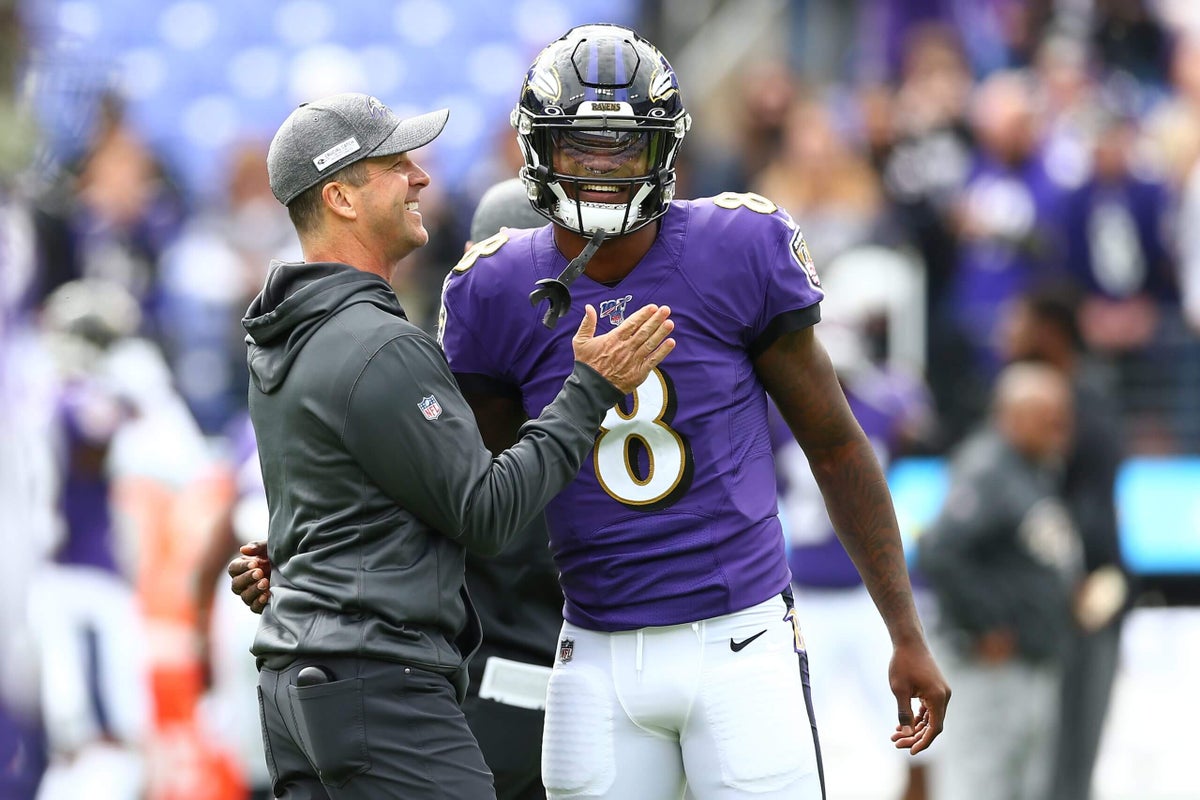
To understand the present, it’s often best to look at the past. So when thinking about a coach on the cusp of his first draft with a new NFL team in nearly two decades, there are lessons to be learned from John Harbaugh’s history in Baltimore.
Harbaugh was a part of 18 drafts with the Ravens, and the whole of his track record is important and telling. But, for this exercise, let’s narrow a scope to a single draft, when the Ravens were in a similar spot to where the New York Giants find themselves now.
The Ravens drafted quarterback Lamar Jackson with the final pick of the 2018 first round. It was a transformational moment for the franchise, and one the Giants are hoping to find after their late-first-round selection of quarterback Jaxson Dart last year. Obviously, the 2026 Giants are not the 2019 Ravens in 2019. The quarterbacks are different, and so are the general managers (the Giants have Joe Schoen, while the Ravens Eric DeCosta was in his first year as Baltimore’s GM in 2019).
But for those, like me, who weren’t following the Ravens closely seven years ago, or anyone for whom time has simply made things a bit blurry, it’s an interesting exercise to go back in the past just to look at how the Ravens handled their first draft with a new face of the franchise at QB — and then consider how Harbaugh might move forward.
A quick refresh: Heading into the 2018 draft, the Ravens had missed the playoffs for a third straight season behind quarterback Joe Flacco, who had been dealing with injuries and slipping production. It was time to start looking for Flacco’s successor, and the Ravens found that in Jackson. They made a deal with the Philadelphia Eagles as the first round wound down. Jackson took over the starting job midseason after Flacco suffered a hip injury, and Flacco never got it back.
The Ravens lost a home wild-card game to the Los Angeles Chargers, then completely altered their offense around Jackson that offseason. They traded Flacco to the Denver Broncos. Harbaugh fired offensive coordinator Marty Mornhinweg and replaced him with Greg Roman, then the team’s tight ends coach. As The Athletic’s Ravens reporter Jeff Zreibec noted, Roman oversaw the overhaul of the offensive playbook with things being “simplified or streamlined for Jackson” in some cases.
With eight total picks in the 2019 draft, the Ravens selected Marquise “Hollywood” Brown with the No. 25 pick. Two of their next three picks were used on offensive skill players: wide receiver Miles Boykin and running back Justice Hill. With their final draft pick, they added Trace McSorley to the quarterback room alongside Robert Griffin III, who had re-signed on a two-year deal. But the draft wasn’t just about getting players for Jackson, it was about getting good players as a whole.
“The goal for Harbaugh and Roman was obvious: create an offense that allows Jackson, a dynamic athlete, and a work-in-progress thrower and decision-maker, to play to his strengths” Zreibec wrote in 2019 of the offseason changes as a whole.
The changes helped ensure the Ravens stayed consistently good, but they never won a Super Bowl with the Harbaugh-Jackson pairing. Since Jackson was drafted, the Ravens made the playoffs six times but only advanced to the AFC Championship Game once. There were issues finishing big games, and the team and Harbaugh parted ways in January.
This time, Harbaugh inherited a quarterback, Dart, whom the Giants traded up for in last year’s first round. The rookie took over the starting reins in Week 4, replacing Russell Wilson. Harbaugh has been complimentary of Dart and expressed optimism in the team’s ability to build around him — just as the Ravens did with Jackson.
“It starts with building a system that’s going to be elegant and enough to handle all the complicated things that go with attacking defenses nowadays, but simple enough that the players can operate it in action, in battle, in the heat of battle … in a real effective way,” Harbaugh said last month. “One of the many great things about Jaxson Dart is he does so many things so well. I mean, he can live in a lot of different worlds.
“If you watch the offenses that we’ve had over the last many number of years, it’s built around a lot of different elements. There is a lot of different elements that Jaxson can play in. Power run, drop back pass, quarterback driven stuff, RPOs, quick ball out-type of completions, throw the ball downfield, throw it off the play-action. I’m not sure what he really can’t do.”
The Giants have plenty of experience on staff to put it together, including Roman, a senior offensive assistant, and Brian Callahan, the team’s passing game coordinator/quarterbacks coach who recently served as the Tennessee Titans head coach. Offensive coordinator Matt Nagy was a head coach for the Chicago Bears and was the OC in Kansas City with Patrick Mahomes. In New York, Nagy said the Giants will play a “physical” offense catered to the players’ strengths and that will get more personalized come OTAs and training camp.
“What I see from that is a really great mix of different things,” Nagy said. “I can’t tell you right now exactly what it’s going to look like. I can tell you, you know, this will be the first time that, again, that we’re putting this together. To me, as we’re going through this as a staff, I can say it really hasn’t been seen, which is a good thing, I think. What it is exactly, we have an idea big picture, but what it becomes through these players’ strengths we’ll have a direction. That’s the exciting part.”
Now, what does that mean with the draft this week? Just because they’re revamping around Dart doesn’t necessarily mean that will be the entire focus, especially when the defense has many areas that could use a boost. The Dexter Lawrence trade shook things up and opened options for New York, giving the Giants another top-10 pick to add a premium player, or to trade back and recoup more assets.
“We’re going to stack the board, and the best player available is the direction we’ll go,” Schoen said.