
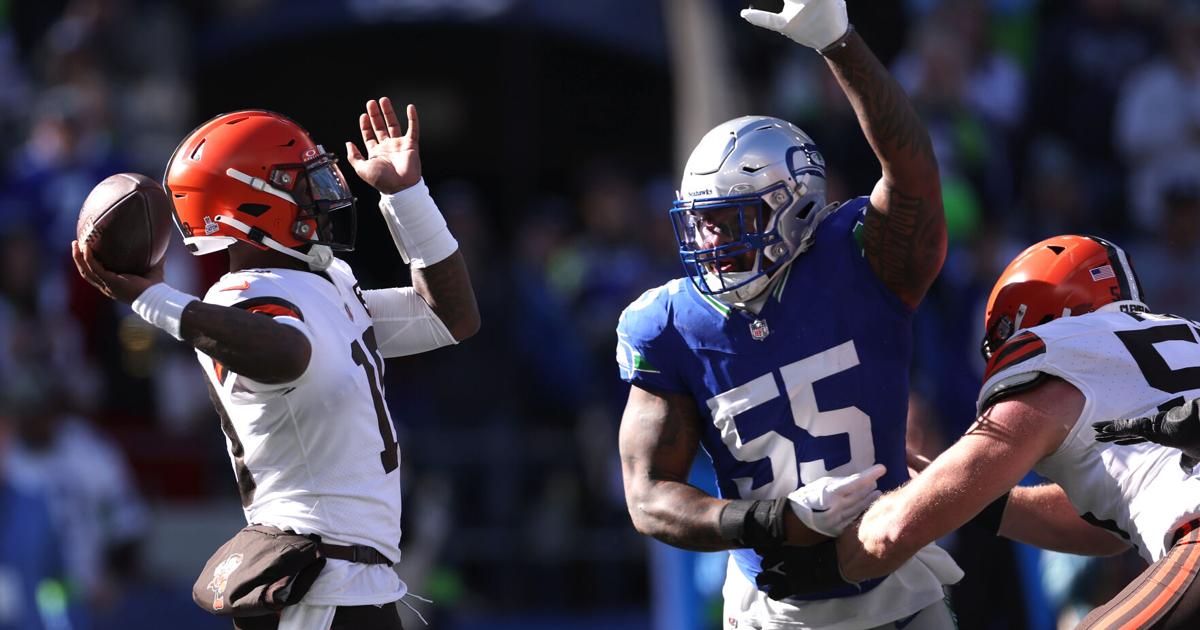
There is no doubt the Titans’ defense is bigger at the edge position this year than it was last season.
But does that necessarily mean the team has improved its pass rush?
That seems a key question, considering how Tennessee struggled to pressure opposing quarterbacks in 2024.
The Titans finished tied for 29th in sacks (32) last season, posted a 16.7 percent pressure rate that was 31st in the league, and earned a team-wide 62.1 pass-rush grade from Pro Football Focus — which ranked tied for 28th in the league.
Those woeful numbers, mind you, came with the help of edge rusher Harold Landry, who took his team-leading nine sacks to New England during the offseason.
The Titans’ preferred body type at edge became apparent during the offseason, when the team signed free agents Dre’Mont Jones (6-3, 281 pounds) and Lorenzo Carter (6-5, 265 pounds), while drafting Femi Oladejo (6-3, 259 pounds) in the second round.
In comparison, Landry was a little lighter and leaner at 6-2 and 252 pounds, as was Khalid Duke — cut during the offseason — at 6-3 and 246 pounds.
“It’s a bigger man’s game,” Titans defensive coordinator Dennard Wilson said of the team’s philosophical change.
“In order to play in this game, you got to crush the pocket, condense the pocket. You got to collapse the pocket. You have elite pass rushers in the National Football League that get paid a lot of money. But if you watch throughout the course of the playoffs and the Super Bowl, the guys that can collapse the pocket, that can knock it back in the `A’ and `B’ gaps and restrict it off the edge, [were] the guys that [were] having success.”
Wilson cited the example of thick-bodied Los Angeles Rams edge rusher Jared Verse (6-4, 260), who racked up 77 regular-season pressures as a rookie last season (fourth in the NFL), as a prototype of what the Titans are looking for.
“Our intention is to be more direct in the way we rush,” Wilson said. “[We want to] have a more balanced approach, no step-up lanes [for the quarterback], getting everybody to work as one up front. We have had a hell of a start doing that throughout the OTAs.”
The added size on the edge should give a boost to the team’s rushing defense, as opponents will likely find it harder to run outside. The Titans finished 26th against the run last season, allowing 133.9 yards per contest.
“You’re trying to set the edge of the defense,” Titans coach Brian Callahan said. “There’s a physicality that comes with it, especially in the run game.”
But will the Titans’ bigger bodies translate to more pressures and sacks?
Jones recorded 45 quarterback pressures last season, which ranked 34th in the league among edge rushers, per PFF. But he totaled only four sacks and, in his six NFL years, has never produced more than 6.5 sacks in a season.
Carter has 21.5 sacks over seven seasons, including five in 2021. But he wasn’t effective with Atlanta last season, recording zero sacks and seven pressures on 150 pass-rush snaps.
Oladejo would seem to offer plenty of potential, as PFF credited him with seven sacks and 33 pressures in 325 pass-rush snaps at UCLA last season — in his first year playing on the edge.
But there may be a learning curve for Oladejo in the NFL, considering his newness to the position.
“He’s a violent player,” Wilson said. “He gives everything he has. He loves it. He’s passionate about it … I hope he just keeps growing and growing into the position, and the rewards will come because he’s going to put the time in to get it right.”
It’s important that one or more of those players step up to help replace Landry’s sack production, giving the Titans someone besides Arden Key to help harass opposing quarterbacks.
An 2023 analysis of sacks by The Washington Post found that each one cost offenses an expected 1.5 points per game, giving defenses a huge opportunity to impact the scoreboard.
It hardly seems a coincidence that seven of the top 10 sack-producing teams made the playoffs last season, while only one of the bottom 10 reached the postseason.
In other words, it’s not enough that the Titans are simply bigger on the edge this season.
They have to be better as well, when it comes to impacting opposing quarterbacks.
“I feel good about the players we added [at edge],” Callahan said. “I think we’re bigger and stouter and stronger at the spot, just body-type wise … We’ll see if we’re better than we were a year ago [in rushing the passer], but I do like the players we’ve added. I’m excited about what they could bring for us.”