
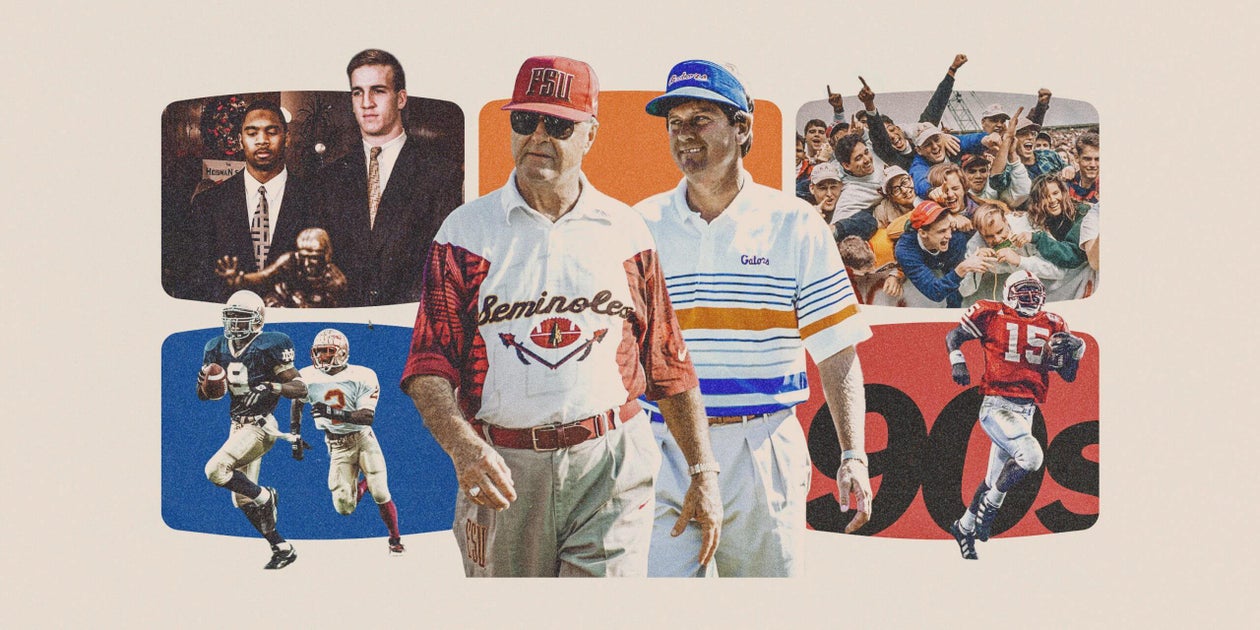
Editor’s note: As the World Cup continues in the United States for the first time since 1994, The Athletic is looking back at college sports in the 1990s and how much has changed since then. Join us for a couple of weeks of offseason football and basketball nostalgia.
College football said goodbye to legendary coaches such as Bo Schembechler, Vince Dooley, Barry Switzer and Jimmy Johnson as the 1980s wound down, and it would be the 21st century before greats such as Urban Meyer, Bob Stoops and Jim Tressel would emerge.
In between, one of the sport’s most improbable turnarounds and some of the most dominant teams it has ever seen — both in the heartland — marked a decade that started with poll-determined champs and ended with BCS computers. It featured the best work of some of the greatest coaches of all time as well.
Though Nebraska may have had the best teams, the sport was centered in Florida. Florida State, Miami and Florida accounted for four of the decade’s 13 championships (yes, 13, thanks to polls and split titles).
This ranking of the 25 best head coaches of the 1990s takes into account only the work done in that particular decade. Championships count big, but so do turnarounds and successful programs built from scratch. Four of the top five coaches on the list inherited difficult situations and engineered lasting excellence.
25. Don James (Washington)
One national championship (split in the polls)
31-5 record in three seasons
Three Pac-10 championships and two Rose Bowl wins
Five national coach of the year awards in 1991
Let’s get controversial right away. A coach who worked in all of three seasons in the 1990s making this list? Hey, we said championships count extra, and James’ Huskies got the coaches’ vote (Miami topped the AP poll) after a 1991 season featuring wins at No. 9 Nebraska, at No. 7 Cal and by a count of 34-14 over No. 4 Michigan in the Rose Bowl.
24. Terry Bowden (Samford, Auburn)
47 wins in less than six full seasons at Auburn
Undefeated 1993 season
Five ranked finishes, two in the top 10
Four wins against top-10 opponents
After a 45-23-1 tenure at Samford, including a run to the 1991 Division I-AA semifinals, Bowden took over an Auburn program hampered by sanctions from the end of the Pat Dye era. His first team beat Steve Spurrier’s Gators and rival Alabama, went 11-0, was barred from postseason play but finished No. 4. It went downhill quickly in 1998, but by then Bowden had five straight finishes in the polls, one at No. 9 and one at No. 11.
23. Bruce Snyder (Cal, Arizona State)
69 wins, tied for 18th nationally
Six national coach of the year awards in 1996
Two top-10 finishes, one in the top five
14 wins against ranked teams, four in the top 10
Snyder took the Arizona State job after leading Cal to a 10-2 season and No. 8 finish in 1991, and he didn’t take long to get a proud program back on track. The 1996 Sun Devils had an outside shot at a share of a national championship entering the Rose Bowl at 11-0. Jake Plummer gave ASU a late lead, but Ohio State, led by former Sun Devils coach John Cooper, scored to ruin the dream.
22. Dick Tomey (Arizona)
71 wins, tied for 15th nationally
One Pac-10 championship
One Pac-10 Coach of the Year award
14 wins against ranked opponents, three in the top 10
Tomey gets the edge over Snyder by virtue of his 5-3 record against Snyder in their 1990s rivalry matchups. Like a lot of coaches on this list, Tomey took his program to places it hadn’t reached and hasn’t since. His “Desert Swarm” defenses led the way for 1993 and 1998 teams that finished in the top 10. The 1998 team was a UCLA loss away from perfection and finished No. 4, best in school history.
21. George Welsh (Virginia)
78 wins, tied for 10th-most nationally
One ACC championship
One national coach of the year award
Four ranked finishes
Virginia football peaked in November 1990, with a team ranked No. 1 in the polls and featuring the most exciting pass-catch combo in the nation — Shawn Moore to Herman Moore. That season faded amid heartbreakers and injuries, but Welsh has to his name six of the 10 seasons in program history that ended with ranked teams. The Hoos still haven’t found anyone who can match him.
20. Fisher DeBerry (Air Force)
78 wins, tied for 10th-most nationally
Two WAC championships
Two ranked finishes
Five wins against ranked opponents, one in the top 10
DeBerry, a College Football Hall of Famer and the winningest coach in Air Force history, led the program from 1984 to 2006 and was right in his sweet spot in the ’90s. He had just one losing season during the decade, which was highlighted by his 1998 team that went 12-1 and crushed Washington in the Oahu Bowl. That season was a 35-34 loss at TCU away from perfection.
19. Joe Tiller (Wyoming, Purdue)
64 wins in nine seasons, 21st nationally
Four ranked finishes
Seven wins against ranked teams, two in the top 10
This may seem high given the numbers, but it might be low when considering innovation and the turnaround of a moribund program. After a successful tenure at Wyoming, culminating with the 10-win season of 1996, Tiller took the Purdue job and brought the spread offense with him. Two decades earlier, Darryl Rogers and then Mike White showed the Big Ten that passing can be good, and Tiller caused fits and copycats — bubble screens started bubbling up everywhere. He debuted with nine wins, Purdue’s first winning season since 1984. Soon, he would introduce Drew Brees.
18. LaVell Edwards (BYU)
86 wins, eighth-most nationally
Coached quarterback Ty Detmer to the 1990 Heisman Trophy
Four ranked finishes, one in the top five
Edwards’ legendary career from 1972-2000 put BYU football on the map and produced consistent offensive fireworks with quarterbacks such as Heisman winner Detmer, Steve Young, Jim McMahon, Marc Wilson and Robbie Bosco. The program peaked with the 1984 national championship — a Holiday Bowl win over a 6-6 Michigan team was enough for the voters — but the 1990s saw consistent winning and a move from the WAC to the Mountain West.
17. Paul Pasqualoni (Syracuse)
75 wins, tied for 13th nationally, in nine seasons
Three Big East championships
Six ranked finishes, one in the top 10
17 wins against ranked opponents, two over top-10 opponents
Yes, kids, Syracuse football used to win consistently. Never more consistently than between 1987 and 2001 under Dick MacPherson, then Pasqualoni. He went 10-2 in his first two seasons, 1991 and 1992, and never had a losing season during the decade. The 1998 season had massive potential with senior Donovan McNabb at quarterback and included a win at Michigan, but it started with a crushing 34-33 loss to eventual national champ Tennessee and ended with a loss to Florida in the Orange Bowl.
16. Mack Brown (North Carolina, Texas)
85 wins, ninth-most nationally
Six ranked finishes, two in the top 10
15 wins against ranked teams, five in the top 10
Coached running back Ricky Williams to the 1998 Heisman Trophy
The best was yet to come for Brown and the Longhorns, but he landed that job on the strength of his 1997 season with the Tar Heels — a 10-1 record, the lone loss to Florida State, with a No. 6 final ranking that was the program’s best in nearly 50 years. That was the culmination of eight impressive years with the Heels, achieved amid Dean Smith’s basketball tenure and after Brown went a combined 2-20 in 1988 and ’89. He tacked on two nine-win seasons to start his Texas tenure.
15. Frank Beamer (Virginia Tech)
77 wins, 12th-most nationally
Three Big East championships
Eight national coach of the year awards for the 1999 season
Five ranked finishes, two in the top 10 and one in the top five
In a different time, Beamer isn’t around to methodically complete one of modern college football’s great program builds — he’s fired after the 2-8-1 season of 1992, his sixth with the Hokies, leaving him with a record of 24-40-2. The rest of the ’90s? Try 64-20 and a spot in the BCS Championship Game on Jan. 4, 2000. The Michael Vick-led Hokies couldn’t quite finish the deal against Florida State, but that set the stage for consistently excellent Virginia Tech teams into the 2010s under Beamer.
14. John Cooper (Ohio State)
91 wins, fifth-most nationally
27 wins against ranked teams, seven in the top 10
Three Big Ten championships
Seven ranked finishes, three in the top 10 and two in the top five
Coached 1995 Heisman winner Eddie George
Ohio State is the lone blue-blood program that hasn’t had a prolonged downturn since the 1960s, and Cooper deserves his share of credit for that. He quickly got things going again after the Earle Bruce era and eventually put together some of the strongest teams in the sport. But the record in big games is abysmal. Cooper was 2-7-1 vs. Michigan in the ’90s (2-10-1 overall), and that included three losses that ended national title hopes. Throw in an inexplicable home loss to Nick Saban and Michigan State — a 27.5-point underdog — in 1998 when the Buckeyes looked like the clear best team, and you’ve got a lot to regret.
13. Lou Holtz (Notre Dame, South Carolina)
63 wins in eight seasons
Six ranked finishes, three in the top 10 and two in the top five
19 wins against ranked teams, 11 in the top 10
Three straight major bowl wins, one Sugar and two Cotton
Unfortunately for Holtz, his 0-11 debut season at South Carolina counts on his record here, before he got things going a bit for the Gamecocks. And this decade immediately follows his Notre Dame peak — the unbeaten 1988 national title team and 1989 season that finished 12-1 and No. 2 behind Miami, both led by Tony Rice and Rocket Ismail. Holtz had another title in his sights in 1993 after beating No. 1 Florida State, but a home loss to Boston College the next week as the No. 1 team lives in infamy. It was never the same for Holtz after that.
12. R.C. Slocum (Texas A&M)
94 wins, fourth-most nationally
Nine ranked finishes, three in the top 10
Four conference championships (three Southwest Conference, one Big 12)
13 wins against ranked opponents, three in the top 10
One of the difficulties of a list like this is comparing consistently successful coaches who did it for the entire decade with peers who had higher highs but less opportunity to accumulate wins. Slocum is the former, an easily forgotten figure among the big names of the ’90s, but nonetheless one of its reliable achievers. No other coach in the annals of this storied program achieved nine ranked finishes in 10 years. That includes the unbeaten season of 1994, 10-0-1 and a final ranking of No. 8, despite NCAA sanctions that prohibited the Aggies from postseason play, the coaches poll and appearing on TV. Imagine that today. Slocum’s 1992 team was 12-0 and ranked No. 4 entering the Cotton Bowl, but lost 28-3 to No. 5 Notre Dame.
11. Lloyd Carr (Michigan)
One national championship (split in the polls)
Two top-five finishes in five seasons
20 wins against ranked teams, 11 in the top 10
Coached cornerback Charles Woodson to the 1997 Heisman, the first defensive player to win it
One thing that shouldn’t be overlooked in Carr’s work as Michigan’s coach in the second half of the decade is the fact that he had to navigate the messy finish to Gary Moeller’s tenure. It didn’t take long before Carr proved that he, not Moeller, would have been the better choice to succeed Bo Schembechler. Carr’s third team in 1997 went unbeaten and got a share of the national title with a dominant, Woodson-led defense. If only Michigan and co-champ Nebraska could have met on the field. In 1999, Carr might have had another title had he gone solely with senior Tom Brady at quarterback.
10. Bill McCartney (Colorado)
One national championship (split in the polls)
Two top-five finishes and ranked finishes in all five seasons
Two Big Eight championships
15 wins against ranked opponents, five in the top 10
Coached running back Rashaan Salaam to the 1994 Heisman
McCartney’s placement, one spot ahead of fellow Bo Schembechler protege Lloyd Carr, might come down to one play — Kordell Stewart to Michael Westbrook, a 64-yard Hail Mary to shock the Wolverines on the final play in 1994 (Carr was not yet Michigan’s head coach, for the record). That win kept the Buffs in contention for the national championship, their third time in six seasons as true contenders. A loss at eventual champ Nebraska ended that, but Colorado still finished No. 3. And shared the 1990 title with Georgia Tech thanks to an Orange Bowl thriller over Notre Dame. The program has not approached that stretch since.
9. Gene Stallings (Alabama)
One national championship
Six ranked finishes in six seasons of coaching, three in the top five
Three SEC West titles and one SEC championship
15 wins over ranked teams, four in the top 10
The Stallings tenure at Alabama was the oasis between dissatisfying stretches for the program after Paul “Bear” Bryant and before Nick Saban — all of which proved that (almost) no program is immune to recession. Stallings, a “Junction Boy” who played for Bryant at Texas A&M, went 70-16-1 in his seven Alabama seasons. And his title wasn’t just any title; it required a brilliant effort to rout loaded and heavily favored Miami in the Sugar Bowl. That win alone elevates Stallings.
8. Dennis Erickson (Miami, Oregon State)
One national championship (split in the polls)
Four top-10 finishes and three top-five finishes in five seasons
17 wins against ranked opponents, 10 in the top 10
Coached quarterback Gino Torretta to the 1992 Heisman
It was a heck of a half decade for Erickson at “The U,” before trying his hand at pro football — a middling four seasons with the Seattle Seahawks — then returning to the college game in 1999 and immediately leading Oregon State to its first winning season in 29 years. That’s awfully strong work. If only Erickson’s 1989 season (winning it all in his debut with the Hurricanes) and 2000 season (11-1 and a No. 4 final ranking with the Beavers) counted, he’d be higher. Yes, he inherited a monster from Jimmy Johnson. But keeping it at that level is impressive.
7. Phillip Fulmer (Tennessee)
One BCS national championship
Two SEC championships
Five top-10 finishes and two top-five finishes
24 wins against ranked teams, fifth-best nationally even though Fulmer’s first full season was in 1993
Tennessee fans may always debate how Fulmer ended up with the job after filling in for his ailing boss, Johnny Majors, in 1992. But there’s no question he’s the second-best coach in program history after Robert Neyland, taking things to a different level after he got the job full time. Fulmer’s tenure is heavily associated with Peyton Manning at quarterback and Steve Spurrier as an infuriating antagonist. But Fulmer and the Vols beat Florida State for the first-ever BCS national championship the year after Manning departed, thanks in part to a huge win over Spurrier’s Gators.
6. Joe Paterno (Penn State)
Undefeated 1994 season, finishing second in the polls
97 wins, third-most in the nation
Four top-10 finishes, two top-five finishes and only one unranked finish
27 wins against ranked teams, tied with John Cooper for third-most
Long after he turned Penn State into a college football powerhouse and long before his career ended in scandal, Paterno navigated the Nittany Lions through a highly successful, unsatisfying decade of football. Penn State joined the Big Ten in 1993 and dominated the league in 1994 with one of the most explosive offenses on record — but the old way of doing things left Penn State second in the polls to Nebraska and fans unable to watch those teams settle it on the field. That was Paterno’s only Big Ten championship of the decade.
5. Barry Alvarez (Wisconsin)
Three Big Ten and Rose Bowl championships for a program that hadn’t won the league since 1962 and had never won a Rose Bowl
Three top-10 finishes and one top-five finish
16 wins against ranked teams, three in the top 10
Coached Heisman Trophy-winning running back Ron Dayne in 1999
You have to be of a certain age to understand the improbability of what Alvarez did at Wisconsin in the 1990s. He changed the place forever and established an expectation of winning that persists today. Before he got there? Doormat central. Thirty years of futility. The Lou Holtz/Hayden Fry protege had to do it the old-fashioned way, with a 1-10 debut in 1990 and two more losing seasons before breaking through and winning the Big Ten and Rose Bowl in his fourth season. By the end of the decade, he had three Rose Bowl trophies, a Heisman winner and the most physical program in the sport.
4. Tom Osborne (Nebraska)
Three national championships, most in the nation (one was split)
Tied for sixth nationally with 87 wins despite retiring after the 1997 season
Five straight conference championships and six overall
Four top-five finishes
22 wins against ranked teams, including 11 in the top 10
The 1990s saw Osborne go out on top after one of the greatest coaching careers of all time — his .836 winning percentage is the highest among major college coaches with 200 or more wins. Bob Devaney established Nebraska as a power in the 1960s and ’70s, winning two national titles. Osborne carried on the tradition with astounding consistency and saved his best for last with all three of his titles in his final four seasons. The 1995 team, which destroyed Florida 62-24 in the Fiesta Bowl, is one of the best ever.
3. Steve Spurrier (Florida)
One national championship
Eight top-10 finishes and five top-five finishes
Second nationally with 102 wins, including 32 wins against ranked teams and 17 against top-10 teams
Five SEC championships, including four straight from 1993-96
When Spurrier took over his alma mater in 1990, after a stint at Duke that saw him bring that downtrodden program an ACC title, the Gators were mired in mediocrity and just emerging from NCAA sanctions — which resulted from a brief 1980s uprising. Florida had three top-10 finishes in its history. Spurrier, who won the Heisman Trophy in 1966 as Florida’s quarterback, had three top-10 finishes in his first four years and did it eight years in a row. Danny Wuerffel won the Heisman in 1996 and led the Gators to the title — avenging a previous loss to rival Florida State in the Sugar Bowl. Beyond the success, Spurrier’s acerbic wit and “Fun ‘n’ Gun” offense defined the decade.
2. Bill Snyder (Kansas State)
Seven ranked finishes and four top-10 finishes for a program that had never finished a season ranked
Seven winning seasons for a program that had four in the previous 54
87 wins, tied with Osborne for sixth nationally
Four national coach of the year awards and four conference awards
Snyder’s debut season of 1989 produced a 1-10 record, which tracked with a program that had been hopeless and hapless for its entire existence, losing more games than any other. There was no reason to expect anything close to what happened next. Snyder, who previously helped Hayden Fry redefine Iowa football as his offensive coordinator, did the same at a totally different level in the Little Apple. The worst program in the country, as accurately declared by Sports Illustrated in 1988, ascended to a No. 1 ranking in 1998. What Snyder did at KSU is more impressive than winning big at an advantaged program and gives him a case for the top spot.
1. Bobby Bowden (Florida State)
Two national championships (one consensus polls, one BCS)
10 top-five finishes
ACC championships in all eight years in the league
Led all coaches with 109 wins, 43 ranked wins and 19 top-10 wins
Like Snyder and others who earned bonus points in these rankings, Bowden was in command of a self-made program. Yes, the building was done well before the ’90s dawned — when Bowden got to FSU in 1976, it had zero ranked finishes and a limited history that dated to 1954 — but he did the work. Then took things to an entirely new level in the ’90s. Heisman winner Charlie Ward piloted FSU to the school’s first championship, then Chris Weinke-to-Peter Warrick capped the decade with an unbeaten BCS title. A top-five finish in every year was twice as many as the closest competitor and was part of an overall record streak of 14 seasons in a row. That may never be touched.
(Honorable mention: Bobby Ross, Don Nehlen, Ron McBride, Gary Pinkel, Ken Hatfield, Hayden Fry, Jackie Sherrill, Glen Mason, John Mackovic, Mike Price)