
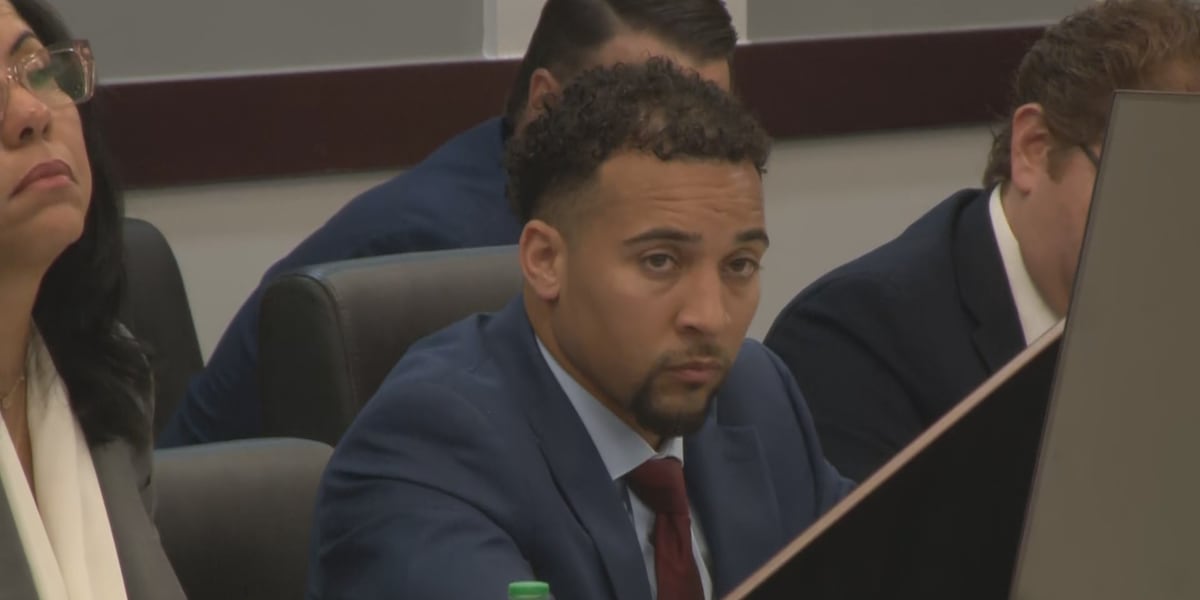
NASHVILLE, Tenn. (WSMV) – The defense rested its case Tuesday in the murder trial of Blaise Taylor: a former Tennessee Titans scout accused of fatally drugging his pregnant girlfriend. Closing arguments are scheduled to begin Wednesday.
Taylor is charged with two counts of first-degree murder and two counts of felony murder. Prosecutors have argued that Taylor did not want a child and spiked Jade Benning’s drink with a lethal dose of cocaine, leading to her death.
The final defense witnesses testified about the drugs found in Benning’s system. Dr. Kelly Larkin, a board-certified emergency physician said medical records indicate Benning may have been using drugs prior to the night she was hospitalized.
During the trial, jurors saw text messages from Benning’s phone that included conversations about her obtaining drugs for other people. No evidence was presented from her phone that she was using drugs while pregnant.
Prosecutors have argued Benning was excited about her pregnancy and had stopped using drugs and alcohol.
Dr. Janci Chunn Lindsay, a toxicology expert testified that a comforter from Benning’s apartment tested positive for fentanyl, cocaine, and cocaethylene, a substance that forms when alcohol is mixed with cocaine. The comforter was removed from Benning’s apartment by a family friend the night Bennings was hospitalized and was later returned to police.
Prosecutors argued the fentanyl found in Benning’s system was administered at the hospital. Defense records showed fentanyl was given to Bennings on Feb. 26, the day after she was hospitalized.
Dr. Lindsay also testified about problems with a blood test taken from Benning at the time of her hospitalization, saying the blood was placed in the wrong tube for testing and that a stabilizer was not used, which can alter results of the drugs found in her system.

“If I knew nothing about this case, I would think that this was a person who used throughout the day and it stacked because of the large amount of metabolite,” Lindsay said. “What does that mean practically for us and the tube that doesn’t have the proper preservative in it. It means we don’t know what that number should have been.”
Dr. Larkin testified about the 911 call Taylor made the night Benning was hospitalized. Taylor told the 911 operator Benning was snoring at times. Dr. Larkin said those symptoms are more consistent with a fentanyl overdose.
“Fentanyl is more drowsiness,” Dr. Larkin said. “When we give fentanyl to try to treat someone’s pain, we have to watch out for them getting too sleepy, but with fentanyl the respiration tends to slow down it’s a more gradual of a change. Verses with cocaine, they’re hyped up and they’ve got things going on that are fast.”
Dr. Larkin also addressed Benning’s autopsy, saying cells in her heart area were larger than normal, indicating a chronic medical condition that would not have been caused by drug use on the night Benning was hospitalized.
“It had to happen over time, so one of the chronic things that can cause this over time is cocaine use over time can cause that myositis to be large and the ventricles to be enlarged,” Dr. Larkin said.
Dr. Larkin also testified that a heart condition or high blood pressure could produce the same findings.
Prosecutors called three medical experts during the trial who testified they believe the cocaine in Benning’s system was ingested shortly before her death. The jury was released for the day following Tuesday’s testimony.
Copyright 2026 WSMV. All rights reserved.