
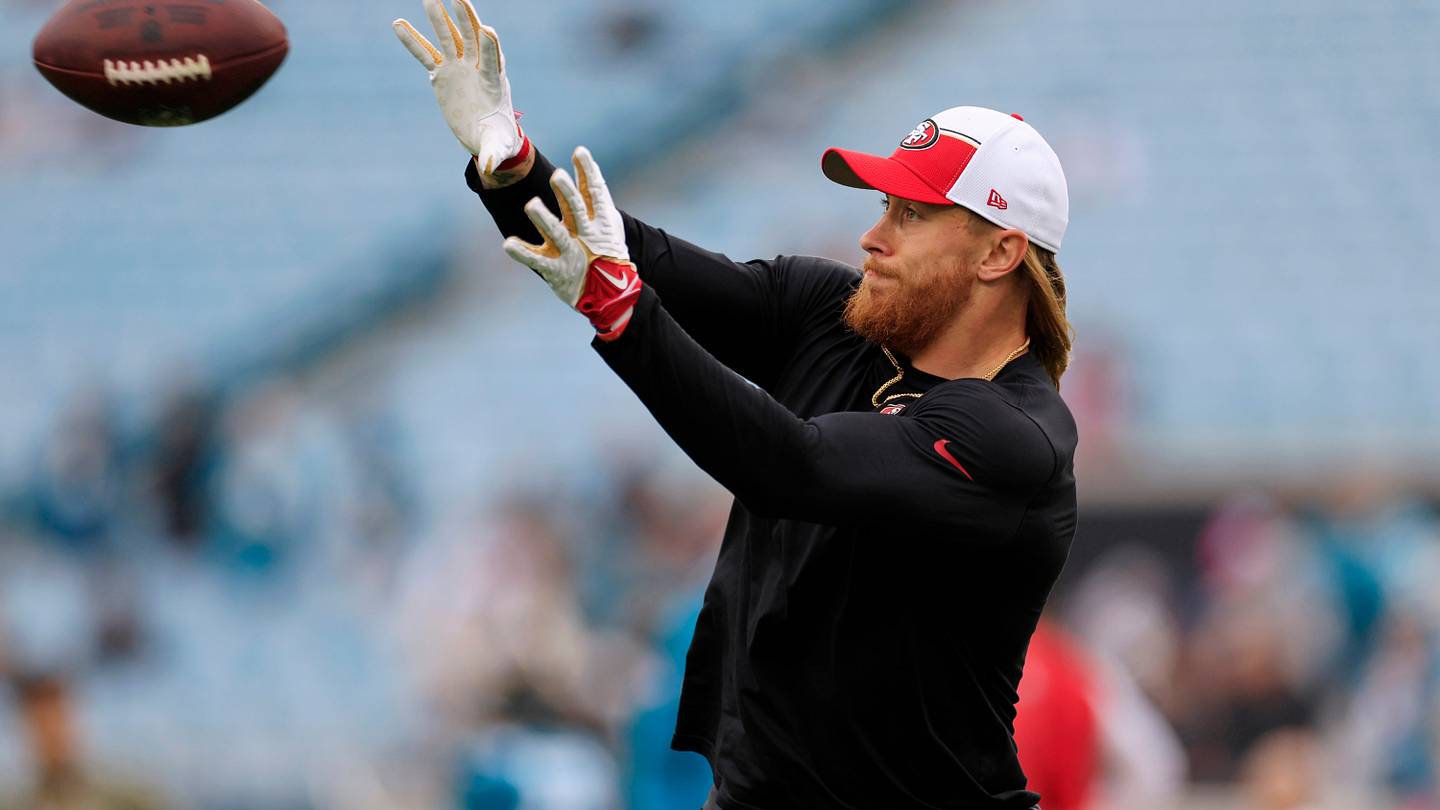
San Francisco 49ers tight end George Kittle is advocating for higher salaries for those at his position.
In recent years, the National Football League has unintentionally established market rates for select positions, and Kittle has argued that tight ends deserve a higher paycheque.
Quarterbacks are now earning roughly $50–60 million per year, with some making even more, while wide receiver salaries have also skyrocketed.
As a result, those two offensive positions alone are consuming an increasingly large share of the salary cap that teams have available each season.
Kittle is currently signed to a four-year, $76.4 million contract that runs through the end of the 2029 season. At the time he signed the extension, it made him the highest-paid tight end in NFL history. The deal carries an average annual value of approximately $19.1 million and includes at least $35 million in fully guaranteed money.

George Kittle and Travis Kelce greet the crowd during the “Tight Ends & Friends” concert at Brooklyn Bowl Tuesday, June 18, 2024 in Nashville, Tenn. | USA TODAY Network via Reuters Connect
But this kind of money is not as much as Kittle believes tight end should be paid, stating: “We’re kind of finally getting a little bit more money as a room, which, honestly, yeah, we’re getting a little bit more pay. I still think we should get more. But it is what it is,” Kittle shared on the New Heights podcast with Travis and Jason Kelce.
“There’s No. 2 wide receivers who get 30 catches a year that are getting over $20 million. The tight end who plays like 50 snaps a game and has one target a game probably deserves at least — he should probably get 50 mil. That’s just my opinion.”
Few positions in the NFL demand as much versatility as a tight end. Players, including Kittle, who does an exceptional job, are expected to block like offensive linemen, catch passes like wide receivers, and pass protect against elite edge rushers. It’s a tough gig and this is why Kittle believes those at his position deserve the big bucks.
One must consider that a certain team’s approach to the salary cap is designed to allow certain players to earn more than others. However, franchises have increasingly overpaid for marquee players, with many teams following suit by adopting the same business model.
San Francisco is slightly different, having rewarded several key veterans with significant contracts, but that should not change the fact that teams are failing to allocate a fair proportion of the salary cap to other positions relative to their contribution.
So, what Kittle says has some substance. Tight ends are expected to contribute in multiple ways, yet their value isn’t paid in dollars.
 Add us as a preferred source on GoogleFollow