

How do you fix a team like the San Francisco Giants? They should get some better pitchers, for one. Maybe a hitter who reminds you of Barry Bonds, even when he’s not doing anything. Just doing those two things would be a heckuva start.
Friend, do the Giants have an amateur draft to share with you.
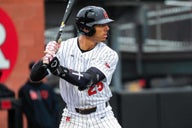
The Giants selected University of California, Santa Barbara right-hander Jackson Flora with the fourth pick in the 2026 MLB Draft, then selected pitchers with three out of their next four picks. With their third-round pick (fourth selection), they selected an outfielder by the name of Bonds. Peyton Bonds. He wore No. 25 at Rutgers in honor of his uncle, who used to play at Arizona State and for the Pittsburgh Pirates. We’ll get to that.
Start with the pitching, though. The Bonds story is fun, but the lack of pitching in the Giants’ organization is closer to existential. The 2026 Giants currently have the seventh-worst adjusted ERA in San Francisco Giants history. They’re on pace to have the second-highest ERA in the Oracle Park era, behind only the 2006 team. There’s a very real chance this staff could have one of the worst seasons for the franchise since leaving New York.
None of this is why the Giants drafted Flora. It isn’t why they drafted pitchers with their first three picks. Every team will repeat “best player available” as many times as they need to, year after year, because that’s the philosophy of every team. You can’t worry about 2026 when you’re focused on 2030 and beyond.
When the best player available happens to be exactly the kind of player you would put on the Giants with a magic wand, though, it sure makes it easier to imagine how it all might work.
Flora was the top college pitcher of the draft. The next college pitcher was selected at pick 19. Flora has an ace’s repertoire, an ace’s build and an ace’s work ethic. If he turns into a perfectly decent starting pitcher, he’ll have beaten the odds that most pitching prospects begin with, but the Giants are hoping he’ll be an ace. And soon.
No pressure, kid.

Jackson Flora can reach triple-digits with his fastball. (Jeff Liang / UCSB Athletics)
Flora has the kind of ready-made stuff that organizations dream of, with all the bells and whistles that modern analysts and scouts like these days, like a high spin rate, a flat approach angle and excellent arm extension. He has two major-league pitches already, with a fastball that can sit in the mid-to-upper 90s and a wipeout sider, and he added a kick-change that should give him a third. He needs to refine his command and control, like almost every other 21-year-old pitcher — so he’s not close to where, say, Paul Skenes was when he was drafted — but he’s still ahead of most of his peers in that respect.
But wait: There’s even more urgency. The Giants’ farm system is currently in the top third of baseball, but that’s mostly on the strength of position players in A-ball and below. The upper levels are starting to spit hitters out, though. Bryce Eldridge has the highest profile of the recent graduates, but he should be followed in short order by a variety of infielders and outfielders. All that’s left is the pitching.
No pressure, kid.
Here’s where Flora might not have only been the best player available, but also the player who made the most sense for the Giants right now. It’s not as if the Giants are without pitching prospects — Roger Munter from There R Giants recently wrote that if 21-year-old Keyner Martínez were draft-eligible, he’d have the kind of stuff that might have put him in consideration for the fourth pick — but it’s hard to identify another Giants pitching prospect you can practically guarantee will be in a major-league rotation soon. Carson Whisenhunt has a chance, but it’s possible that he follows Keaton Winn into the bullpen, with Blade Tidwell and Carson Seymour likely taking a similar path.
Before Flora was selected, that left open the possibility of a gap between the first and second waves of hitting prospects and any young starters in the majors to support them. While Flora is still a young pitcher, and you should never, ever trust those things, he’s not a high school infielder who needs to be polished and perfected at every step along his developmental path. While the competency and effectiveness of every organization’s player-development team can vary wildly, Flora feels like a pitcher whose success will have more to do with his body holding up than anything his organization does or doesn’t do. He should in the majors at the same time as Jhonny Level, Gavin Kilen, Bo Davidson and/or Dakota Jordan, a foundation that ideally would be followed shortly by a second wave of prospects who are still teenagers right now, like Luis Hernández and Josuar Gonzalez.
Will the Giants need pitching when that happens? No idea. Never draft for need. In two years, the Giants might have the best group of pitching prospects in the country, and all of the hitting prospects might have stalled.
Using all of the available evidence we have at the moment, though, it sure seems like a polished college right-hander would be perfectly positioned for a team on the Giants’ timeline. Flora, in this perfect world where all the dominoes fall as expected, would be established by the time the youth movement picks up.
There are downsides, of course. Some concerns with Flora that are reasonable to have:
• He’s a pitcher
• He’s a prospect
• He’s a pitching prospect
While you can get excited about top-of-the-first-round college pitchers in a way that feels more tangible than the distant excitement you might feel with the best high school prospects, it’s still an impossible profile to predict with any accuracy. Scroll through draft histories, and you’ll spot ghosts from draft classes past. Look at the drafts that built the Giants’ championship teams: Before Tim Lincecum, teams drafted the much safer and polished Luke Hochevar and Brandon Morrow. Before Madison Bumgarner was Daniel Moskos; before Buster Posey was Brian Matusz. Those profiles all inspired write-ups similar to this one. Should move quickly, more polished than their peers, a certain major leaguer, et cetera, et cetera.
There is also a question about Flora’s strikeout rate, which is outstanding (11.7 K/9) in isolation, but not as robust as a lot of the big-stuff, top-five college pitchers from recent drafts. You want college pitchers drafted there to dominate. You want stats that suggest Flora is a pitcher who made hitters study harder after they realized they weren’t future major leaguers.
This is a minor concern relative to the rest of the profile, though, and it’s certainly one with a variety of acceptable explanations. Now that we’ve acknowledge that, let’s focus on the fun stuff. Like how Flora throws the baseball:
If you’re looking for reasons why the Giants made this pick, you don’t have to start thinking about the future of teenagers in the Arizona Complex League. You can just look at the videos of Flora pitching. He has the kind of size and frame that led FanGraphs’ Michael Baumann to give him the rare “ideal baseball body” tag. (Baumann was also enamored of Flora’s personality, remarking in the FanGraphs’ draft chat that he was “outrageously charismatic” and talked for 20 minutes at the MLB Draft Combine, which is about 18-19 minutes longer than most prospects.)
There are tangential reasons to be excited about the pick. Not only is Flora from Pleasanton and Foothill High, like Brandon Crawford, but he also grew up a Giants fan, sprinkling names like Jeff Samardzija into his post-draft conference call after the requisite Matt Cain, Madison Bumgarner and Tim Lincecum mentions. On that same call, he had to correct himself when calling the ballpark AT&T Park instead of Oracle, which is simply charming.
It’s Flora’s backstory that gets me most excited, though. Not the part where he might have seen one of Kelby Tomlinson’s three perfect home runs, but the part where he went undrafted out of high school. This doesn’t mean that he lacked the talent to be drafted, just that he wasn’t likely to be drafted high enough to buy him out of his college commitment, so teams ignored him.
Then Flora went to UCSB’s pitching factory, one that got a lot more notice when Shane Bieber emerged out of the mists. They didn’t do everything that made Flora the fourth pick, but it’s easy to imagine him developing into a much different prospect at another school. Head coach Andrew Checketts actually prefers high schoolers with a chance to grow into their stuff, saying that they’ve had to learn how to pitch differently. They couldn’t dominate with raw stuff, so command and pitchability was how they got to a Division I school in the first place.
“They’re not hard throwers when they’re younger, so they figure out how to throw it down the middle of the plate,” Checketts told The Ringer in 2021. “And then they’re successful in high school because they have the ability to throw the fastball where they want it.”
The work of the modern pitcher isn’t just to get bigger and stronger, throwing harder along the way. It’s also to take instruction and turn words into action. Why a pitch is thrown a certain way, the differences between how pitches spin, the sequences that work best with the movement and release point he offers, how to improve that release point, et cetera.
A lot of pitchers learned those things in college, but only one of them was picked in the first half of the 2026 draft. It speaks to Flora’s general malleability as a pitcher, which is almost as important as velocity readings and slider shapes these days. Think of him as someone who got an earlier jump on the language of major-league pitching, like a kid put into a foreign-language immersion school. You can see evidence of this in Flora’s changeup, which he picked up just this past season. He needed a pitch that moves away from left-handers and prevented them from sitting on the natural movement of his fastball and slider, so he developed one. In under a calendar year, he took a pitch from concept to Baseball America’s list of best changeups in the draft.
None of this guarantees success, and you’ve seen pitchers have all kinds of success in unorthodox ways, even when they didn’t have the physical head start that Flora’s DNA gave him. Lincecum won Cy Youngs with the frame of a backup infielder on the 1974 Cardinals. Ryan Vogelsong had to travel around the world for a decade. Logan Webb had to stop throwing harder and focus on the movement of his pitches, becoming an All-Star as a high school draftee when peers like Brady Aiken or Tyler Kolek — the top two picks of the 2014 draft — didn’t make the majors at all.
When building a pitcher from scratch, however, you would love some components to be pre-installed. You want the size, and you want the stuff. You want at least three pitches, including one that gets opposite-side hitters out. You want polish, but you also want ceiling. You want to eliminate as many of the surprises as a pitching prospect might come with.
Here’s a guy who does that, and it doesn’t hurt that he’s also slid down the Coke bottle a few times. You won’t know what the best pick would have been for another few years, if not longer. Everyone knew which pick makes the most sense right now, though, and it just so happened to be the best player left on the Giants’ board. It’s nice to have that kind of synchronicity in a year when nothing else has been in sync.
If the Giants drafted an unrelated player with the name “Bonds,” it would be worth noting. Heck, it was worth noting when the Giants drafted Bonds with back-to-back picks in 2007 — Brock Bond in the 24th round and Casey Bond in the 25th. Looks like the Giants are trying to draft Bonds again, we all said. It was a good bit.
Well, here’s the actual item, an honest-to-goodness Bonds back in the organization. His grandfather, Bobby Bonds Sr., played seven seasons for the Giants, and his uncle, Barry Bonds, played 15 for them. They combined for 772 home runs in a Giants uniform and 1,094 major-league home runs overall.
GO DEEPER
Giants select Barry Bonds’ nephew in third round of MLB Draft
That’s a long shadow that’s being cast by his family, which isn’t the kind of situation that benefits everyone. Peyton Bonds’ dad, though, wasn’t nearly as successful, playing seven seasons in the minors and another three in the independent Atlantic League after that. That’s why MLB’s writeup on Peyton included this bit:
He gets high marks for his plus makeup and passion for the game, perhaps handed down from his father, who grinded it out in the Minors for more than a decade.
It’s not not a swipe at Barry, considering that it answers the first question a lot of you had, but it’s helpful information. He isn’t as prickly as his uncle, and he seems to like baseball in an uncomplicated fashion, like most baseball players seem to. Just not that one.
As for the scouting report, it’s tools over production for now, but the tools are legitimate. Peyton Bonds is said to be a no-doubt center fielder, and he was the reason current Giants prospect Trevor Cohen played right field in the same Rutgers outfield. He was a legitimate top-100 pick, drafted where the pre-draft projections had him, and Giants scouting director Michael Holmes made it clear that this wasn’t a reach based on lineage and nostalgia.
“We drafted him because of his ability … just a real unique talent, super strong, athletic, super high exit velocities off the bat,” Holmes said. “We think there are some things we can do with his swing to help him elevate the baseball a little bit, but you get an athlete in center field, in the middle of the diamond, who hits the ball hard, and it’s a real good starter kit. He’s a Giant because of Peyton Bonds,” not his family ties.
Bonds is far from the majors, but he has a legitimate shot, and it’s hard to imagine just how warm of a welcome that would be.
In addition to Flora, the three pitchers who were also taken on Day 1 of the draft, in order:
• The 29th pick was spent on Carson Bolemon, a left-hander out of Southside Christian High in South Carolina, who entered the season as one of best pitching prospects of the draft, but slipped a little as the year went on. He’s more polished than the typical high-school pitching prospect, with more strike-throwing ability than most teenagers. He’s throwing in the low-to-mid-90s at the moment, but the Giants are hoping he’ll add more velocity, even if it’s not something that absolutely has to happen for him to make the majors.
• Kaden Waechter is a right-hander out of Jesuit High in Florida with a similar profile, but from the right side, with more strike throwing than the typical high school pick. Keith Law writes that the command gives him a chance to stick as a starter in the majors.
• Carlos Martinez is a right-hander who missed all of the 2025 season, but came back from Tommy John surgery strong. The Giants were on him before he got hurt, and while he’s listed as a college senior in the MLB database, he had a year of eligibility remaining because of the injury, so don’t expect this to be a budget-minded signing to set up the later rounds.