
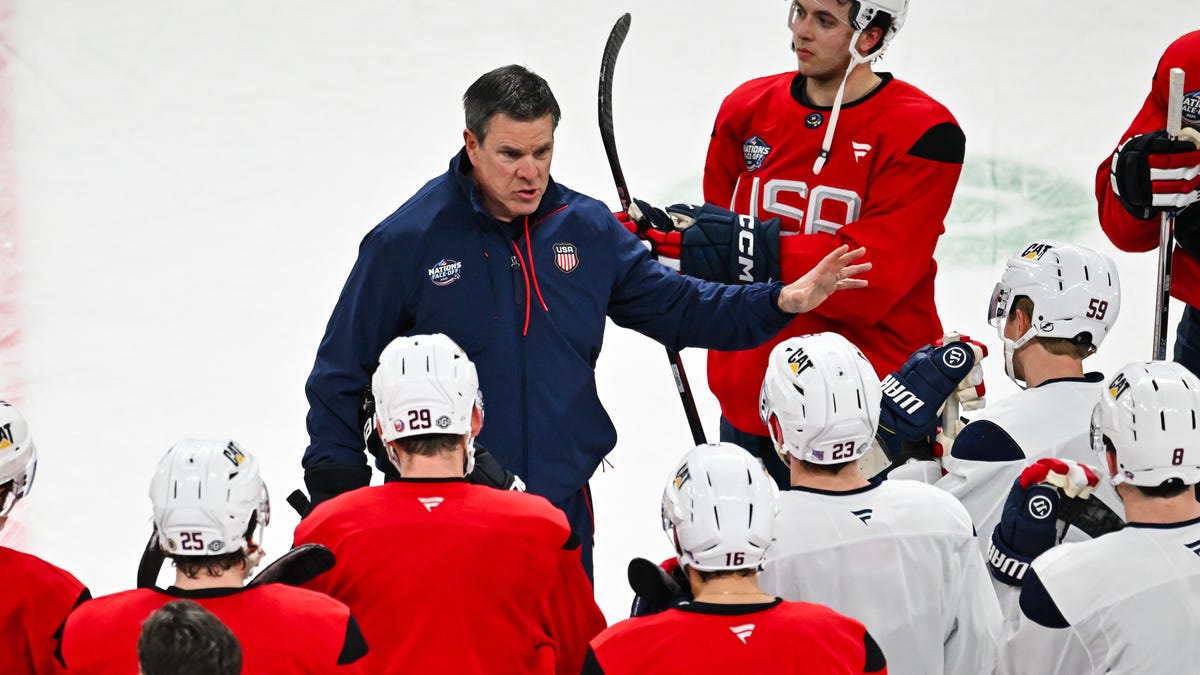
The Rangers worked quickly to snatch up their top coaching candidate, officially hiring Mike Sullivan only four days after he was let go by the Pittsburgh Penguins.
Multiple reports suggest the new contract will make him the highest-paid coach in NHL history, which shows how much team president Chris Drury and owner James Dolan coveted the man who several league sources believe has been their No. 1 choice for years.
They’ll wait at least a few more days to introduce the 38th head coach in franchise history, who will be charged with turning around one of the NHL’s biggest disappointments. The Rangers were a mess, both on and off the ice, which led to them missing the playoffs just one year after capturing the Presidents’ Trophy and making a run to the Eastern Conference Final.
That cost former head coach Peter Laviolette his job and opened the door for Sullivan, who will have his work cut out for him. He’ll be facing numerous questions − many of which will take months, if not years, to answer − but we’ll begin by examining seven of the most pressing dilemmas.
1. Can he win without Sidney Crosby?
We’re going to find out.
Sullivan won back-to-back Stanley Cups behind the best player of this generation, which is an easy way for critics to try and discredit those accomplishments. But Crosby had only won once in 10 seasons before Sullivan’s arrival and has always spoken glowingly about the coach’s influence in propelling the Penguins back to the top.
Crosby has maintained his high level of play into his late-30s, but the rest of the Pittsburgh roster has crumbled around him. Diminishing returns from co-stars Evgeni Malkin and Kris Letang, shaky goaltending and a scarcity of young talent has led to three straight seasons missing the playoffs.
Sullivan shares some of the blame for that falloff, but the whole situation had grown stale in recent years. Now he’ll get a chance to start fresh and prove he can win without the great No. 87 carrying the load.
2. How will he handle the youth?
One of the few gripes Penguins fans had with Sullivan was the lack of development on his watch, but the other side will argue that he was working with one of the league’s weakest prospect pools. Pittsburgh consistently traded away draft picks to chase Cups, leaving their pipeline thin on impact players who could help the NHL club.
When Sullivan had notable young talent during the championship years – specifically forwards Jake Guentzel, Bryan Rust and Conor Sheary, defensemen Brian Dumoulin and Olli Määttä and goalie Matt Murray – he didn’t hesitate to unleash them.
It will be critically important for him to elevate the next wave of Rangers. That’s been a struggle for Sullivan’s predecessors, with both Laviolette and Gerard Gallant reluctant to trust the products of the rebuild era. That’s stagnated their growth, and in many cases, led to frustration and fractured confidence.
It starts with the more seasoned youth – particularly forward Alexis Lafrenière, who regressed after signing a seven-year extension in October, and defensemen K’Andre Miller and Braden Schneider, who have both flashed their potential but struggled with consistency – and extends to fresher faces such as Brett Berard, Brennan Othmann and top prospect Gabe Perreault.
It’s hard to envision the Rangers bouncing back and sustaining any level of success if several of those players don’t graduate to more prominent roles and provide production.
3. Can he salvage Mika Zibanejad?
Pretty much all the Rangers’ core veterans are coming off down years, so Sullivan will have his hands full trying to help them rediscover the magic of years’ past. But none seem quite as vexing as the 32-year-old Swede.
Zibanejad’s play has slipped for two consecutive seasons now, but the first half of 2024-25 was downright alarming.
He looked like a shell of himself while managing only 21 points (six goals and 15 assists) through the first 36 games and spoke openly about the mental struggles it caused. And while he rebounded with a much-improved second half, concerns about how a contract that pays him $8.5 million annually and has five years remaining will age have been amplified.
The Rangers may be tempted to move on, but Zibanejad controls his own destiny with a full no-movement clause and doesn’t seem particularly interested in leaving.
Assuming he sticks around, it will be one of Sullivan’s primary responsibilities to reinvigorate a player who not too long ago ranked as one of the NHL’s top scorers and better all-around centers. Whether that means permanently moving him to right wing, where he found some success late in the season, or shifting him back to the middle is a key question. But the bottom line is the Blueshirts need more out of Zibanejad, wherever he plays.
4. How about unlocking the power play?
One of the most perplexing storylines to emerge in this lost season was the precipitous drop of the Rangers’ once-vaunted power play.
For a five-year run that began with the 2019 arrivals of Adam Fox and Artemi Panarin, New York’s PP ranked fourth in the league with a 24% conversion rate. They were remarkably consistent − a pillar of the team’s success during that time.
But despite returning all five members of their top unit − Fox, Panarin, Zibanejad, Chris Kreider and Vincent Trocheck − the 2024-25 power play plummeted all way to 28th while converting only 17.6% of the time.
It only got worse as the season wore on, with the Rangers going 5-for-55 in their final 22 games while allowing four shorthanded goals. Their 9.1% success rate in that span ranked dead last.
How could such an accomplished unit look so lost and disjointed? Sullivan will have to figure that out and make the right choice for whichever assistant coach is tasked with overseeing that effort.
5. What’s the plan for a regressing D corps?
Sullivan will also have to pick the right person to coach up a group of defensemen who all stagnated or regressed under Laviolette and associate head coach Phil Housley.
Helping Miller and Schneider take the next steps will be crucial, but they’re not the only ones who experienced more downs than ups under the previous staff. Ryan Lindgren and Jacob Trouba went from physical tone-setters to borderline liabilities, which led to both being traded, and even Fox seemed to lose some of his magic. The 2020-21 Norris Trophy winner didn’t make his usual dynamic plays with the same frequency and wore down under the weight of difficult defensive assignments.
It will likely require outside help to upgrade a D corps that’s not on par with the big, tough and mobile groups we see excelling in the playoffs. But many defensemen will return, putting the onus on Sullivan and his defensive signal caller to get them trending back in the right direction.
6. Is his system a good fit? And will players buy in?
Sullivan will become the latest coach to take a crack at trying to transform a bunch of east-west, finesse players into a direct, hard-nosed operation.
That was an endless source of frustration for Gallant and Laviolette (and even David Quinn before them), raising questions about whether any coach can shake the Rangers of their bad habits.
The 57-year-old is expected to implement a fast-paced, straight-ahead system that gets pucks deep and applies pressure with a relentless forecheck, which sounds similar to what Gallant and Laviolette tried to achieve but didn’t have the horses for. One notable difference is that Sullivan prefers a zone defensive scheme, which could be a good thing after the Rangers often looked lost in Laviolette’s demanding man-to-man coverage.
There will be subtler changes, as well, but achieving a lasting buy-in the previous two coaches couldn’t maintain beyond their first seasons will be the true test. Inevitably, this dare-we-say-soft version of Blueshirts tend to lose battles in the high-danger areas and fall back on high-risk passes that lead to inordinate odd-man rushes against. That’s why they ranked as one of the NHL’s worst defensive teams this season. (For what it’s worth, so did the Penguins.)
It’s part of their DNA, but if Sullivan somehow changes that − or shows the ingenuity to adapt his system to this personnel − it will serve as proof that he’s one of the best coaches in the world.
Of course, Drury can help the cause by bringing in players who fit the mold of what his new coach wants to accomplish.
7. Can he fix a broken culture?
For all the on-ice problems to fix – of which there are many – there may be just as many fences to mend off of it.
Igor Shesterkin put it best when he said “something broke” with the Rangers this season, with trade drama, communication breakdowns and behind-the-scenes tension causing obvious rifts in the locker room. A walking-on-eggshells feeling took over as the season wore on and surely contributed to the lackluster results.
It’s going to take a savvy culture-setter to effectively bridge the gap that seemed to widen between players and management.
Sullivan has a reputation for being just that. He’s considered hard but fair, which earned him high marks and wide respect from those he coached in Pittsburgh. And he’s known for being an upfront communicator who cares but doesn’t sugarcoat and prioritizes making sure players know where they stand.
Drury defended Laviolette’s communication process, which by all accounts was an improvement over Gallant’s hands-off methods, but there was too much smoke for there not to be any fire. Multiple players expressed frustration with how they were handled and lamented uneven accountability.
Some of that falls on Drury, who has developed his own reputation for being secretive and ruthless. Much of the sagging morale and general paranoia stems from the top. And while he still has ultimate authority, Sullivan is uniquely positioned to effect change under a general manager who seemingly values his opinion and can’t afford to get this hire wrong.
Vincent Z. Mercogliano is the New York Rangers beat reporter for the USA TODAY Network. Read more of his work at lohud.com/sports/rangers/ and follow him on Twitter @vzmercogliano.