
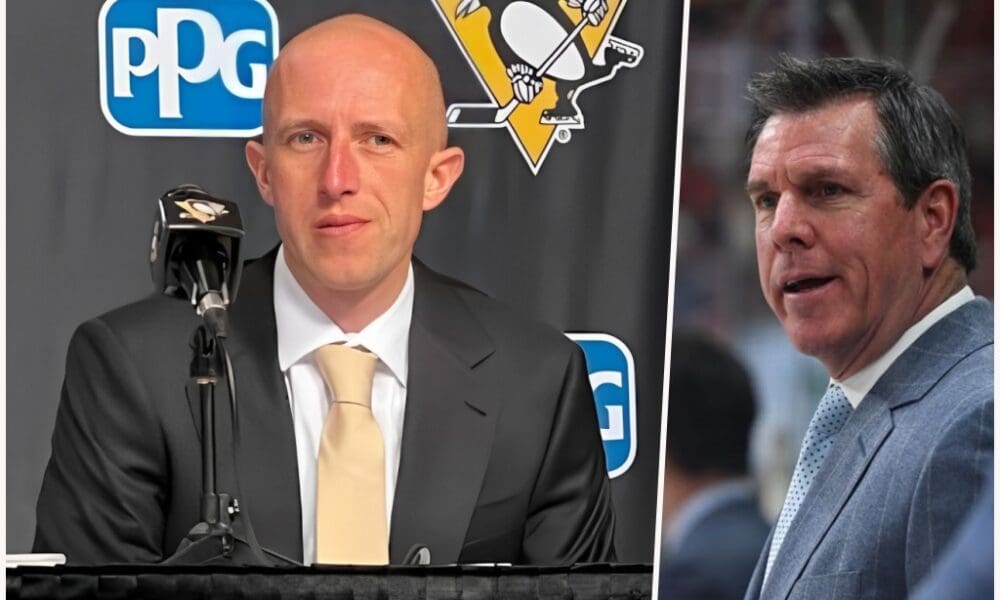
Perhaps being human has drawbacks, most notably the lack of omniscient hockey knowledge as Pittsburgh Hockey Now pushes forward daily on Pittsburgh Penguins coverage and analysis. As Penguins general manager Kyle Dubas navigates the murky and choppy waters of the off-season, and chums the NHL trade waters with valuable veteran players, much of the off-season is following the script.
But not everything.
Nor have I been right on everything over the past year or two, actually.
As a matter of accountability and some fun for those who seem to disagree with me daily, we can lay out a few of the things that may have looked right or sounded right at the moment, but were later proven to be wrong (or you were right).
After being up close to the new-look Pittsburgh Penguins coaching staff, as well as Dubas, assistant GM Jason Spezza, and Wilkes-Barre/Scranton coach Kirk MacDonald over the past few weeks, the Penguins universe is coming into focus.
So, what did we get right, and what did I get wrong?
Mike Sullivan
PHN questioned Sullivan’s tenure, but we didn’t think ownership and management would take the plunge to fire him in April. In fact, we wrote a couple of heavy pieces that used Dubas’s own words to question Sullivan’s future, but the end still seemed surprising nonetheless. We actually got that part right, as Dubas shocked many of us and leaped into a new era.
What we got wrong was timing. While many fans had long wanted a new coach behind the bench, it seems that 2022-23 was the moment that the Sullivan era truly broke. After a Round One series loss to the New York Rangers that they deserved to win in 2022, the team collapsed at the end of the 2022-23 season, giving away an assured playoff spot. The Penguins were neither good nor competitive again, suffering only hot streaks of emotional engagement for the past two seasons.
The canard and tropes of hating young players or not making adjustments were just that, canards and tropes, but they publicly obfuscated the real underlying issue that was the Penguins’ lack of fire for two years running.
We certainly saw it, and called it out in December 2023 (Read More: Penguins Grades: Internal Frustration, Something is Deeply Wrong), but I should have been bolder. The column calling for Sullivan’s job was written and approved by other PHN staff in March of 2024, following a disastrous loss to the Washington Capitals and the obvious sulking following the Jake Guentzel trade, but was not published. Such a column is tough to walk back, and I didn’t believe in my gut that the Fenway Sports Group was eager for the change.
However, here’s what brought the hindsight into focus: Dan Muse.
Talking with Muse and assistants Todd Nelson and Mike Stothers was more refreshing than a tall glass of lemonade in August. Their small media availabilities were engaging, sometimes funny, but informative, too. They shared philosophies, talked about hockey, and were accessible.
They were everything that Sullivan was not, including to some players. Sullivan had grown too powerful and too familiar.
The calm and the enthusiasm of the new staff will bring new optimism, and the comparison to the past few years is unmistakable. Perhaps a change after the 2022-23 season might have given Sidney Crosby one more playoff run, but hindsight is easy (except for those of you who carped upon it for years).
In fairness, it was easy to believe that Sullivan was the right person for the job, and–just being honest–many of the people clamoring for his dismissal had been doing so consistently regardless of the situation. With hindsight, it should have happened a couple of years earlier.
Trade Prices
On multiple occasions, I have opined that Rickard Rakell was a three-asset trade piece. I think Dubas agreed, or still agrees.
However, the market clearly is not ready to pay up my perceived value for a 35-goal, 70-point winger who, excluding a disastrous start to the 2023-24 season, has been quite good beside Sidney Crosby and Evgeni Malkin since being acquired three years ago.
Rakell has a very underrated physical streak, sharp playmaking, and his finishing ability is akin to a 30-goal scorer.
Yet, the NHL trade market seems to be not nearly as enthusiastic as my evaluations. I do not necessarily understand why Rakell hasn’t garnered a higher price yet, but that is the reality. Building on Tuesday’s column, we were told prior to the draft that the LA Kings had called on Rakell. The Seattle Kraken and others seem to be good fits.
I’ll double down on the opinion–I would take Rakell at $5 million over Nikolaj Ehlers at $8.5 million.
However, it seems other GMs disagree, and thus (at least for now), I’m wrong.
What Did I Get Right?
Dubas has been methodical in his approach. The firesale talk at mid-season was obviously not true, but Dubas hung the shingle over his office as early as January. He’s been selective and has not sold below market value, or, as some may argue, at market value.
Dubas is selling and building, but he’s got a longer-range plan.
I think we called it–there would not be bigger free agent signings, and moves now are for the 2027-28 season. The signings of Anthony Mantha, Justin Brazeau, and Alex Alexeyev are for the future or the scrap heap. If they flunk out of Muse school, it will be easy to move on. If they succeed, they have trade value or long-range potential.
In fact, this writer is intrigued by Brazeau’s size and still somewhat untapped potential. If the Penguins’ development staff and performance staff can help him along, he has more to give. That is very much true of Alexeyev, too.
I think we uncovered the Rosetta Stone of the Dubas Code when we looked ahead two seasons to see that almost none of the veterans are under contract. When you compare that to the Florida Panthers and other contenders, who have their core and complementary players under contract for years, the Penguins will have a clean slate in ’27-28.
Kris Letang, Ryan Graves, Rust, Rakell, and Tristan Jarry are the only vets who have a contract beyond the next two years. It also does not require Sherlock Holmes to deduce that most of them will not be with the team in a couple of years, or that the vets who have struggled will have enjoyed a great turnaround.
The Dubas Code. Maybe we will coin that, eh?