
It has been eight months, almost to the day, since the NCAA voted to open up eligibility to Canadian Hockey League players. We’re now weeks away from the official Aug. 1, 2025 date set by the Division I Council.
The flow of college hockey commitments from OHL, QMJHL and WHL players is now ramping up as each school’s admittance deadline for the fall semester approaches — as are CHL clubs’ efforts to develop relationships with agencies and NCAA programs and recruit players across the border in the other direction from U.S. minor hockey, Canadian Jr. A and the USHL.
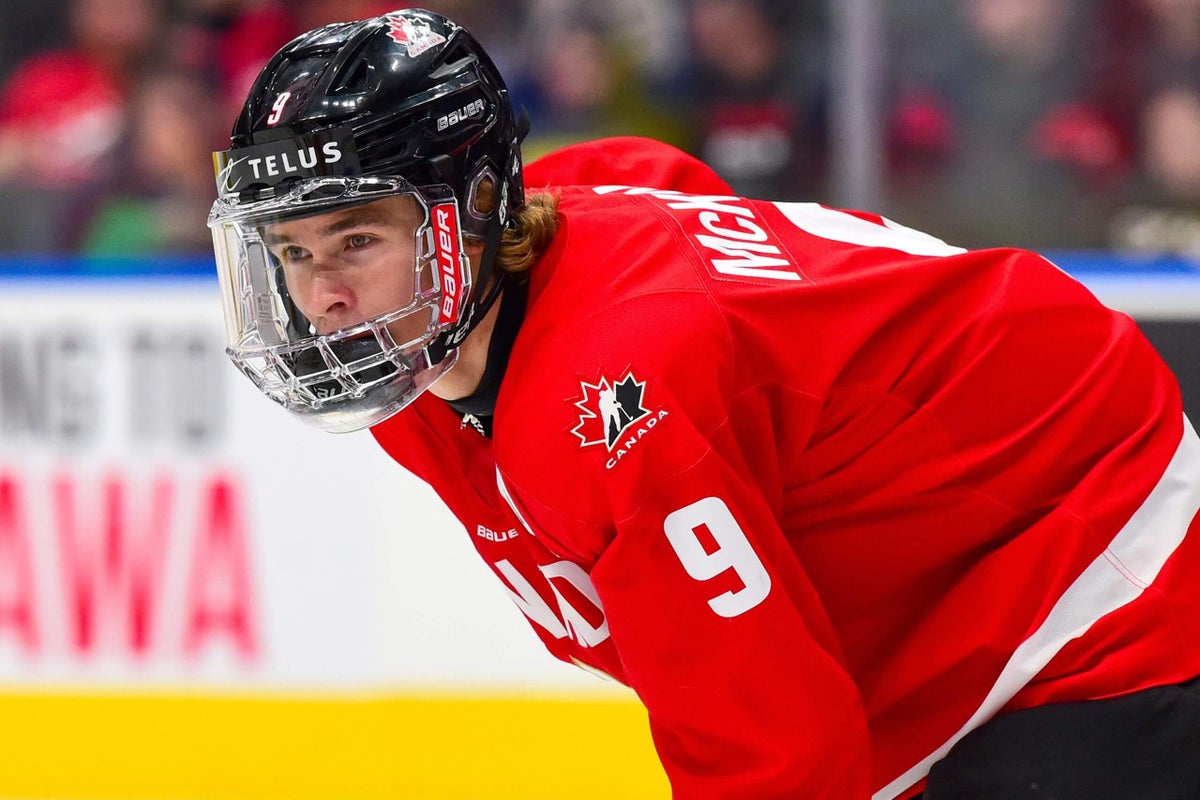
On Tuesday night, when the reigning CHL Player of the Year and No. 1 prospect in the 2026 NHL Draft class, Gavin McKenna, announced on ESPN’s SportsCenter his decision to commit to play his draft year at Penn State University, it marked the biggest decision since November’s rule change and arguably the biggest freshman recruitment in the history of college hockey.
Here’s where the landscape stands and what it means for the NCAA, CHL, Penn State and the rippling impact of NIL money in the sport.
Different approaches around the NCAA in new era
Penn State’s approach in this new era of recruiting has been pretty clear: The Nittany Lions have positioned themselves and their NIL pot as a major player financially and are looking to capitalize on the momentum of a Frozen Four appearance to sell their first-class facilities, coaching staff (led by head coach Guy Gadowsky) and Hockey Valley as a new top destination for players.
But more interesting than that to me over the last several months has been the different ways schools are going about their sales pitch. Michigan State has really sold its coaching staff under Adam Nightingale and the renewed history and facilities at Munn Ice Arena to successfully recruit top classes and transfers. I heard a lot about Boston College, Boston University and Maine spending time in QMJHL rinks this year, and Maine has had some positive early successes tapping into Quebec and eastern Canada for players. Colorado College under Kris Mayotte has smartly recruited mid-round picks who were top players for their CHL teams, but are maybe not marquee names. Nebraska-Omaha is trying to carve out a reputation as a U Sports recruiter and has successfully recruited a class of former top CHLers who didn’t get pro deals and were stars at Canadian universities last year. North Dakota is using geography, history and a new staff structure to go after the top players in western Canada and has already landed two big ones in top 2026 prospect Keaton Verhoeff and 2025 first-rounder Cole Reschny. And there are other programs, like the University of Minnesota which has so heavily focused on players from within the state for so long, that haven’t yet made the same kind of inroads.
Who has success doing what is going to be one of the fascinating stories of the next few years in college hockey.
The CHL will still be the CHL
I think there’s been a bit of hyperbole and conjecture in all of this about the ultimate fate of the CHL.
There have been a little over 150 commitments made by CHL players to the NCAA. Of those, roughly 85 percent are graduating or 19-year-old players, meaning only a little over 20 players aged 17-18 have so far made the move for next year. In the last couple of weeks, several first-rounders who had interest from top NCAA programs, including Jake O’Brien, Benjamin Kindel and Lynden Lakovic, have decided to return to the CHL and sign entry-level contracts with their NHL clubs. (Look out for a few more in the next couple of weeks.)
It’s still a sensitive topic and time for the leagues, their teams and owners and fans in 61 hockey markets.
The counterflow back the other way and into the CHL has been real as well, though. More than 25 USHL players made the move to the CHL this season, and others, like Sharks second-rounder Haoxi Wang, made the move out of Canadian Jr. A and into the league. In the fall, college-bound USHL players like Blake Montgomery and Lev Katzin made quick decisions to come north. Other top young Canadian players like Adam Valentini and Caleb Malhotra, who didn’t previously have the CHL as an option after they made NCAA commitments, are now choosing it as their preferred path into college. A record number of American players were taken in the 2025 OHL Priority Selection. Some of the bigger programs think they can challenge the U.S. NTDP for top American talent now. The Quebec Remparts were aggressive in the QMJHL draft, targeting prospects in the U.S. The Saint John Sea Dogs have a history of pulling American players from the northeast of the U.S. that they can now lean on. The Penticton Vees, the CHL’s newest franchise, have a similar history out west and established relationships with NCAA programs. I’ve heard that franchises like Portland, Moncton and Kitchener have also worked hard to establish lines of communication with agencies and schools.
“There’s this big thing that we hate them and they hate us, but we’ve all got buddies who coach in the NCAA,” one OHL general manager told The Athletic.
“In my eyes, build a good program, have good coaching, development, communication, then why would they leave? It’s the best development league in the world,” said another OHL general manager.
Just last week, the Brantford Bulldogs secured USHL and Czech national team star Adam Benák, a Wild prospect, in the CHL Import Draft. The Regina Pats drafted USHL goalie and Red Wings prospect Michal Pradel. The Sea Dogs drafted Olivers Murnieks, a potential top-two-rounds pick in 2026, who played last season in the USHL. On Monday, I got a text about Nikita Klepov, another potential top-two-rounds pick in 2026 who played in the USHL last season and may end up in Saginaw next year. The list goes on.
“Once everything kind of settles, is it a bad thing? I don’t know if it’s a bad thing,” said a QMJHL head coach.
The $ — and NIL — of it all
Money talks.
It has always talked loudly in hockey, an expensive sport made up predominantly of well-to-do people.
But it’s talking louder than ever in the sport right now, and McKenna’s package from Penn State has set a new bar. Not that long ago, top NHL prospects were telling me they were getting branded sweaters and free meals at local restaurants as their NIL packages. McKenna’s package, all in all, is rumored to be upwards of $700,000 USD — or in and around a million CAD. (I haven’t been able to verify that number with people connected to McKenna, but it’s the biggest package ever given to a college hockey player.)
The CHL’s three leagues remain in good positions to hold their standings as the NHL’s top leagues for developing players. Several markets, including Brantford and Ottawa, have new arenas in the works. On Tuesday morning, at the height of McKenna Watch, the Drummondville Voltigeurs announced a complete overhaul of their Centre Marcel Dionne. There is big money behind organizations like Moncton and Saint John. In May, players’ area upgrades were announced for The Aud, Kitchener’s legendary arena. Other teams have reached out to their municipalities for the first time in decades in an effort to take this moment to improve their facilities and offerings.
“It puts a little bit of the onus on the owners of upscaling what they have to offer for facilities,” one OHL coach told The Athletic.
However, many CHL clubs can’t compete with the money and facilities offered at the big American schools. I’ve been to dozens of the CHL’s rinks and virtually all of the NCAA’s big schools. I’ve been behind the scenes at Wisconsin’s Kohl Center and Labahn Arena, and Michigan State’s newly upgraded and iconic Munn Ice Arena. I know what they’re up against. But where the money goes, the players will benefit. That’s true in both the NCAA and CHL, where the developments of the last year are only positive for what they mean for the pockets of the players and the amenities and paths they’ll have available to them on either side of the border.
There’s fear within the CHL and the NCAA that the rich will get richer and smaller markets and schools will have an even tougher time competing with the likes of London in the CHL and the powerhouses in the Big Ten or Hockey East than they already do, but smart hockey and business minds will find niches and avenues forward.
A program-shaping time for Penn State
The Nittany Lions didn’t become a Division I hockey program until 2011. When they did, they brought in Guy Gadowsky, previously of Princeton and Alaska-Fairbanks. In their second season as a Division I program, they played as a conference-less independent school. They’ve yet to produce an NHL player of note. But after a stunning run to the Frozen Four following a difficult, testy start to last season, they’ve now suddenly emerged, with their big-money backing (and their Pegula Ice Arena — with all of its bells and whistles — named after it), as a front-runner in the recruiting race for top talent. Last year’s team helped turn Nashville Predators prospect Aiden Fink into one of the country’s top scorers and overager Charlie Cerrato into a second-round pick, but they’ve never had a best-in-class freshman class, or even a freshman class of any notoriety. Now, after landing big transfer portal gets like Mac Gadowsky, Guy’s son, and goaltender Kevin Reider, they’ve also lured freshmen like Blue Jackets first-rounder Jackson Smith, Flames prospect Luke Misa and now McKenna.
And it cannot be overstated what McKenna does for the Nittany Lions. Not only is it a transformational time for the program and its boosters, it could create another potential giant in a Big Ten conference that had already had quite the glow-up over the last several years thanks to the re-emergence of Michigan State and the continued relevance of Michigan, Minnesota and Wisconsin (albeit with mixed on-ice results for the latter).
A player like McKenna in Hockey Valley was unthinkable a short time ago. Part of the impetus of his decision was to put his mark on the program he chose. In choosing Penn State, he changes everything for them.
(Photo: Leila Devlin / Getty Images)