
Gavin McKenna is the presumptive 2026 first-overall pick and will play hockey this season at Penn State before presumably enjoying fame and fortune as an NHL player beginning in the 2026-27 NHL season. This week, his decision to bolt Canadian junior hockey was more than a ripple in the pond. It signaled a seismic shift in thinking.
And player development.
Canadian junior hockey updated its transfer rules for this season and beyond, but the CHL still prohibits NHL organizations from plucking players who have not yet played four juniors seasons and stashing them in the AHL, regardless if teams think its better for the player.
The rule makes for weird situations like the Pittsburgh Penguins’ 2024 second-round picks. Harrison Brunicke was selected 44th overall but is not eligible to turn pro except to play in the NHL until next season. Tanner Howe was selected 46th overall by the Penguins, and he will turn pro this season, after he heals from a torn ACL.
So, why can Howe turn pro a year after being drafted and play in Wilkes-Barre/Scranton (or Wheeling), but Brunicke cannot?
There isn’t a really good answer except the CHL wants to protect its integrity and believes older players help develop the younger players. It’s a legitimate theory but has held back many prospects over many, many years. Penguins director of player development Tom Kostopoulos would like to see changes, especially as it relates to Brunicke.
“I think (it does present development challenges). I think it’s a good question,” said Kostopoulos following the conclusion of Penguins Development Camp. “I think it’s something that the league should look at because (Brunicke) has probably played his way out of junior hockey. He might be it might be ready for a step up.”
Kostopoulous touched on the issues regarding the limitations of junior hockey. When Auston Matthews was in a similar spot as McKenna, Matthews chose to play a year in the Swiss League to face increased competition. Such drastic measures are no longer necessary, but McKenna has kicked down the mental constructs that kept players beholden to traditional thinking and paths.
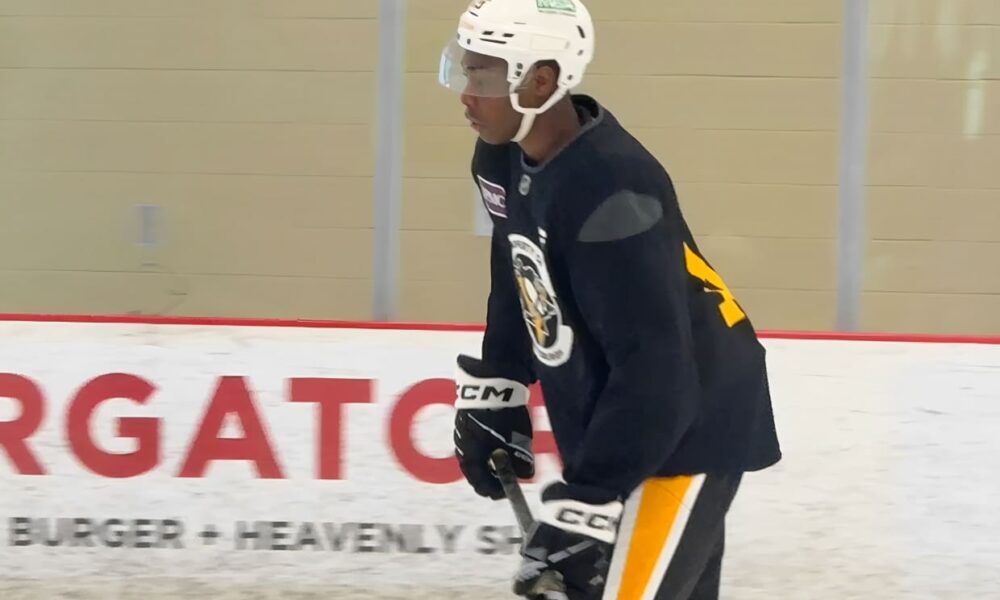
After observing him at the Penguins Development Camp, it would not be a bad idea for Bill Zonnon to follow McKenna’s lead. Zonnon is 6-foot-2 and about 190 pounds. He was clearly bigger and stronger than most of the Penguins prospects, and will be bigger and stronger than most players in the QMJHL league, too.
As fellow Penguins first-rounder Will Horcoff gets a hockey education at the University of Michigan with top notch player development staff and facilities, Zonnon is scheduled to play for the Blainville-Boisbriand Armada.
While Blainville-Boisbriand plays in a well-regarded arena, it’s a 3100 seat barn that is half the size of the facilities available to Big 10 hockey players, and those who go to the blue blood programs of the northeast, such as Boston U, Providence, and Boston College. And now, Penn State, too.
In addition to larger facilities and more personnel available, the players are bigger and stronger, too.
The latter point is why the Penguins should seriously consider directing Zonnon and other prospects to college hockey immediately.
(As a side note, if a local university is serious about a hockey program, it would be an extraordinary coup to make a deal with the Penguins to use PPG Paints Arena and recruit the Penguins’s prospects so they have quick access to the full breadth of the Penguins’ player development staff and performance department. Essentially a minor league team on scholarship. If inferred university sees this and takes the idea, you’re welcome.
And if you don’t think deals like that are coming, you haven’t paid attention to the absolute destruction of amateur collegiate athletics over the last three years.)
Last season, was Zonnon’s third in the Q, and he posted a very healthy 83 points with 28 goals in 63 games. One would expect him to dominate this season.
Third-round pick Charlie Trethewey will get a good education on the ice and the classroom at Boston University but second-rounder Peyton Kettles (39th overall), will play with the Swift Current Broncos of the WHL. Kettles has been somewhat overlooked amidst the clamor over three first-round picks and Trethewey’s local ties to the Pens Elite Program, but the 6-foot-6 shutdown defender is in the indentical situation that Brunicke found himself in, and is two years away from being able to turn pro.
Steady and stay-at-home defensemen don’t typically stand out in the 4v4 Development Camp scrimmages, and Kettles was no exception. However, he too would seem to benefit from the facilities and competition of college hockey.
Since the idea is only in its infancy, we do not expect a mass migration from the CHL to NCAA this summer or next, but even the Penguins 21 and 20-year-old Finnish prospects at Western Michigan (Iiro Hakkarainen and Joona Vaisanen, respectively) showed a different level of polish to their games and thus impressed at Development Camp.
The downside is that college players can’t realistically attend rookie camps, play in rookie tournaments, or attend training camp (in theory they could, but they cannot play against other teams, cannot miss classes, and have to pay their own way).
As more players jump to college hockey for the competition and NIL money, which is significant in some cases, the competition level will also improve, further exacerbating the developmental differences for players entering their 20s and offsetting any negatives.
Perhaps Zonnon would like a Go Blue sweatshirt or to play in the Beanpot. It might very well benefit him and the Penguins. It seems now the question is if the Penguins will be ahead of the curve and nudge their prospects to college or wait to see if it unfolds as we all think it will.