
The Montreal Canadiens shed a few bad contracts this offseason, with the departures of several free agents. It’s getting to the point where their “worst” contracts don’t necessarily count as bad… just not as good as the best.
Related: Canadiens’ Best Contracts for 2025-26
It’s obviously a process, similar to the rebuild. And, while the Canadiens aren’t legitimate contenders yet, they under general manager Kent Hughes’ watchful eye are establishing themselves as an incredibly hard team to beat.
That many of the players on this list of the team’s worst contracts heading into 2025-26 indisputably contribute to that culture is very telling. If the Canadiens really wanted to, they could probably trade every name on this list, albeit with varying degrees of the hypothetical return coming back. Push come to shove, they probably wouldn’t, with one exception:
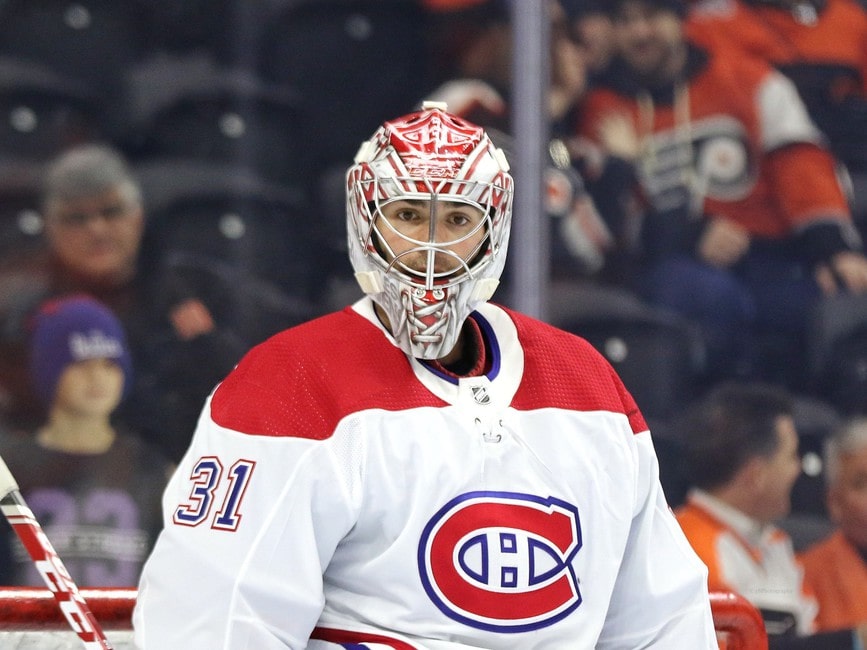
5. Carey Price ($10.5 million cap hit)
As Canadiens beat writer Marco D’Amico has explained in the past, even if the Habs put Carey Price’s $10.5 million hit on long-term injured reserve as anticipated to have it not count against the cap, they’d still prefer to avoid doing so. The practice presents complications regarding performance bonuses and turns into a vicious cycle of sorts. So, the ideal scenario has always been to trade Price’s contract, which is a weird sentence to write, because it implies he’s still active despite having been in the conversation to be named to the Hockey Hall of Fame a few weeks ago.
 Montreal Canadiens goalie Carey Price – (Amy Irvin / The Hockey Writers)
Price’s play in the history of the organization is clear. He’s one of the greatest Canadiens goalies ever. However, the contract was still one of the worst on the team, even when Price was still playing. They couldn’t even give it away to the Seattle Kraken in 2021. However, there is good news on the horizon: Price only has a single year left (at a base salary of just $2 million), making it theoretically an attractive asset to a team looking to get above the floor.
One way or another, this Price’s final year on this list.
4. Noah Dobson ($9.5 million)
About a year ago, it seemed as if the Canadiens were determined to keep Nick Suzuki’s $7.875 million cap hit at the top of the payroll (excluding Price). Then last summer they acquired forward Patrik Laine and the remaining two years of his contract which carried a hit of $8.7 million.
Then, just before the NHL Entry Draft this year, the Canadiens traded for defenseman Noah Dobson, who, fresh off signing a new deal, has a new-team-high hit of $9.5 million. That’s huge. Consider how the Habs still have to re-sign the 66-point-scoring, Calder Memorial Trophy-winning Lane Hutson to an extension. As an offensively dynamic, but perhaps more-well-rounded defenseman, he’ll probably expect a similar contract in his near future. That’s not the issue here, though.
Dobson is capable of scoring 70 points, which is impressive. However, he’s done it just once in his career, in 2023-24. He dropped to 39 points this past season. If he continues to produce like he can, the deal becomes worth it, based on the going rate for a top-end “offenseman.” If he produces like he just did, maybe not.
There are extenuating circumstances, in that Dobson is just 25 and in the prime of his career. Furthermore, with the retirement of David Savard, they had a vacancy on the right side on defense. Combined with a presumed desire to build on their playoff finish, the Canadiens kind of had no choice, because Dobson does make them a better team. Sometimes you just have to go for it.
In that light, the Dobson deal is more so a risky than overtly bad contract. In some ways, Laine’s hit hurts more just because he only scored 33 points in 52 games this season. However, as Laine only has one year left and Dobson does eight, it’s not like the former can come back to bite the Canadiens at this point. They’ve already made the playoffs, in large part because of Laine, which must have been the goal when Hughes acquired him.
The next goal and subsequent stakes are much higher now.
3. Jake Evans ($2.85 million)
Jake Evan’s new deal also isn’t bad per se. For a face-off-capable, 29-year-old bottom-six centre, it’s quite reasonable, especially when you consider ex-Canadiens pivot Christian Dvorak just signed with the Philadelphia Flyers for $5.4 million for one year, nearly double Evans’ $2.85 million hit. Obviously, Evans, who signed for four years, opted more for job security. Therein lies the problem.
You can’t really count on Evans being as effective by the tail-end of the deal, especially from an offensive standpoint. He is coming off career highs of 13 goals and 36 points (Dvorak had 33), but off an unsustainably high 16.3% shooting percentage (9.8% in his career). Signing his extension on March 4, the at-one-time pending unrestricted free agent shot just 4.8% in his final 21 games of the season, scoring a single goal… into an empty net in the final game of the season.
Seeing as Evans probably got extended largely on the strength of his offensive totals, it’s actually reasonable to say he disappointed down the stretch. To be fair, his new hit only comes into effect next season. Hopefully the next four years more closely resemble his first half of 2024-25 from a scoring perspective, in which case the deal will end up being great instead of one that’s just okay.
2. Josh Anderson ($5.5 million)
To Josh Anderson’s credit, he just rebounded from a horrible previous season, in which he scored nine goals and 20 points. The 15 goals and 27 points he tallied in 2024-25, while not significantly higher in magnitude, nevertheless came in a reduced role, leading many to believe he’s finally found his niche with the Canadiens.
It seems to have taken the Canadiens running out of room in their top six for Anderson, having gone to that well far too often in previous seasons without him having found sustained success there, for them to discover he’s actually a bottom-six forward. What’s ironic is, for a time, amid Laine’s even-strength struggles, Anderson’s line of misfits with Brendan Gallagher and Dvorak produced as if it really were the second line.
From March 18 to April 8, a span of a 12 games over which the playoff berth-chasing Canadiens went 7-3-2, Anderson scored five goals and seven points in 11 appearances. Gallagher meanwhile totalled six goals and 13 points (12 games). There’s a good case Anderson was more of a complement to him (and Dvorak), but there’s nothing wrong with that, based on what he brings to the table as a speedy power forward who’s unafraid of throwing the body and throwing fists if the situation calls for it. It would just make him more of a fit if his cap hit aligned with that role.
1. Brendan Gallagher ($6.5 million)
So, why does Anderson rank where he does and Gallagher at No. 1? Anderson’s intangibles, younger age and lower cap hit, primarily. Ultimately, it says two things that Gallagher is coming off an objectively pretty good season, but that his contract still ranks as arguably the worst on the team:
It was a pretty bad contract to start.
The Canadiens are doing pretty well from a salary-cap standpoint, in spite of it.
The sad truth is, Gallagher is no stranger to this list, for all his heart and respectable secondary scoring, especially last season, when he notched 20 goals for the first time since 2019-20. It’s still literally the fourth straight season he’s been ranked No. 1, through little fault of his own.
 Montreal Canadiens forward Brendan Gallagher – (Jess Starr/The Hockey Writers)
Gallagher is really only guilty of:
Putting the team first throughout his career
Putting his body through the wringer on the regular in the process
Accepting a huge contract when someone offered him loads of money
Just about anyone would do the same, relative to the third point directly above. Few would Points 1 and 2, at least not to the same degree. For that, he arguably deserves everlasting appreciation from the fanbase. If it should happen to come in the form of an inflated $6.5 million cap hit for a few remaining years, as the ceiling continues to increase, that’s beyond tolerable.
If Gallagher should so happen to replicate his 2024-25 production again this coming season, his ranking on this list in 2026 may have to finally be reassessed. Another thing Gallagher has going for him, is 2026-27 will be the last year of his contract. So, the deal, as it becomes more tradeable (despite his no-movement clause), won’t be quite as daunting.
What Canadiens fans need to ask themselves is, can they even really picture a Habs team without him? As hard as it is to have to place him at No. 1, it may be harder to respond to that last question in the affirmative. Maybe, just maybe, he stays.
