
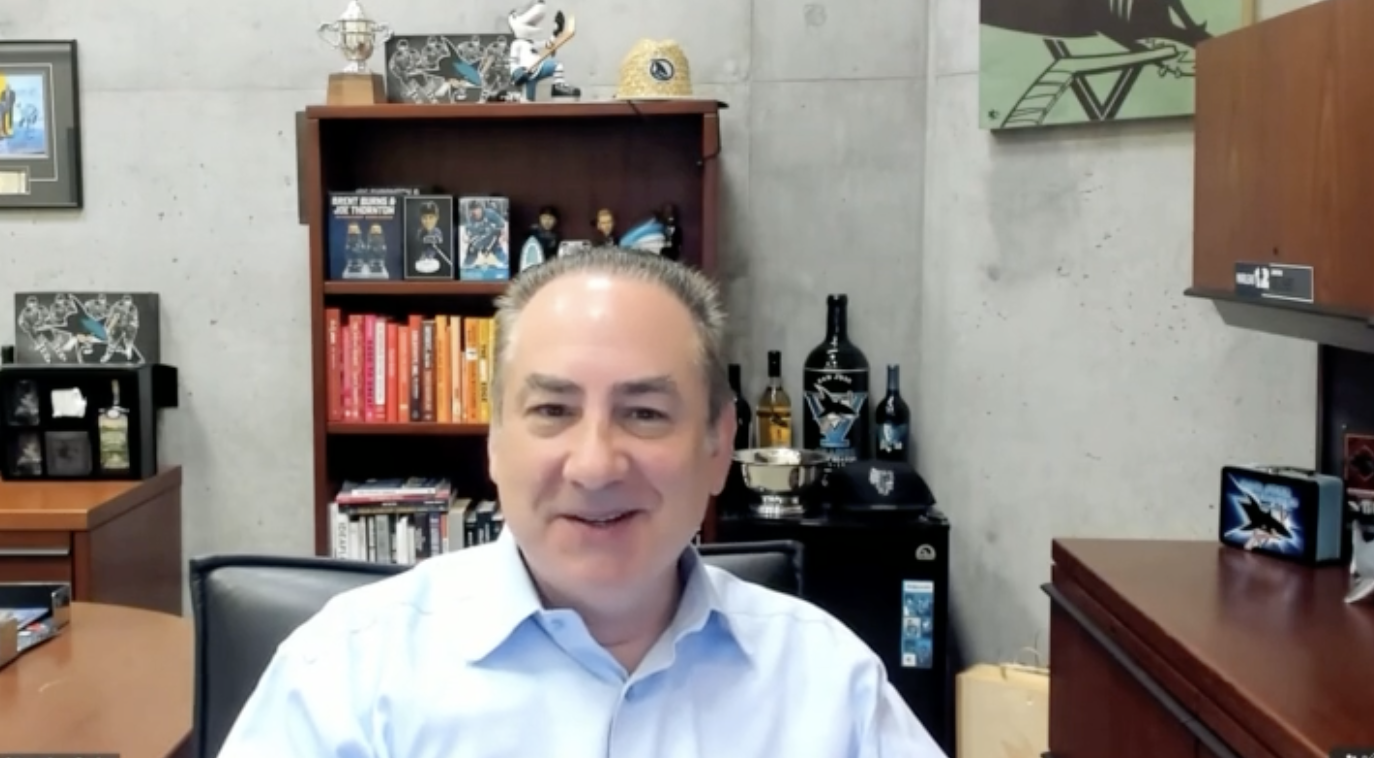
(Jonathan Becher, President, San Jose Sharks)
Historically, SAP missed a couple of notable CRM shifts. But is there another chance now – to go where the puck is moving?
That issue jumped out during a media/analyst discussion with SAP customer San Jose Sharks – so yes, the pun was intended.
What does modern CX look like for SAP customers?
SAP CX has its own messaging. But what if I step back and ask: what would modern CX look like for SAP customers, and what could SAP offer that is different from the other CX vendors in play? Three things jump out:
It should be easy for me to plug in the SAP CX components I need, even if I am running CRM software from other vendors.
Those CX components should help me to compete in an environment where omni-channel customer expectations are high: from personalized experiences on the one hand, to hassle-free, quick transactions on the other hand.
I should derive additional value from SAP CX via my back end ERP investments.
Notice I did not say anything about AI. SAP is talking a lot about “Intelligent CX” (you can hear this AI positioning via the SAP CX Live virtual event replay). Getting this multi-channel thing right doesn’t start with AI; it starts with data. Get the data part right, and AI gets a whole lot easier. SAP’s AI plans matter here, but AI can only solve for so much.
Sprinkle gen AI techno-candy on top of an inadequate or disjointed customer experience, and AI isn’t solving much of anything. However, there are interesting data shifts pertaining to AI:
Can AI help us to use unstructured data more effectively?
Can AI help us fuse structured and unstructured enterprise data into a better customer result?
San Jose Sharks’ Jonathan Becher: “We’re in the experience business now”
How can we validate SAP’s progress here? As I wrote in Is SAP CX ready for the AI-driven retailer?, it’s time for me to hear from SAP customers. Last time around, I featured a revealing conversation with Aldo about their AI plans – one that put AI firmly in the context of bringing out the best in human teams. On the day prior to CX Live 2024, another media/analyst virtual session brought a familiar face into the fold: San Jose Sharks President Jonathan Becher, an interview sparring partner of mine from eons ago, when Becher was pushing marketing envelopes at SAP.
During his talk with Ritu Bhargava, SAP President & Chief Product Officer, Customer Experience (CX/CRM) & Industries, Becher laid out the unique challenge faced by the San Jose Sharks (note: Sharks Sports and Entertainment is comprised of a number of businesses, including two professional hockey teams).
As Becher explained, most businesses want to turn customers into “fans” of their brand. Whereas Becher’s team wants to turn fans into customers:
The way I tend to think about that is we’re in the experience business. What we actually do is create reasons for people to come together, in our case, mostly in person, but occasionally digitally as well, and make lasting memories for our guests. Create experiences that they remember, and those experiences could be based on a sports game, a concert, an ice skating lesson, a restaurant meal, lots of different things. The heart of the DNA is the experience.
But Becher makes a crucial point: delivering on that experience has changed. Customers want more:
The modern expectation, the modern formula, is much stronger than that, and so you have to expand your definition of when the experience starts and when the experience ends… In my world, if the weather is bad or if traffic has an accident, or is heavier than normal, then one of our guests, or maybe many of our guests, may miss the beginning of a concert or the puck drop at a game that negatively impacts their experience.
Now the first reaction is, ‘Well, that’s not my fault. We didn’t control the weather,’ – but it doesn’t really matter, because that’s the memory they’ll live with. The negative memory is stronger than all the positive things we do, so therefore, we have to expand our mental model of what our experience looks like. We have to work with local authorities, consider alternative transportation, and encourage people to find different ways in there, or sometimes even delay the starts of events to deal with that.
Yesterday’s technology stack can’t support the needs of today’s customer
If experience is the bar, then your competitive landscape changes also. Becher’s biggest competitor isn’t other sports teams, or even other urban activities – it’s the couch.
My direct competitor isn’t really other live experiences. It’s figuring out how to get people off their couch and then back home safely. So technology has a huge role to make this experience happen, to broaden those end to end. But when it works, it feels a little bit like magic. It’s invisible, frankly, to most of our customers, and it’s certainly got to be frictionless. When it really works well, our guests benefit from it, but don’t necessarily notice the technology.
This is where modernization hits you head on. As Becher told us, you aren’t delivering this with yesterday’s technology stack:
Sports teams are anchored emotionally in the past… We’re more of a forward looking organization. We have a vision statement; we call it our BHAG. Our big, hairy, audacious goal is that we want to pioneer the future of sports and entertainment. The idea is the mental model of experimentation and quick adaption. That’s why we are so cloud-based with our IT infrastructure. We want to be able to grow and change, and we want to be able to try new things. When they work, do more of then. When they don’t work, shut them down.
Quite frankly, we can’t afford what I would describe as the old days of IT, where there are long, detailed assessments and multi-year deployments. We’ve just got to try things and then move on, and because all our units are interconnected… If there’s a bottleneck at one entry gate in an arena or in one food stand, or there’s too long of a line in a store, or if the bespoke app that we built is down or not functioning correctly, the fan experience will take a hit.
Given all these interconnections, you better shore up your own weaknesses:
We almost have to think about everything as an integrated chain and look for the weakest link and build up that weakest link. Whereas normally, you would say, ‘Go find the thing you’re best at and double down on that.’
San Jose Sharks – SAP CX progress report
So, Mr. Becher, how is SAP doing? What do we have to show for this? Becher shared a marketing success:
Last season, for the first time, we used all this technology on what’s called our membership renewal campaign. That’s the biggest part of our business, or at least the biggest revenue part of our business. For those of you that know the technology world pretty well, membership renewal is a little bit like the SaaS business model. It’s a bit like subscription renewal is for you, or in to B2B as well. The most important measurement there is renewals and upsells.
Using all this technology, last season, we got our renewal plus upsells just shy of 90%, which was above our target of 85% – and more than ten percentage points higher than the previous season when we didn’t use SAP CX technology. So I can’t give all the credit to you Ritu, but a big part of that was because we were able to much more easily build a more engaging and relevant campaign for individual people.
The easiest way for me to see that is on the engagement rate, the amount of times that people interacted with a campaign in more than one step, and how long they spent doing that. And that nearly doubled from before using SAP CX to after using it. For what it’s worth, 90% is a phenomenal renewal rate in this industry.
So what are the SAP tech components Becher is using? Becher says across the business, they are running “11 different SAP cloud ops.” In the customer experience area, the key SAP apps are the customer data cloud, Emarsys for email marketing and guest management, and SAP Sales Cloud and SAP Analytics Cloud. But what really stood out for me was Datasphere:
In the last couple of years, our emphasis has moved from the Business Technology Platform more to the guest experience. That’s what you at SAP would probably call CX, the customer experience. At the heart of that strategy is Datasphere. If I were to oversimplify what we’re trying to do with Datasphere, we’re trying to get meaning out of all the data we have.
On a good week and a good month, we have somewhere between 15 to 20 different data sources. Many of which don’t have what you would consider a modern API, an easy way to get data in and out of them. So the heart of Datasphere sits as this middle hub, and masks all those differences for us, so that we can see what’s going on in each part of the business and then make those decisions.
Top AI lessons – unstructured data, experimentation, and changing the physical experience
Then, Becher brought out one of the biggest AI lessons of the fall event season: AI gets interesting with unstructured data – and a spirit of experimentation.
In the past, virtually all the insights we built have come from structured data, things that feel like rows and columns. We see the AI coming from SAP, from the CX AI toolkit and other things you’ve told me about, that you might want to build over time, as a way to extend out the analysis to unstructured data as well, to the data that we have that’s sitting in systems, mostly SAP systems, but some others as well – about the business, about our guests, about the fans, etc. And frankly, we have 10/15 times more unstructured data than we do have a structured data.
Becher sees a big difference between prior chatbots, and what he expects to do with SAP:
Chatbots work okay; the problem is they didn’t really have access to the data that’s in SAP systems, and so missed what I consider essential business context. So the CX AI Toolkit, because you’re closely embedded, obviously it’s coming from SAP as well – you can give a much more relevant answer.
Becher’s team gets deep into the pros and cons during these experiments:
A couple of years ago, we experimented with chatbots inside our app to help answer questions in real time during events like, ‘Where’s the closest food stand that sells a vegan burger?’ Chatbots work. The problem is they didn’t really have access to the data that’s in SAP systems, and so they they missed what I consider essential business context
The experiments won’t stop, but he sees more successful bots ahead:
We’re still very early in this journey. I think you guys just released this a few months ago as well. We’ve done a bunch of experimentation. If this was a hockey game, we’re still well in the first period. We have a long way to go, but we’re excited about all the different experiments that we could run.
Becher thinks his team can take AI further – and bring the same personalization to physical experiences that are used on digital channels:
Most live experiences treat all the guests the same, and maybe there are modest changes for VIPs or members over time. We think we can adjust nearly every element of the physical experience, not just the digital one, based on individual preferences – and AI is the key to that vision.
My take
Before presstime, I asked ASUG CEO Geoff Scott for his latest view on SAP’s CX moves, with SAP CX Live in the rear view. While giving Salesforce the nod for capitalizing on this market first, Scott sees a way for SAP to make its CX presence felt for SAP customers now. How? Via proper application of customer data:
I think that there’s a huge opportunity for customers to look at SAP CX as a credible alternative, and an ability to couple data together, versus having to stitch it back together ex post facto. When we talk about a world where consolidated data models are essential, it takes one step out of the process.
Becher’s challenge to turn fans into customers turns CX thinking on its head; most brands would gladly swap challenges, and add more “fandom” to their customer base. But is there a middle ground? Isn’t the real payoff not just creating so-called experiences for our customers, but creating a palpable sense of belonging to something? Who doesn’t need more of that in their lives? If you wanted to cultivate belonging, wouldn’t that bring the question of AI and personalization into a different lens? I’d love to hear Becher’s take on that. Knowing how we tend to run into each other at unexpected times, it may not be too long.
For now, it’s a good sign to see the SAP CX stories piling up. The numbers and results are coming, but what I’m really hearing from customers is a validation that these solutions speak to issues beyond SAP, changing how they serve their own customers. If SAP can build on that long game – without losing this narrative in the RISE/GROW marketing Colossus, the AI (and the ROI) will be not be hard.
End note: for more context on this event, check out Isaac Goldberg’s How SAP CX Solutions Changed the Game for the San Jose Sharks on ASUG.com.