
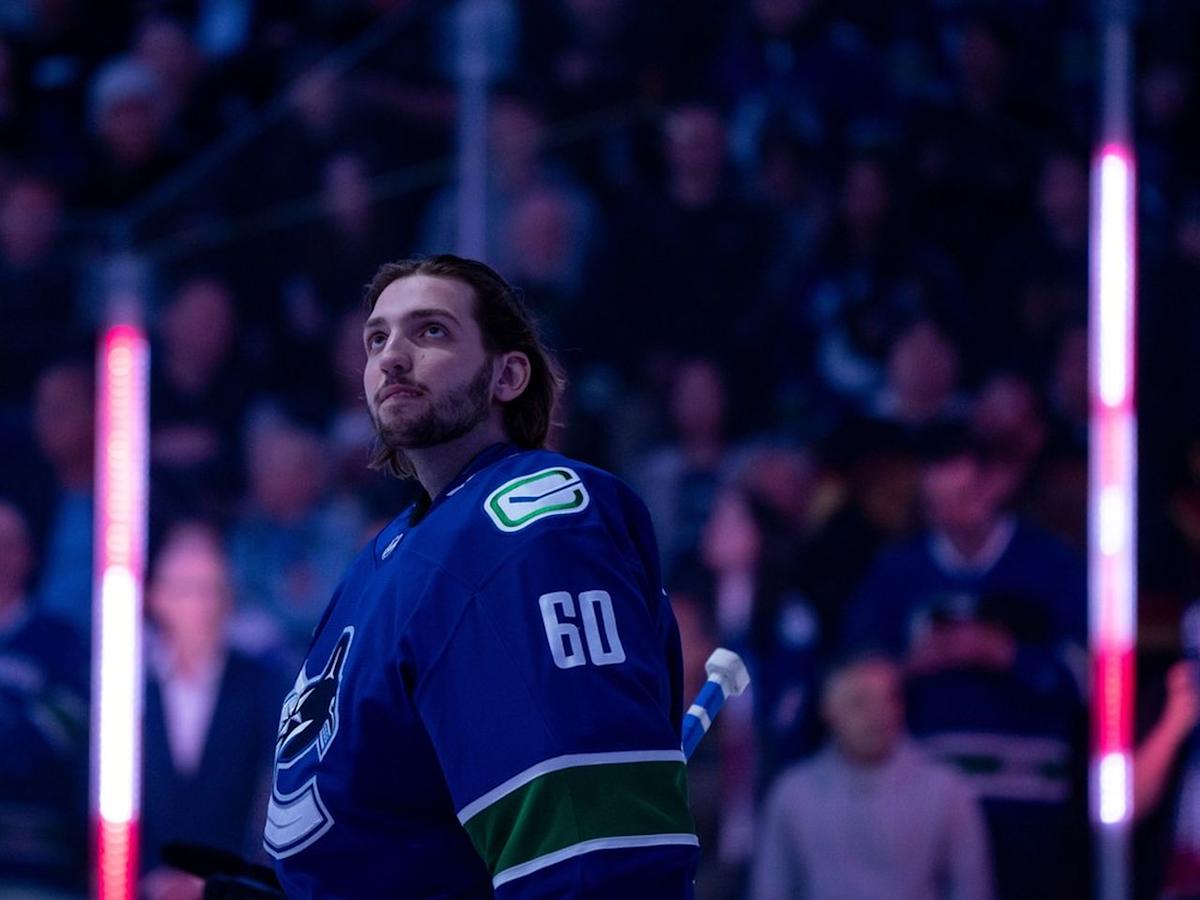
The journey is the adventure.
That summation is affixed to anybody trying to get somewhere in a chosen profession. And for towering Vancouver Canucks goaltender Nikita Tolopilo, it now carries more meaning.
His long road to the NHL from Belarus as an undrafted and undaunted dreamer got shorter Sunday when Arturs Silovs was traded to the Pittsburgh Penguins for winger Chase Stillman and a fourth-round selection in the 2027 NHL Draft.
Tolopilo, 25, also earned a two-year, $1.55-million US contract extension last week after a strong AHL season with Calder Cup champion Abbotsford Canucks, so it would be easy for the 6-foot-6, 229-pound Minsk native to have his head in the clouds amid positivity and future promise.
But that’s not Tolopilo. He knows staying humble in a game that can eat you up on or off the ice is imperative, because time moves fast.
Starting goaltender Thatcher Demko and back-up Kevin Lankinen are locked up financially, and Silovs would probably still be here as the No. 3 if he was waiver exempt. Now, Tolopilo is under a bigger microscope as the go-to guy in Abbotsford and the what-if guy in Vancouver.
What if Demko suffers another injury? What if Lankinen tweaks something? Tolopilo doesn’t dwell on that because he is dialled into the moment and not what may or may not occur.
Kevin Woodley of InGoal Magazine said the test for Tolopilo at the NHL level is to marry size with movements.
“It’s largely the pace and reads at the highest level,” Woodley told Postmedia on Monday. “He just needs reps to adjust and get comfortable keeping up with it. We saw a great game in a controlled environment, but tougher results in a more dynamic one coming off the bench.
“And that wouldn’t be a surprise with any goalie, but at that size the challenge often becomes moving without getting caught moving. It’s a process he’s only begun against NHL shooters.”
Tolopilo had the right adjustments and attitude April 14 in his NHL debut, the second-last game of a season gone seriously south for the Canucks. If he could stay square and calm and not overreact while running on adrenalin, his big night would be deemed a success. It went beyond that.
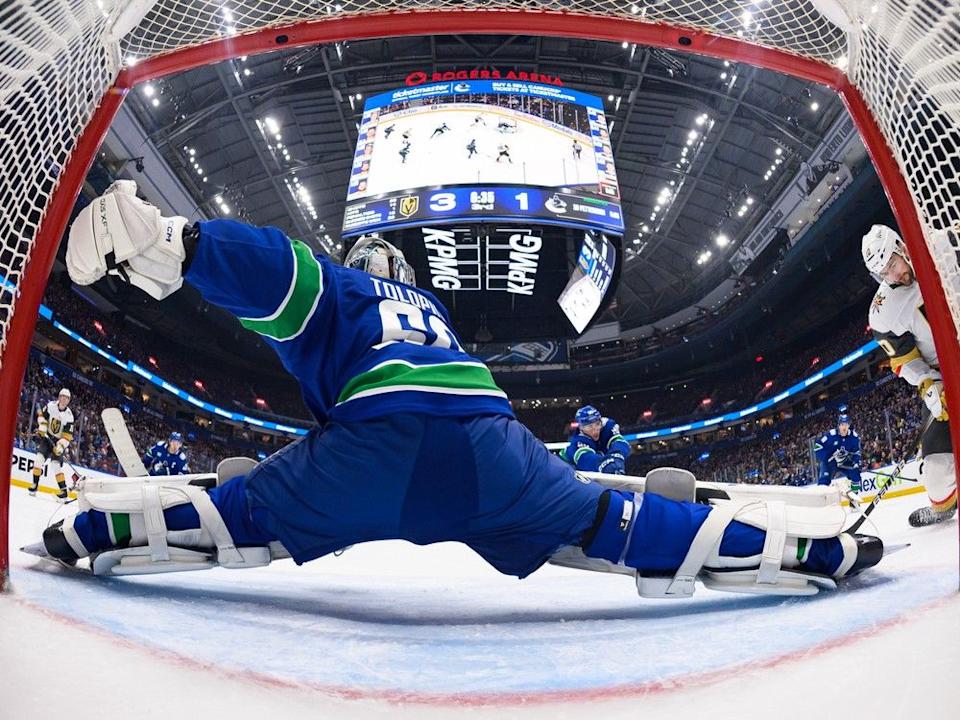
Nikita Tolopilo makes save on Nicolas Roy of the Golden Knights on April 16 at Rogers Arena. Vegas won 4-1.
He made 14 saves in a 2-1 overtime victory over the hapless San Jose Sharks at Rogers Arena, and his appreciation of the moment was a window on his competitive world. He didn’t look out of place in an NHL game played at a different pace where players are faster, passes are quicker, and shots pack velocity and accuracy.
“I was just so glad to get this chance,” said Tolopilo, who left home at age 15 to further his career. “A long journey for me and I’m so happy. I just want to build from this game, and it gives me more confidence for sure.
“You don’t need to find motivation. NHL is the best league in the world. I’ve been thinking about this since I was a kid and watching highlights. It’s tough to get here. They just don’t give it to you.”
Tolopilo finished with a 1-1-0 NHL record last season, 2.15 goals-against average, and .885 save percentage.
When Silovs cleared waivers last season to get his game in order after a short and rough NHL run that finished with a 2-6-1 mark, 3.65 GAA and .861 saves percentage, Tolopilo remained the capable, supportive and confident teammate.
He even outplayed Silovs and went 20-14-2 in the regular season with a 2.66 GAA., .902 saves percentage and four shutouts — including back-to-back blankings — to showcase improving skill. And in a league where games can be a scramble and when goaltending structure, tracking, and consistency are under constant fire, an ability to cover a lot of net didn’t go unnoticed.
Especially when Silovs got on a run and then took it to another level in the playoffs. His remarkable 16-7-0 record, 2.01 GAA., .931 saves percentage and five postseason shutouts — one shy of the AHL record — obviously drew the attention of NHL clubs, who knew Silovs wouldn’t clear waivers next season. He was trade bait.
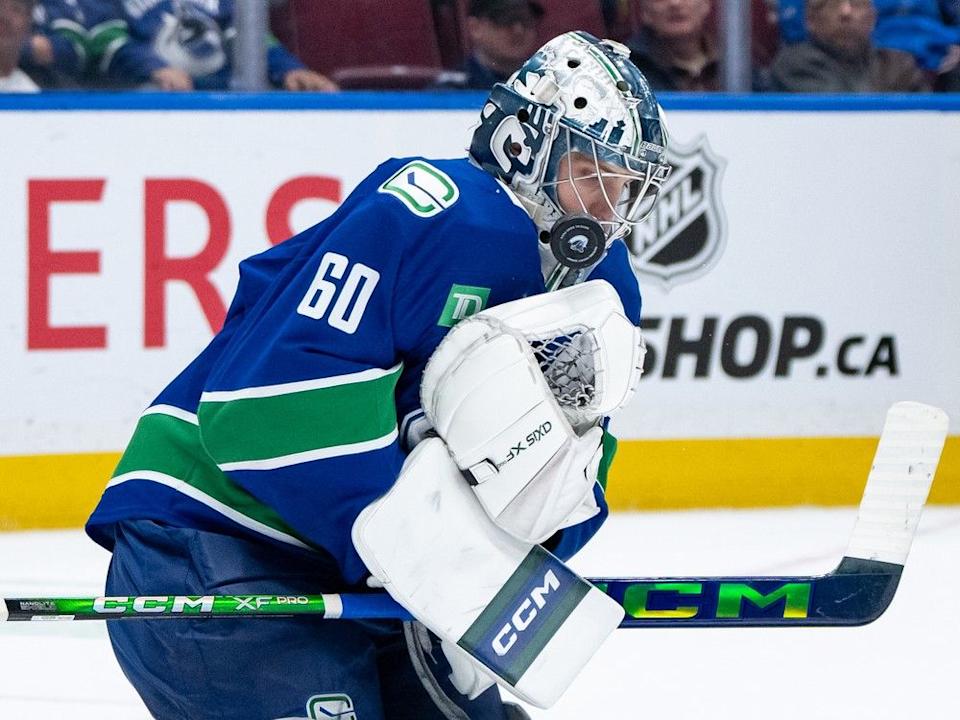
Nikita Tolopilo makes an overtime save against the San Jose Sharks during his NHL debut on April 14 at Rogers Arena.
The Canucks also know the goaltending position is demanding and draining, and injuries are a constant concern.
There is nothing to suggest Demko isn’t tracking to return to top form. He is training and skating and has a year left on his current contract before a three-year, $25.5-million US extension kicks in. The term was a clear indication of management caution.
Demko was a Vezina Trophy finalist in 2024 and that spoke to superiority when there is durability. In 51 games in 2023-24, before being sidelined by a freak popliteus knee-muscle strain at the back his knee on April 21, he posted a career-best 2.45 GAA., .918 saves percentage and five shutouts.
However, popliteus rehab became arduous. Demko didn’t see the net last season for the first 26 games and also missed 15 with an undisclosed Feb. 8 ailment. Prior to that setback, he was 3-1-1 with a 1.25 GAA, .952 saves percentage, and a shutout.
So, when healthy, Demko is very good. The Canucks are banking that. The pressing question is will the popliteus pop up again to be a problem?
“It’s such a rare injury, but it could occur again if (Demko) were to have a movement or contact that causes the injury,” B.C. physician Dr. Harjas Grewal told Postmedia. “It could happen with direct contact to the outer knee, or even just rotation of the knee while it’s flexed.
“Most muscles work to move the knee forward and backward. The popliteus is unique and important in starting flexion. To get into a butterfly, or any other position, initial knee bending is initiated by the popliteus.
“These types of plays happen a lot, and this injury is so rare that it would shock me to happen again. In terms of prevention, there’s not much outside of regular strengthening exercises and ensuring good mobility.
“Managing his workload helps to reduce risk, but that’s true for essentially all muscular injuries.”