
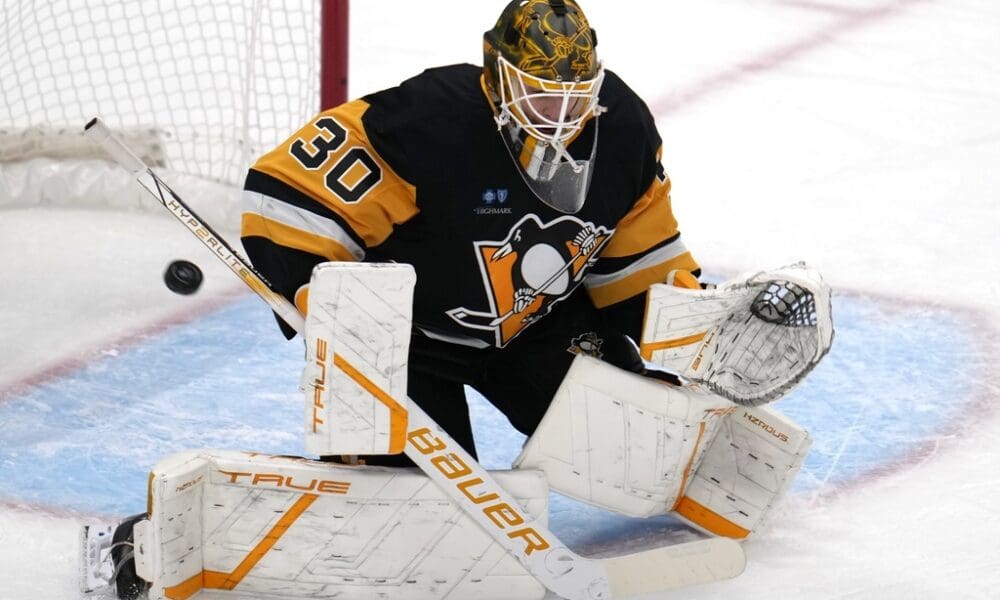
Over the past week, the Pittsburgh Penguins have made a couple of otherwise small trades that would typically not register large ripples in the hockey pond, but this is not a typical off-season, and every move the Penguins make could have larger implications for contending teams.
The Penguins are the only sellers on the market. At this moment, the team has essentially claimed a monopoly on trade boards and chatter as teams that whiffed in free agency are poking around the league to fill remaining needs, or looking at a luxury piece such as Erik Karlsson and pondering the possibility of making it work within their team and salary cap structure.
The Penguins are unique on the market, but not quite in the catbird seat, as there remains a bit of an incongruence between what they’re offering and what other teams want. Or at least there’s a difference of opinion on the value of what the Penguins are offering.
However, it was notable that following the Penguins’ most recent two trades, acquiring Matt Dumba and a second-round pick from the Dallas Stars and acquiring goalie Artus Silovs from the Vancouver Canucks for a fourth-rounder, not only did the trade chatter greatly increase, but the analysis of what those trades meant veered in sharply different directions.
Penguins Trade Counter Analysis
Penguins acquire Silovs:
From Jeff Marek on the Sheet to analysts across the league, the prevailing national ponderance upon the Penguins acquiring the big Latvian goalie was that it immediately and directly impacted starting goalie Tristan Jarry.
Marek joined a host of others who pondered if the Edmonton Oilers would finally get involved in Jarry trade talk. He certainly wasn’t alone.
We see it differently.
With respect to everyone connecting dots, they certainly make sense, but those connections don’t include the new Penguins goalie. No, the Penguins did not acquire Silovs as a starting goalie. His numbers and performance at the NHL level have been spotty, and he spent most of last season at the AHL level. To expect him to become a starting goalie after posting an .861 save percentage in 10 games last season would be a wild endeavor that has a much greater chance of catastrophic failure than success.
Silovs was the MVP as the Abbotsford Canucks won the Calder Cup, as his ability to rise to big moments was again evident. However, Silovs will have far less immediate impact on Jarry than he will on presumptive backup Joel Blomqvist. The Penguins trade was shrewd because Silovs and Blomqvist will battle for the No. 2 role, presumably spurring the best from both, or Silovs is an insurance policy against more Blomqvist struggles.
Of course, one or both of the young goalies (Silovs is 24, Blomqvist is 23) push Jarry; that’s only an added benefit of the trade. Little ventured, and perhaps a lot gained, but the only immediate pressure on Jarry will be to erase the disastrous 2024-25 season.
Of course, Sergei Murashov, 21, is quickly advancing in his career and might render the entire discussion moot at some point this season.
The Penguins could very well trade Jarry, but the timing doesn’t seem right, and it wouldn’t be because of acquiring Silovs–unless or until Silovs or Blomqvist force the issue as Jarry did with Matt Murray, and Murray did with Marc-Andre Fleury.
Trade 2: Matt Dumba
Many leaped to the conclusion that Dumba’s arrival meant the end of opportunity for young defensemen Harrison Brunicke or Jack St. Ivany. Local radio hosts were on that topic.
We disagree.
The Dumba trade was about spending $3.5 million on a second-round pick, not about the player. Yes, the Penguins now have six right-ride defensemen who could or should be in the lineup: Kris Letang, Karlsson, Connor Clifton, Dumba, St. Ivany, and Brunicke. Alex Alexeyev makes seven.
However, as Dubas attempts to corner the market on available righties, Brunicke can and should take precedence. Unfortunately, the new transfer rule allowing teams to place one 19-year-old in the AHL doesn’t begin until the 2026-27 season, but it still appears Brunicke will be given every chance to make the NHL roster.
There is no way that a team in the Penguins’ position would block a smooth-skating, puck-mover with NHL readiness in favor of Dumba.
It already seems a decided issue that Alexeyev will be sent to the Wilkes-Barre/Scranton Penguins so that he can log big minutes and find his game. One can easily assume that Dubas has no fears of waiving Dumba because the Penguins have already received what they wanted in the trade: that second-round pick.
Of course, training camp and preseason performances will matter greatly, and all members of the Penguins staff from top to bottom have been clear that young players must earn their spot. So, don’t worry so much about this one. If the young D-men earn their keep, they will indeed be kept.
What becomes more interesting is the logjam of bodies. What will Dubas do as the season approaches and he still has Karlsson on the roster?