
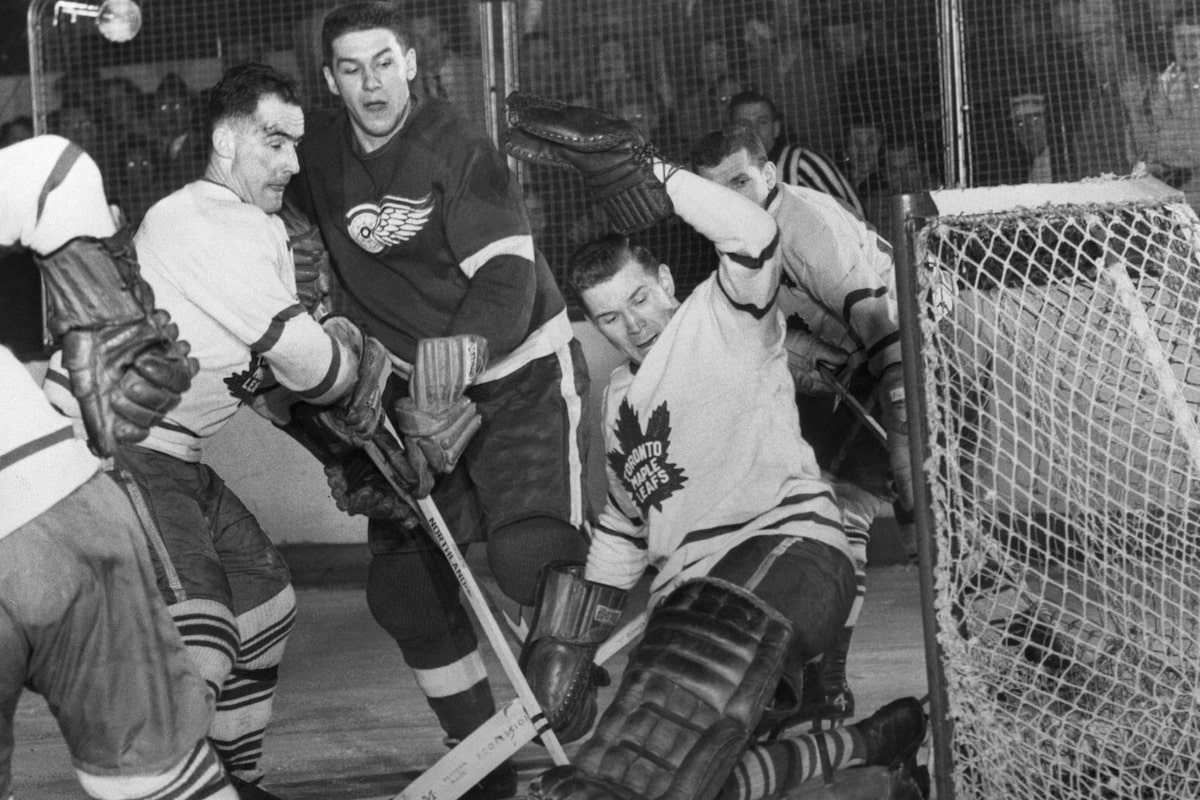
Alex Delvecchio, playing for the Detroit Red Wings, is firing the puck past Toronto goalie Harry Lumley for the Wings’ third and winning goal in the final period of the playoff game.Bettmann/Getty Images
By the age of 23, Alex Delvecchio had placed his name on the Stanley Cup three times. He kept skating with the Detroit Red Wings until he was 41, but he never won another championship.
For nearly a quarter-century, he quietly put together one of the greatest careers in National Hockey League history, though few outside Detroit paid much notice. The forward never won a scoring title, never was named a first-team all-star, never won a most-valuable-player award. Overshadowed by teammate Gordie Howe, it was barely noted upon Mr. Delvecchio’s retirement as a player that he was the league’s second-highest scorer of all time, trailing only his famous linemate.
Mr. Delvecchio, who has died at 93, was a durable and consistent forward who made teammates better thanks to his unselfishness with the puck. Known for crisp passing and clever playmaking, the centre also had a deceptively hard and quick shot delivered with little flourish.
A clean player on the ice and regarded as a gentleman off it, Mr. Delvecchio won the Lady Byng Memorial Trophy for sportsmanship three times. He also served as an unofficial ambassador of the sport, which led to him being awarded the Lester Patrick Trophy in 1974 for outstanding service to hockey in the United States.
A left-handed shot, Mr. Delvecchio spent more than a decade playing alongside Mr. Howe on versions of the famed Production Line: with Ted Lindsay during the 1954 playoffs, as a left winger with Norm Ullman at centre, and as a centre with Frank Mahovlich on left wing. All five players have been inducted into the Hockey Hall of Fame.
For his part, the good-natured centre who was known to enjoy cigars in the dressing room said the secret to his success was “hustle and skate.”
But his career suffered from the incompetence of Red Wings management. A dynasty was broken up by general manager Jack Adams with a series of ill-considered trades in the mid-1950s. Toward the end of Mr. Delvecchio’s playing days, the club hired college hockey coach Ned Harkness before promoting him to general manager, an era remembered by fans as the “Darkness with Harkness.” After his playing career Mr. Delvecchio assumed both coach and general manager titles, though he had no success reviving the club.
National Hockey League alumni, from left, Red Kelly, Ted Lindsay, George Armstrong, Alex Delvecchio and Kris Draper.Paul Sancya/The Associated Press
Alexander Peter Delvecchio was born on Dec. 4, 1931, in Fort William, which is now part of Thunder Bay. He was the fourth of five children born to the former Anne Tapak, the daughter of Slovakian immigrants, and Francesco (Frank) Delvecchio, an American-born son of Italian immigrants who was an automobile mechanic at the time of Alex’s birth and later became an engineer with the Canadian Pacific Railway. Alex’s mother died of ovarian cancer in 1943, when he was just 11 years old. Having learned to skate on an older brother’s hand-me-downs, he began playing organized hockey the following year. The youth signed with the Detroit organization after being scouted by Lou Passador.
At 18, Mr. Delvecchio was the leading scorer for the junior Fort William Hurricane Rangers, also leading the league in penalty minutes with a scrappy style of play. At the end of the season, he was added to the roster of the rival Port Arthur Bearcats for an unsuccessful defence of their Memorial Cup title.
At home, his father urged him to get a real job.
“He’d say, ‘You can’t eat pucks,’” Mr. Delvecchio told reporter Patrick Kennedy in 2021. “But I was determined to show him that while you couldn’t eat them, you could make a living playing with one.”
Detroit assigned him to the junior-A Oshawa Generals, where he led the Ontario Hockey Association with 72 assists in just 54 games. He also scored 49 goals, finishing second in league scoring behind linemate Lou Jankowski.
But despite his success, coach Larry Aurie told him he was no help to the club in the penalty box, a lesson later reinforced by Mr. Adams in Detroit.
“I was a hothead then, getting too many penalties for fighting and popping off to the referees,” Mr. Delvecchio once told The Hockey News.
He made his NHL debut in the final game of the 1950-51 regular season, seeing limited action in a 5-0 shutout of the Montreal Canadiens in Detroit. It would be the first of Mr. Delvecchio’s 1,550 NHL games, all with the Red Wings, during which he scored 456 goals and 825 assists. He scored another 35 goals with 69 assists in 121 playoff games.
Alex Delvecchio would go on to serve in both head coach and general manager positions for the Detroit Red Wings after his career as a player.Paul Sancya/The Associated Press
Though the stylish centre still had a season of junior eligibility, he was assigned to the minor professional Indianapolis Capitals. After just six games, during which he recorded nine points, he was called up to the parent Red Wings, a posting he would hold for 23 consecutive seasons.
In his rookie season, he was put on Detroit’s third line with Johnny Wilson and Metro Prystai, and the trio often had the duty of checking the other team’s top scorers. The Red Wings went on to win the Stanley Cup in 1952 by winning eight consecutive playoff games, during which Mr. Delvecchio recorded three assists. It was his first championship of any kind in hockey.
The Detroit centre got a single vote for the Calder Trophy for rookie of the year, which was won by Bernie (Boom Boom) Geoffrion of the Montreal Canadiens.
Mr. Delvecchio’s teammates had memorable nicknames. Mr. Howe was Mr. Hockey, Mr. Mahovlich was The Big M and Mr. Lindsay was Terrible Ted, but Alexander the Great – a moniker coined by newsreel announcers to describe Mr. Delvecchio – never caught on. He had been saddled since childhood with the unfortunate nickname Fats, which more than once led Mr. Adams to pick on a player who was far from overweight. The sobriquet had been bestowed by an uncle who thought his nephew had a round face.
The Red Wings repeated as Stanley Cup champions in 1954 and 1955. The slick-skating, six-foot, 195-pound centre emerged as a top scorer in the 1955 playoffs with seven goals and eight assists in just 11 games.
In Game 7 against the Canadiens that year, with the Cup on the line at the Olympia in Detroit, Mr. Delvecchio opened the scoring by grabbing a loose puck before launching a 15-foot backhanded shot over Jacques Plante’s right goal pad. Then, with Montreal trailing 2-0 at the start of the third period and pressing in the Detroit end, Mr. Delvecchio intercepted a pass by Don Marshall before outpacing a pursuing Tom Johnson, who harassed him from behind with his stick, to drive the puck past a desperately diving Mr. Plante. Detroit went on to win the game by a 3-1 score, clinching the Cup.
The consistent centre also proved to be durable, rarely missing games with injuries. One exception was a broken ankle suffered early in the 1956-57 season, which forced him to miss 22 games.
Upon his return from the injured list, Mr. Delvecchio began a streak of 548 consecutive games played, which ended nearly eight years later when he suffered a hairline fracture to his jaw after being struck by a shot by former teammate Red Kelly. He only missed two games on that occasion.
He was made captain in 1962, an honour he would carry for 12 seasons until retiring as a player.
Chicago Blackhawk goalie Tony Esposito stretches to block Alex Delvecchio’s shot during a Stanley Cup hockey playoff game in 1970.The Associated Press
Mr. Delvecchio won the Lady Byng Trophy for ability, sportsmanship and gentlemanly conduct in 1959, 1966 and 1969. On the first occasion, his general manager told reporters Andy Hebenton of the New York Rangers was more deserving.
For the 1968-69 season, Mr. Delvecchio, 37, centred a line with Mr. Howe, 40, on right wing and Mr. Mahovlich, 31, on left wing. The veteran trio set league records for goals (118) and assists (264) by a forward line, both marks later surpassed.
The late-career success, coming after the NHL expanded to 12 from six teams, earned Mr. Delvecchio a cover of Hockey Illustrated magazine. The headline read: “Alex Delvecchio: Quiet, but Great.”
Mr. Delvecchio played alongside Mr. Howe for 20 seasons. He assisted on 210 of Mr. Howe’s 786 goals with the Red Wings, more than any other player.
Over his career, Mr. Delvecchio skated in 13 all-star games. He also played in eight Stanley Cup finals, losing five. He only twice received league end-of-season honours, being named to the second all-star team in an era dominated by such centres as Jean Béliveau and Henri Richard of Montreal, Stan Mikita of Chicago, Dave Keon of Toronto and Phil Esposito of Boston.
A month before his 42nd birthday, Mr. Delvecchio retired as a player to become Detroit’s coach, the seventh man to hold the position in five years. When he got home that day, his wife said, “You have joined the ulcer department.” Seven months later, he was named general manager, but his four years upstairs and behind the bench failed to revive a Red Wings franchise widely derided as the Dead Things. In 1977, Mr. Delvecchio was fired and replaced by Mr. Lindsay, his old linemate.
The centre’s No. 10 sweater was officially retired by the Red Wings in 1991.
A bronze statue of Mr. Delvecchio by Omri Amrany stands on the concourse of Little Caesars Arena, the Red Wings current home, near statues honouring Mr. Howe and Mr. Lindsay. The statues were originally unveiled in Joe Louis Arena.
Mr. Delvecchio stands in front of a statue of him after its unveiling at Joe Louis arena in Detroit, Michigan.Rebecca Cook/Reuters
Mr. Delvecchio was inducted into the Hockey Hall of Fame in 1977, his first year of eligibility. He was named one of the NHL’s 100 greatest players on the league’s centenary in 2017. He was inducted into the Northwestern Ontario Sports Hall of Fame in his hometown in 1982 and into the Michigan Sports Hall of Fame in 1977, as part of a class including former U.S. president Gerald Ford, who was honoured for his football career with the University of Michigan Wolverines.
Near the end of his playing days, Mr. Delvecchio launched an eponymous public-relations company and acquired a sign-making company which produced plaques, corporate gifts and other promotional materials.
Mr. Delvecchio died on July 1 at his home in suburban Rochester Hills, Mich., about 40 kilometres north of Detroit. A cause of death was not announced. He leaves his second wife, Judy Munro, a painter. He also leaves five children, 10 grandchildren, four great grandchildren and a sister. He was predeceased by two brothers and a sister.
Mr. Delvecchio was the last living member of the 1952 and 1954 Stanley Cup teams. Glenn Hall, who played two regular-season games in 1954-55 for Detroit, is now the lone surviving member of that championship team, though his name was not engraved on the Cup as he was only a spare during the playoffs.
Red Wings players join coach Jimmy Skinner in their dressing room to celebrate their 3-2 victory over Toronto Maple Leafs in the 1956 Stanley Cup semi-final series opener. Alex Delvecchio sits on the far left.The Associated Press
In 1974, the Detroit organization held a night in Mr. Delvecchio’s honour at the Olympia, the arena that was his home for more than two decades. He received a note of congratulations from Pope Paul VI and a telegram from Mr. Ford, then U.S. president. Another telegram sent from his Thunder Bay hometown ran for 28 pages to include the names of hundreds of supporters.
He received gifts, including a US$2,000 cheque from the NHL to donate to charity, as well as two pieces of luggage and a battery-operated portable television from the players.
“The best gift I could ask for on this day is a win,” Mr. Delvecchio told a reporter.
Instead, the Red Wings lost 4-1 to the Los Angeles Kings.
“I’m glad it only went three periods,” he said after the game. “We were getting worse.”
Special to The Globe and Mail
You can find more obituaries from The Globe and Mail here.
To submit a memory about someone we have recently profiled on the Obituaries page, e-mail us at obit@globeandmail.com.