
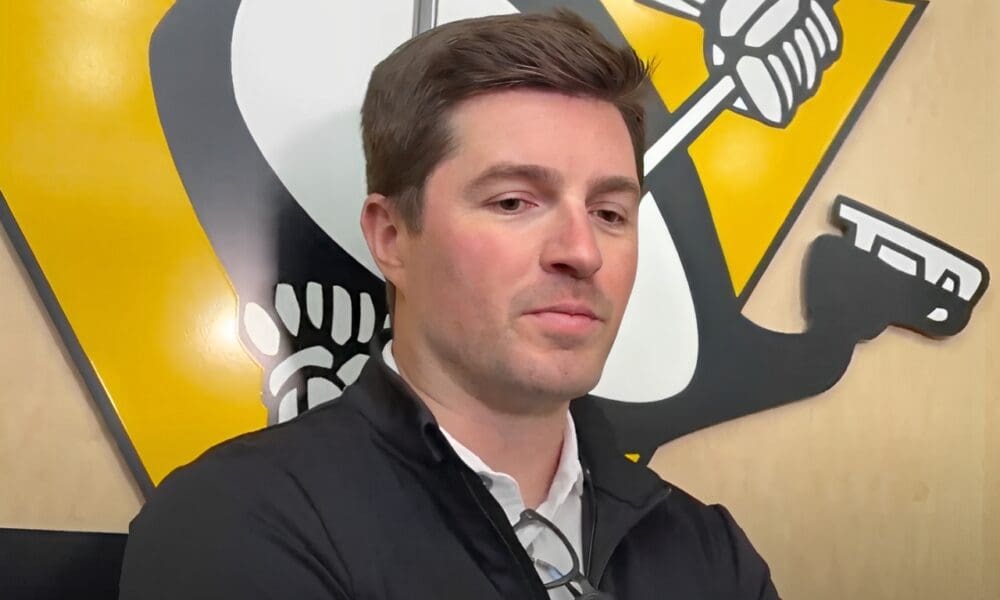
Unless the offer has the wow factor, the Pittsburgh Penguins will not trade winger Bryan Rust.
It could be a bit of posturing one day before Rust loses his no-movement protection, but general manager Kyle Dubas upped the ante for the reportedly high number of teams who have kicked the tires or made aggressive pitches for the scrappy winger.
Dubas’s statement was the latest in a summer of tight-ropping between the past and future attempting to avoid hitting rock bottom and wandering through an aimless rebuild endlessly awaiting the arrival of the next generation of players but still building a team that will again contend before the decade is over.
“It means a lot to the team. (Rust) has been a part of the team for 15 years since he was drafted. So unless it’s something that blows us away in terms of what it returns–that it can very easily be looked at to help us return to contention–that would be a tough one,” said Dubas. “But we’ve gotten lots of calls on him. He’s a great player, he’s signed, but he’s also a massive member of the Penguins. We’ll continue to be open for business, but the price will be very high.”
Dubas’s comments followed a first-of-its-kind press conference Monday at the UPMC Lemieux Complex in which the Penguins introduced their prospects to the media by setting a stage at center ice with chairs and cameras some 20 feet away. The 13-member 2025 draft draft class was so large, photos were difficult and even Dubas had a cheat-sheet with him as he anchored the stage with a split session press conference featuring the largest draft class since the 11-round 1994 class had 14 players.
And to put to rest any concerns the Penguins decided not to trade up in the draft, Dubas put it succinctly.
“I think to move up (into the top 10) in the first round–there was just no appetite for any team to move, really.”
RFAs
As Dubas raised the bar on Rust, he will be parting with most if not all of the team’s restricted free agents. The deadline to qualify restricted free agents is this afternoon, but Dubas and staff have already made their decisions.
The team is qualifying Vasily Ponomarev, who signed in Russia last month. The offer will retain his rights for several years if he decides to return.
Otherwise, none have been qualified. Only two forwards might stick around as the team is still in conversations with Philip Tomasino and Connor Dewar. However, P.O Joseph will again go to free agency.
Dubas was clear the team has eyes for a couple of restricted free agents whom they believe will be available and they can begin those conversations at 7 p.m. Monday.
Perhaps one of those players is the target of many trade stories here at PHN and elsewhere: Nick Robertson of the Toronto Maple Leafs, who acquired a similar player via trade Monday when they traded for Matias Maccelli. However, several more enticing RFAs figure to be available, and Dubas is interested in more than a one-year contract.
In fact, Dubas essentially rolled out the red carped for some RFAs looking for a chance, but again eschewed any big-name free agents.
“The types of players that you could expect (in free agency) are not dissimilar from last summer,” Dubas said. “Unless there were RFAs or trade that we would do with long-range deals with players–we’ve got a number of players in mind that we think we can give good opportunity to, and they won’t be the one-year contracts; maybe two or three (years), where we can see if they can be a long-term part of what we’re trying to do here and be a part of it when the team is back in contention.”
Development Success & Failure
Dubas lit up when asked about the challenges of player development. The inner hockey geek emerged with a dedicated answer, including one of his biggest regrets as a general manager.
As the GM of the Toronto Marlies, they signed Mason Marchment as an overage juniors player in 2016. Marchment admitted not just that he needed to improve his skating, but that he, “needed to learn how to skate.”
That’s when Marchment was 21. He spent most of his first professional season working with the skills coach rebuilding his skating stride. Things progressed through the ECHL but eventually to the NHL and Marchment played four games for the Toronto Maple Leafs in 2019-20. However, Dubas traded him to the Florida Panthers for Denis Malgin.
Believe it or not, the move still haunts Dubas as Marchment has become an impact player. He scored 22 goals with 47 points in 62 games for the Dallas Stars last season.
“I think the greatest example I’ve ever seen on the skating side (development) is Mason Marchment. We signed him to an American League deal as an overage in Toronto … we didn’t play him for a long stretch of the first year because he needed to build up the foundation and you see the type of player he’s turned into,” said Dubas. “We traded him in Toronto. I think about it every day in terms of being a mistake. A big one, probably one of the biggest for me. But he would be the player that I think of in terms of that’s grown the most and developed the most in one specific area.”
Specifically with the Penguins, Dubas understands the need for skating improvements and developments. Some will be closer than others, and some may need a few years. Yet Dubas isn’t necessarily harping on what he knows, as much as where the game is going.
Teams used to work on individual skills and offense, but now add defense to that development program.
“In the beginning, when we started, we focused so much on skill and offense and play making and I’ve had to adapt my view of that and how we are going to improve these guys as defensive players,” said Dubas. “And so that’s been a major focus and you’ll see it here (in Development camp). You look every year and watch the playoffs every year, and the ability to go back and retrieve a puck under immense pressure is hugely important. We’ve started to build that in as a key centerpiece of everything we want and part of our program. You’ll see that throughout the development camp.”