
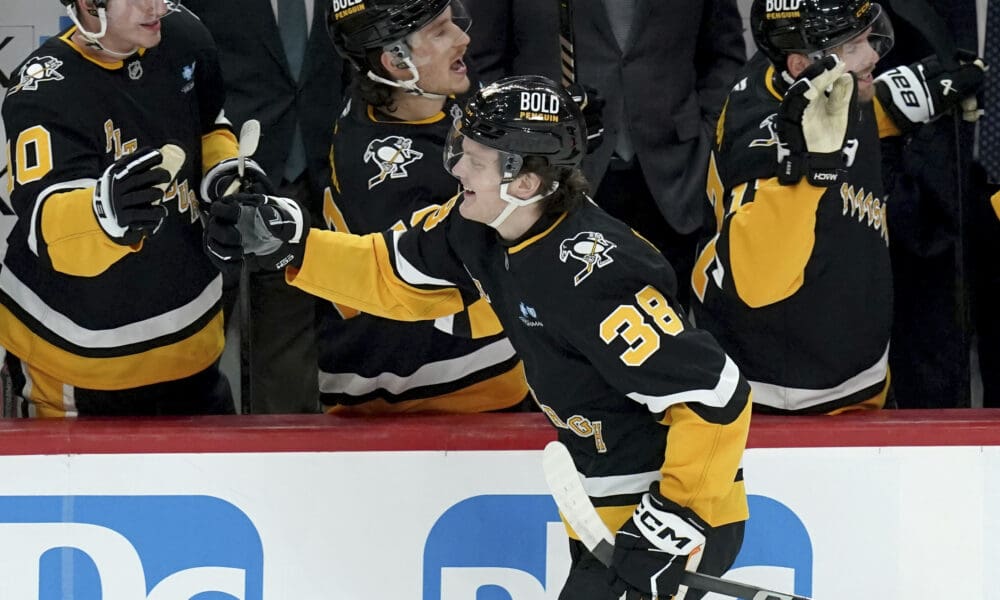
Where once there were none, now three first-round draft picks fill the top 10 Penguins prospects list, and the extraordinary realization that this is only Nos. 10 through six, not even the top five.
This is the fourth of five stories in the series of the Top 25 Penguins prospects.
The list is a far cry from the blunders and miscalculations of top-round choices that highlighted the Penguins’ most successful decade in franchise history from 2009 through 2019. The team had seven first-round picks from 2008 through 2014, promptly traded one (Kasperi Kapanen) for Phil Kessel a year later, and had five of the six fail to make an impact at the NHL level, and the prospect pool dried up after 2017.
The only first-rounder from that period to stick around was Olli Maatta, who was selected 22nd overall in 2012 and helped the team to the back-to-back Stanley Cup championships in 2016 and 2017. The other names are a painful reminder of the cost of injuries and bad selections, such as Derrick Pouliot, Beau Bennett, and Simon Despres, none of whom made an impact with the NHL club.
However, president of hockey operations/general manager Kyle Dubas has invested heavily in player development and performance. New techniques and technology were on display at the most recent Development Camp. According to Dubas on a recent podcast, the team also believes it has identified ways to discern players who can greatly improve their skating vs. those who are limited, thus the team was not afraid to take a few players they felt had other attributes, such as hockey IQ.
And so the prospect list also becomes much more important as the new era is on the horizon. Soon, the core three will dwindle, the veterans who have posted big numbers will be elsewhere, and the team will be in the hands of several players who are currently not even on the top-five list yet.
PHN will note our selection criteria for the Top 25 Penguins prospects is a subjective mixture of measuring a player’s ceiling against how soon they will arrive with the Penguins.
Top Penguins Prospects, Nos. 10-6
10. Joel Blomqvist
The Penguins’ goalie had a golden opportunity to seize an NHL spot following a stellar 2023-24 season in the AHL. Dubas specifically cited him as a player ready to push for his NHL sweater, and wanted to see Blomqvist perform well in the AHL playoffs as a means of proving he was ready.
However, Blomqvist, 23, had a bad couple of games in those AHL playoffs, and the Wilkes-Barre/Scranton Penguins’ season was quickly over. The team re-signed Alex Nedeljkovic a month later, but Blomqvist forced the issue in training camp, pushing the team to carry three goalies.
However, Blomqvist was increasingly shaky, allowing four goals in three of his last five starts and getting pulled in the first period of another. In November, he was sent down for a couple of months to reset and retrench. His next big chance was in mid-January when the team waived Tristan Jarry. However, Blomqvist’s performances didn’t greatly improve, and he again looked like a shaky rookie.
Blomqvist is a nice mixture of athletic and big goalie. When he’s on point, he’s calm, steady, if not a bit of Matt Murray-type steely. When he’s off his game, the rebounds pop to the circles and stoppable shots slip past.
Blomqvist is only 23, but he is reaching that awkward stage of being too good for the AHL but not yet good enough for the NHL. With the recent addition of Arturs Silovs, Blomqvist’s situation would appear to be complicated unless the team moves Jarry. He is still waiver-exempt, which might work against his immediate NHL future.
9. Tristan Broz
Broz may not have the same top-six upside, but then again–he might. Since being moved to center in his final season at the University of Denver, Broz has blossomed. He was on track to play in the NHL last season until catching mono put him back to square one.
Broz, 22, was the team’s second-round pick in 2021, so it seems like he’s been on the board forever, but as a winger, he didn’t necessarily project as an NHL’er. His growth over the last two seasons has been fantastic, including leading Denver to a National Championship and the WBS Penguins to near the top of the AHL standings. With a less crowded roster, he would seem to be guaranteed an NHL spot in October, but instead, he may be an unwilling casualty of the crowded house.
Hey, don’t dream it’s over?
We like his game and his build (6-foot, 205 pounds) as a third-line center with some offensive upside, but he has thus far exceeded expectations over the past year. Broz’s first professional campaign had somewhat misleading statistics because he spent the first part of his season adjusting to the league, and then later in the season, recovering from a difficult illness.
In 59 AHL games, he had 19 goals and 18 assists. Broz has filthy mitts when he gets the space to use them, and we’re not putting a limit on his potential. The ninth spot on this list seems too low, but the list is packed.
9A: Artur Silovs
We debated his inclusion because he was a sixth-round pick in 2019, but ultimately, he meets the rules of a prospect. He’s under 25, still qualifies as an NHL rookie, and is yet unproved at the NHL level.
Silovs, 24, is a big goalie who has sparkled in the biggest moments, first for Latvia in the 2023 World Championships, leading the undermanned team to the Bronze Medal game. He relieved injured Vancouver Canucks goalies Thatcher Demko and Casey DeSmith in the 2024 playoffs and led the team to a comeback series win over the Nashville Predators. Then, he pushed the vaunted Edmonton Oilers to seven games.
To buttress his big game resume, he led the Abbotsford Canucks to the Calder Trophy championship last season and was the MVP.
Silovs is 6-foot-4, 202 pounds and still full of potential, though some problems. His consistency has been the biggest problem, and in 10 NHL games last season, he posted only a .861 save percentage. He’s still raw and needs some work, but Dubas said the Penguins can give him the “runway” to figure it out.
8. Bill Zonnon
The Penguins traded back from the 12th overall draft slot to acquire the 22nd and 31st (before flipping the 31st spot and a second-round pick to get the 24th pick). With the 22nd pick, they nabbed strapping Zonnon from Rouyn-Noranda of the QMJHL.
Zonnon, 18, is 6-foot-3, 190 pounds. He has some work to do on his skating, though his straight-line speed does not appear to be an issue. He’s a strapping forward who doesn’t mind going through defensemen if he can’t go around them. He uses his size to win puck battles but also keep the puck; his strength on the puck was immediately obvious and confirmed scouting reports.
There was a lot to like about his performance in the recent Penguins Development Camp. In fact, we project him to the NHL sooner than his two other first-round compadres.
Last season, the Q couldn’t stop him. He had 28 goals and 83 points in 64 games.
Zonnon might be a center. He might be a power forward. With any luck, he could be the rarest combination of a power center. It’s not out of the question that he’s in the NHL by 2026-27. If the NHL roster wasn’t already overcrowded, we wonder how close he would be to making it this year.
7. Ben Kindel
While we like Zonnon to reach the NHL faster than Kindel, we’re expecting bigger things from the Penguins’ first-round pick, 11th overall, who projects as a second-line center.
Kindel, 18, was not as highly ranked by the amateur scouting services. He was closer to 20, so we’re giving the Penguins’ staff the benefit of the doubt with this ranking. Kindel will need to improve his skating as well as continue to get stronger. His strengths are his hockey IQ and his shot.
In 65 games with the Calgary Hitmen of the physical WHL, Kindel notched 99 points with 35 goals. The 5-foot-10, 176-pounder has a couple of years before his feet and body are ready for the NHL. He didn’t have a good Development Camp, especially the scrimmage, but centers who can put up those numbers in the WHL should not be ignored. After all, what’s a Development Camp?
Kindel is a raw prospect with a bit more work to do than others selected around him, but the organization believes he has a higher ceiling. Given the physical growth necessary, sometime in the 2027-28 season seems to be the right projection.
6. Owen Pickering
It has been a lightyear since we traveled to WBS and witnessed probably the worst game of his life in April of 2023. Pickering was an inch or two shorter then and probably 15 pounds lighter too. That night, he was the direct culprit for four goals against.
That brutal game highlighted just how much work and how far the prospect had to go.
Pickering, 21, was the Penguins’ first-round pick in 2022 (21st overall) and got off to a rough start. Still growing like a weed, the team put him on an extensive diet and weight program, which probably contributed to a couple of summer injuries in the two years immediately after being drafted.
However, the now 6-foot-5 (maybe 6), 200-pound defenseman should be ready for full-time duty in the NHL this season. In fact, he IS ready. He played 25 games with the club last season in his first professional campaign, but the organization sent him down to WBS after his play began to dip in January. The demotion was another acquiescence to winning at the NHL level rather than building, as Pickering was far from a significant problem on the otherwise porous blue line.
In his NHL stint which included some top pairing time with Kris Letang, Pickering had three points (1-2-3). In 47 AHL games, he had 13 points (2-11-13).
Offense won’t be his game, but the interesting thing about Pickering is that he’s a thinker. He absorbs information and is able to apply it quickly. His growth curve has been rapid, and how much better he is today than in April of 2023 is stunning. He’s elevated his projections from a good third-pairing defenseman to a solid second-pair guy, perhaps even a shutdown defender with good skating and adequate puck moving. A bigger, heavier Marcus Pettersson-type willing to do some of the dirty work by the net and capable in all facets would be just fine.
Pickering is a builder in the locker room. He builds community and brings the room together. Perhaps some of the veterans were a little taken aback by his floppy hair or jovial demeanor, but he very well might be the internal center point of the Penguins’ next era.