
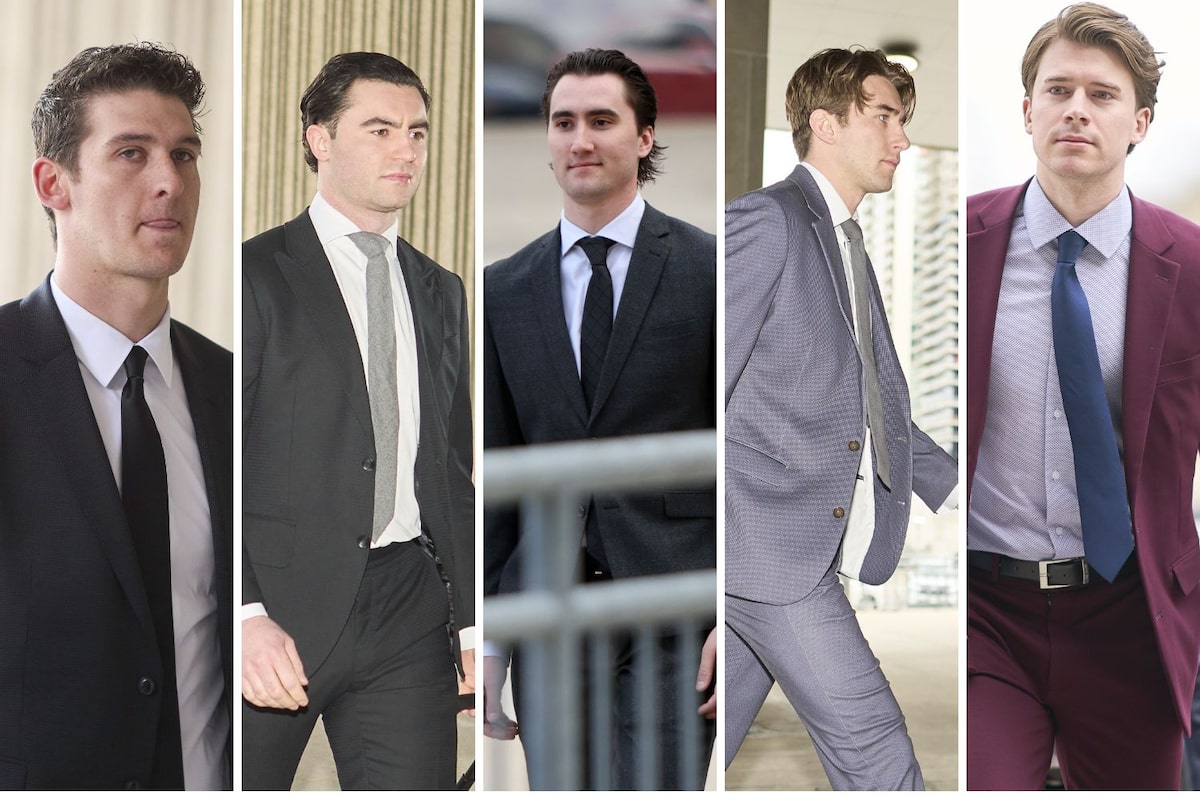
Former NHL players Cal Foote, Dillon Dubé, Alex Formenton, Michael McLeod and Carter Hart, accused in a sexual assault following the World Junior Hockey Championships in 2018, arrive at the Court House in London, Ont., on April 23.The Globe and Mail/The Canadian Press
It was unexpected and the reason can’t be shared yet. Just days after a jury began hearing the sexual assault case against five hockey players in a London, Ont., courthouse, the judge ordered a mistrial. The players have pleaded not guilty.
The proceedings restarted immediately on Friday with the selection of a new jury. To help understand the legal concepts, here are the insights of two veteran criminal lawyers and a former Crown attorney.
The lawyers interviewed in this article weren’t involved in the London case and were not aware of the specific reasons for the mistrial, which remain under a publication ban.
What is a mistrial?
A mistrial is a trial that is not completed after it was halted by the judge out of concern about the fairness of the proceedings.
Mistrials can happen for a variety of reasons, such as a logistical problem, the sudden unavailability of jurors, scheduling issues or jurors hearing something they weren’t supposed to, said Salvatore Caramanna, a Toronto criminal lawyer.
Judges can declare a mistrial if they deem that it is the best way to maintain fairness for both sides, Mr. Caramanna said.
Opinion: Whatever the verdict, the benefits of hockey are diminished
“The judge has to be satisfied that in all the circumstances, anyone looking into this case would say the fairest thing to do is declare a mistrial and start all over again in order to ensure that everything is fair for both sides and no one can complain later.”
Gary Martin, a criminal lawyer in Montreal, said judges can declare a mistrial if there are just suspicions that the integrity of the trial has been affected. “You can’t leave any ambiguity,” he said.
Were critical details already disclosed to the jury before a mistrial was declared?
The jury only sat through one day of proceedings and heard the prosecution’s opening statement. They were also told some facts that were agreed to by both the Crown and the defence.
While the Crown had disclosed its road map, “the opening statement is not evidence,” Mr. Martin said.
Typically, prosecutors and judges will caution jurors that opening remarks only signal what they can expect to hear. They will have to make their decision based solely on the testimonies and evidence presented in court.
Mr. Martin said it was better to restart the proceedings immediately rather than carry on further and have a potential problem become a ground for appeals. “You may as well do it now before the jury has heard any other evidence and just disband the jury and that’s it,” he said.
Why were the reasons for the mistrial not made public?
Publication bans are standard at various points in the judicial process – bail hearings, preliminary hearings and trials. In jury trials, there is a type of publication ban that always applies: anything said outside the presence of the jury cannot be reported during the trial. Instead, news outlets must wait until the jury retires to consider its verdict. Such a ban is in place at the sexual assault trial in London.
The public will know all the details eventually, but during the court proceedings the publication ban is designed to shield the jury’s views from being contaminated by inadmissible information.
Publication bans also ensure that “the case isn’t tried in the public sphere,” Mr. Caramanna added.
How could they have found impartial new jurors considering all the publicity?
Under the Charter of Rights and Freedoms, an accused has the right to be heard by an “independent and impartial tribunal.”
However, being impartial doesn’t necessarily mean being uninformed. “We don’t expect the jurors necessarily to come into a case without any knowledge whatsoever,” Mr. Caramanna said.
Jury candidates are instead required to have no preconceptions or favouritism towards either the Crown or the defence, Mr. Martin said.
In some situations where the accused have been the object of abundant media coverage, it is impossible to find people who aren’t aware of the case.
In 2002 and 2003 in Quebec, for example, members of the Hells Angels were defendants in two mega-trials in the wake of a turf war between biker gangs that monopolized media attention in the province. In addition, the jury selection in 2002 took place at the same time that the Hells Angels leader Maurice (Mom) Boucher was on trial for murder.
Most jury candidates knew about the bikers and during selection were asked instead whether they would be able to set aside any preconceived opinions and judge individual defendants solely on the evidence introduced in court, said Jean-Claude Boyer, a former prosecutor who was involved in those organized-crime trials.