
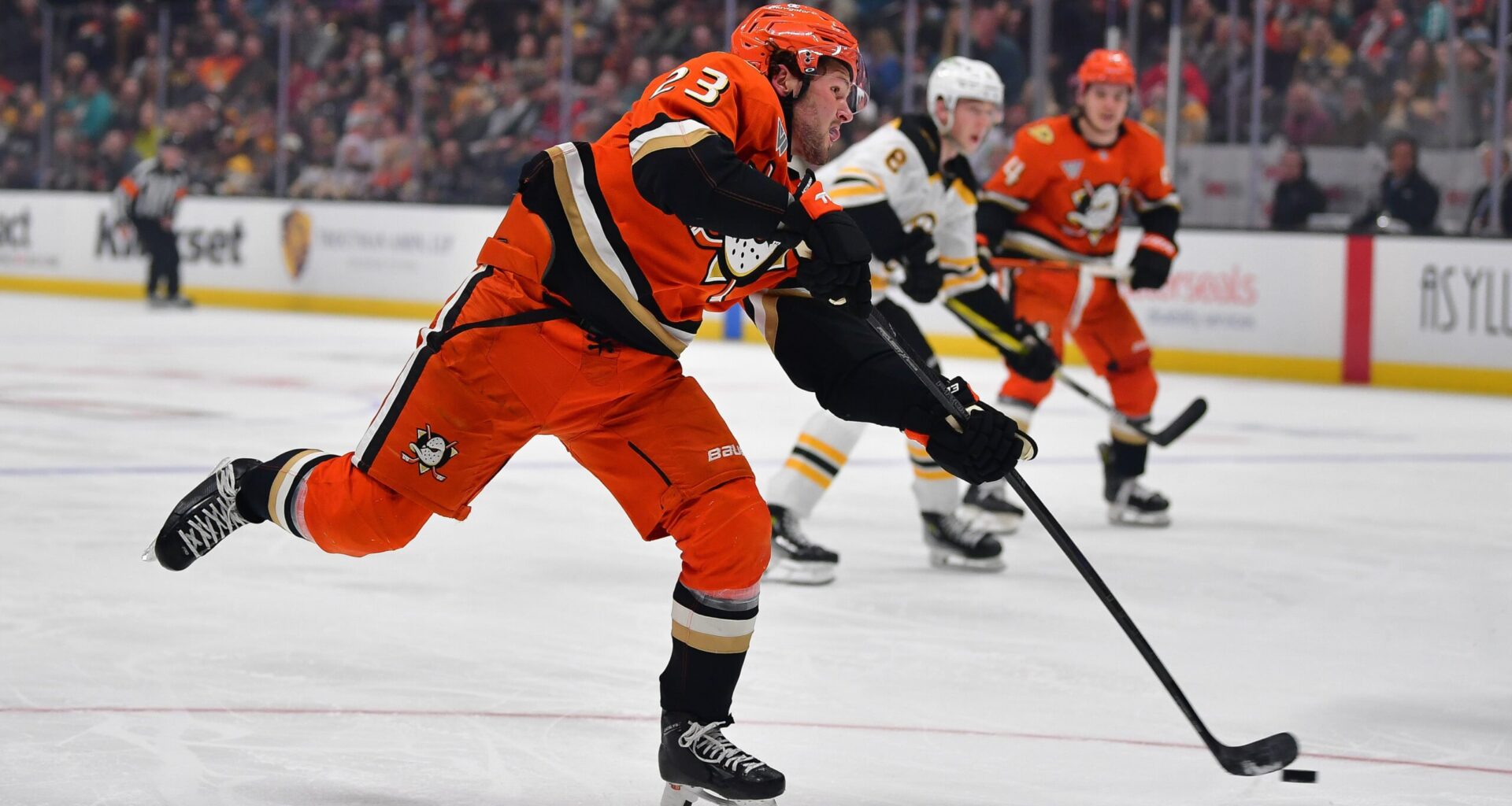
It’s the long days of summer and the offseason for the NHL, but tensions are rising in Anaheim. There is a lot of chatter circling around Mason McTavish’s contract situation and what the Ducks are going to do. The Anaheim Ducks face a pivotal decision on the Mason McTavish contract. Here’s a data-backed look at how they should approach it.
What the Ducks Should Do About the Mason McTavish Contract
McTavish’s entry-level contract expired after the 2024–25 season, making him a restricted free agent (RFA) at age 22. The Ducks control his rights and have significant cap space, meaning only an offer sheet with a cap hit above $7.02 million could even tempt the Ducks. Anaheim is well-positioned to match it anyway (via PuckPedia).
The reality is, despite speculation, general manager Pat Verbeek isn’t going to trade McTavish, and no fan-proposed trade has come close to justifying that kind of move. The key question, then, isn’t whether McTavish stays. It’s what kind of contract structure makes the most sense, both in dollars and term.
McTavish’s Value by the Numbers
McTavish finished 2024–25 with 52 points in 76 games, a 0.68 point-per-game clip. Also, he served as Anaheim’s third-line centre. While that placement undersells his impact, and he will surely see a promotion in 2025-2026, McTavish’s offensive production was strong across multiple advanced metrics:
Even-strength Points/60 mins: 2.16
Expected goals (ixG): 25.35, actual goals: 22
Offensive Rating: +7.0, 79th percentile (via HockeyStatCards)
Yet his two-way play is a major sticking point. He posted a defensive rating of -5.5, among the worst on the team, driven by poor shot suppression and heavy expected goals against. His Corsi For % (CF%) was just 45.2% and DFF% sat below 45%, further emphasizing his struggles without the puck.
The Offer Sheet Threat Is Overstated
The Athletic’s Shayna Goldman laid out the case for McTavish as a potential offer sheet candidate. However, she also acknowledged that Anaheim has the cap flexibility to match any realistic offer, and that no team is likely to go so high as to trigger a four-first-round pick compensation threshold.
With Anaheim’s pipeline already stocked and the Zegras trade signaling a shift toward building around McTavish and Carlsson, the Ducks simply don’t need more futures. They need impact now. A $7 million offer sheet wouldn’t scare Verbeek, it would just force his hand.
What the Analytics Say About Term and Risk
According to The Athletic’s contract model, McTavish’s projected contract value is $8.5M average annual value, though his market value is closer to $6.8M. That creates a modest surplus risk if Anaheim were to commit long-term, especially since McTavish has just a 28% chance of delivering positive contract value.
His net rating trajectory peaks in the +2.5 range (strong second-line territory) and begins declining as he approaches age 28. His closest player comps, names like Max Domi, Casey Mittelstadt, and Dylan Strome, hint at a player who can contribute meaningfully but likely won’t become elite.
This is exactly why a bridge deal makes sense. A two-year contract would keep McTavish an RFA when it expires. Thus, giving Anaheim time to evaluate further growth while preserving future control. It also prevents Verbeek from overpaying for development that hasn’t fully arrived yet.
Supporting Cast Will Help Evaluation
Dom Luszczyszyn of The Athletic ranks Anaheim as one of the NHL’s most improved teams this summer. This assertion is in part because of their additions of Chris Kreider, Mikael Granlund, and head coach Joel Quenneville.
These upgrades should help McTavish significantly. Better wingers and a tactically elite bench boss could create the environment needed for a breakout. If McTavish flourishes under Quenneville, then Anaheim can revisit a long-term extension from a position of evidence, not hope. The Quenneville hire, while controversial at best, is certainly generating buzz about players wanting to play for the three-time Stanley Cup champion.
Recommendation
The smart bet for Anaheim is a two-year bridge contract around $7 million AAV. This strikes the right balance between rewarding McTavish’s production and mitigating long-term risk, especially given his below-average defensive value and modest comparable contracts. It also keeps him an RFA at expiry, giving the Ducks leverage and flexibility heading into his true prime.
Verbeek isn’t rushing this, and they shouldn’t he. But make no mistake, Anaheim isn’t letting McTavish walk, and the next contract will reflect that calculated confidence.
Main Photo: Gary A. Vasquez-Imagn Images