
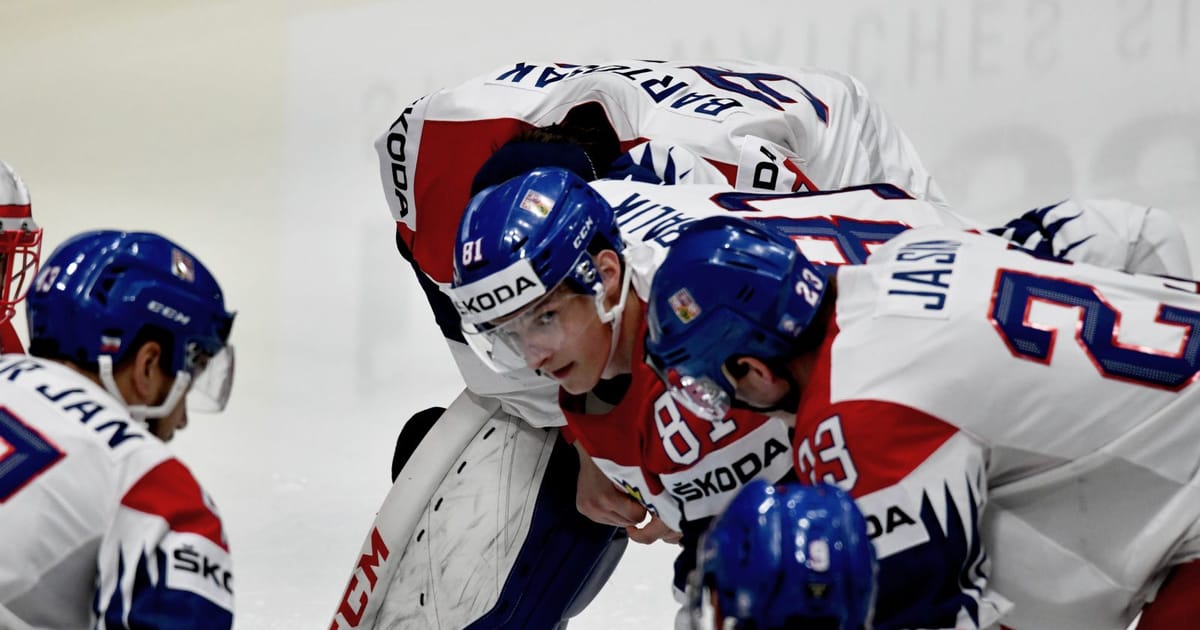
They exist in a legal gray zone, paid as self-employed contractors under what are known as “player contracts.” These contracts, governed by civil rather than labor law, offer none of the traditional protections afforded to workers. No sick leave. No employer-funded health care. No pension contributions, no collective bargaining. In most of Europe, this would be unthinkable. In the Czech Republic, it’s the norm.
To understand the weight of this contradiction, one must understand hockey’s role in Czech cultural history.
Charter of the Czech Ice Hockey Association|Photo: Kaden Krzeminski, Radio Prague International
The Czech Ice Hockey Association was founded in 1908, making it one of the oldest in Europe. Long before Czechoslovakia became an independent republic in 1918, the sport was being used as a unifying symbol of Bohemian pride. By the mid-20th century, hockey had become synonymous with national strength.
But the game has never existed in a vacuum.
In 1950, following a period of dominance on the world stage, nearly the entire national team was arrested on fabricated charges of treason. The Communist regime that had come to power two years earlier accused them of attempting to defect. Players were imprisoned, tortured, and banned from sport. It was one of the darkest chapters in Czech sports history, leaving behind a legacy of mistrust and state interference.
Hockey world champions of 1949|Photo: Post Bellum
Then came 1969, a symbolic reckoning. Following the Warsaw Pact invasion that crushed the Prague Spring reforms of 1968, Czechoslovakia’s hockey team faced the USSR in the World Championships. The tournament, originally scheduled to be held in Prague, was relocated to Stockholm for political reasons. But that didn’t stop the Czech team. They beat the Soviets — twice.
The streets of Prague exploded with emotion. Soviet flags burned. It wasn’t just about hockey anymore — it was national resistance on ice.
Czechoslovaks celebrating victory over USSR in 1969|Photo: YouTube
That passion returned in 1998, when the Czech Republic, newly independent and eager to assert itself globally, stunned the world by winning Olympic gold in Nagano, defeating powerhouse Russia 1–0. The win sparked celebrations across the country. Tens of thousands flooded Prague’s Old Town Square. In a young republic still carving out its post-Soviet Bloc identity, hockey became a cultural cement.
Since then, the Czech Republic has continued to produce world-class players — from Jaromír Jágr to David Pastrňák— yet the domestic system supporting them remains stuck in a bygone era.
Patrik Brůna|Photo: YouTube
“I’m not considered an employee,” said Patrik Bruna, a player for HC Vítkovice Ridera. “Every single year I have to do my taxes myself. The team pays me before taxes, and I have to figure the rest out.”
Bruna’s experience is not unique. The Czech model of athlete contracting, known as the “player contract,” is governed not by the Labour Code, but by the Civil Code. These agreements reflect a longstanding workaround, one rooted in economic convenience and legal ambiguity.
“In Czech professional hockey, many players operate as self-employed individuals under civil law contracts,” said Jakub Augusta, Head of the Media Communication Unit at the Ministry of Labour and Social Affairs. “The Labour Code is difficult to apply to the highly specific environment of professional sports.”
This system creates a stark divide between Czech hockey and other sports — most notably football (soccer). While footballers in the Czech Republic now benefit from standardized contracts and formal union representation, hockey players do not.
Jan Exner|Photo: Faculty of Law, Charles University
“There is a standardized contract in football,” said Dr. Jan Exner, a labor lawyer for the Czech Olympic Committee and lecturer at Charles University. “But in hockey, it’s not publicly available. Clubs often use templates, but there’s no union pushing for minimum terms.”
According to Exner, there was once a draft for a Czech Sports Act meant to clarify these labor distinctions. “But it didn’t bring anything new,” he added. “There was pressure from the football lobby — they didn’t want players classified as employees because it would be too expensive for clubs.”
Indeed, the economics of employment are what keep hockey players in this gray zone.
“If you’re an employee and your salary is 2,000 euros, the club actually pays 3,200 euros,” Exner explained. “As freelancers, clubs can pay players 2,500 and still save money.”
According to Section 2 of the Czech Labour Code, an employment relationship exists when there is a relationship of dependent work, regular work performed in person for an employer, in exchange for remuneration. On paper, this should apply to professional athletes — players train, compete, and travel under the direct instruction of clubs. But because Section 77 allows parties contractually to opt out of the protections provided by the Labour Code, using civil law agreements, most teams exploit this exception.
In essence, the law makes space for what many would consider a loophole: as long as both parties agree to a civil contract, even inherently subordinate labor like hockey is not recognized as employment. This technicality forms the legal backbone of the Czech Extraliga’s freelancer model.
For clubs operating on tight margins, this flexibility isn’t just desirable — it’s survival.
Matouš Veselský|Photo: YouTube/Fakulta tělesné výchovy a sportu UK
“There’s a joke here: owning a hockey team is like running a charity,” said Matouš Veselský, a professor of sports and cultural studies. “Clubs depend on sponsorships and exposure. They don’t want the added costs of employee benefits.”
Bruna emphasized that, on the surface, players are taken care of.
“We get treated well — our sticks, gear, cars, protein drinks, everything is covered. But we’re not employees. We have to pay for things such as health insurance ourselves.”
This setup might be palatable for some — especially players with agents and decent pay. Bruna, who earns 50,000 CZK per month, says it covers rent, food, and transportation. But he admits, “In the lower leagues, guys make 10,000 CZK a month. That’s not enough to live. A lot of them work second jobs.”
It’s a fragmented ecosystem: star players are fine; journeymen scramble. And yet, despite these gaps, there’s little momentum toward unionization.
“I don’t see the point of a union in hockey,” Bruna said. “For the most part we get treated well by teams.”
This attitude may come from a broader cultural context.
When asked if a collective bargaining agreement would help the Czech Extraliga. Exner said:
“Yes generally, but there’s no strong tradition of collective bargaining in Czech sports, so I do not see it happening in the near future” Exner noted. “It might be related to our history under communism. There’s a general distrust of organized labor.”
Photo: Jolana Nováková, Czech Radio
Even so, the legal system has addressed the issue. A 2011 judgment from the Supreme Administrative Court (2 Afs 16/2011) stated that the state cannot force one model of cooperation between clubs and athletes. The court emphasized that labor law should protect employees, but not at the cost of making athlete-club relationships unworkable.
“There’s case law confirming this,” said Augusta. “If a player and club agree to exclude the Labour Code, that decision must be respected.”
But respected doesn’t mean protected.
Without employee status, hockey players in the Czech Republic are excluded from key benefits: state-covered health insurance, paid sick leave, pensions, unemployment coverage. Even if a player gets injured on the ice, there’s no guaranteed income if he can’t perform.
Photo: Zuzana Jarolímková, iROZHLAS.cz
When asked about a union, Exner hesitated. “I’m not sure [the Czech Ice Hockey Players’ Association] is still active. If it is, it’s certainly not strong.”
Bruna hadn’t heard of one either. “There’s no union that I know of. Maybe for football.”
Indeed, the Czech Association of Football Players (ČAFH) has been instrumental in implementing protections for footballers. A conversation with their legal team could reveal a roadmap for what is missing in hockey.
Even if unionization is not on the horizon, there are other models worth exploring — namely collective bargaining agreements.
A ruling came in October 2023, when the European Court of Justice questioned whether football’s transfer rules violated EU competition law. The verdict hinted at a future where athletes gain more agency in labor negotiations. The shockwaves of that decision could be felt across sports, including hockey.
As hockey continues to globalize, the Czech system appears increasingly out of step. In countries like Sweden, Germany, Finland, and even Slovakia, hockey players are treated as full employees — with pension plans, healthcare, and legal protection.
“The only place still doing it this way is Czechia,” said Bruna. “It’s kind of behind the times.”
While most Czech players aren’t outwardly struggling the absence of legal protections is a problem under the surface, as Bruna put it: “It would be nice if we were considered employees. It would put us on par with the rest of Europe.”
For now, the Czech Extraliga runs on tradition, custom sticks, and a handshake agreement with the law. But as hockey becomes increasingly global, the question remains: how long can a system this fragile keep skating by?f