
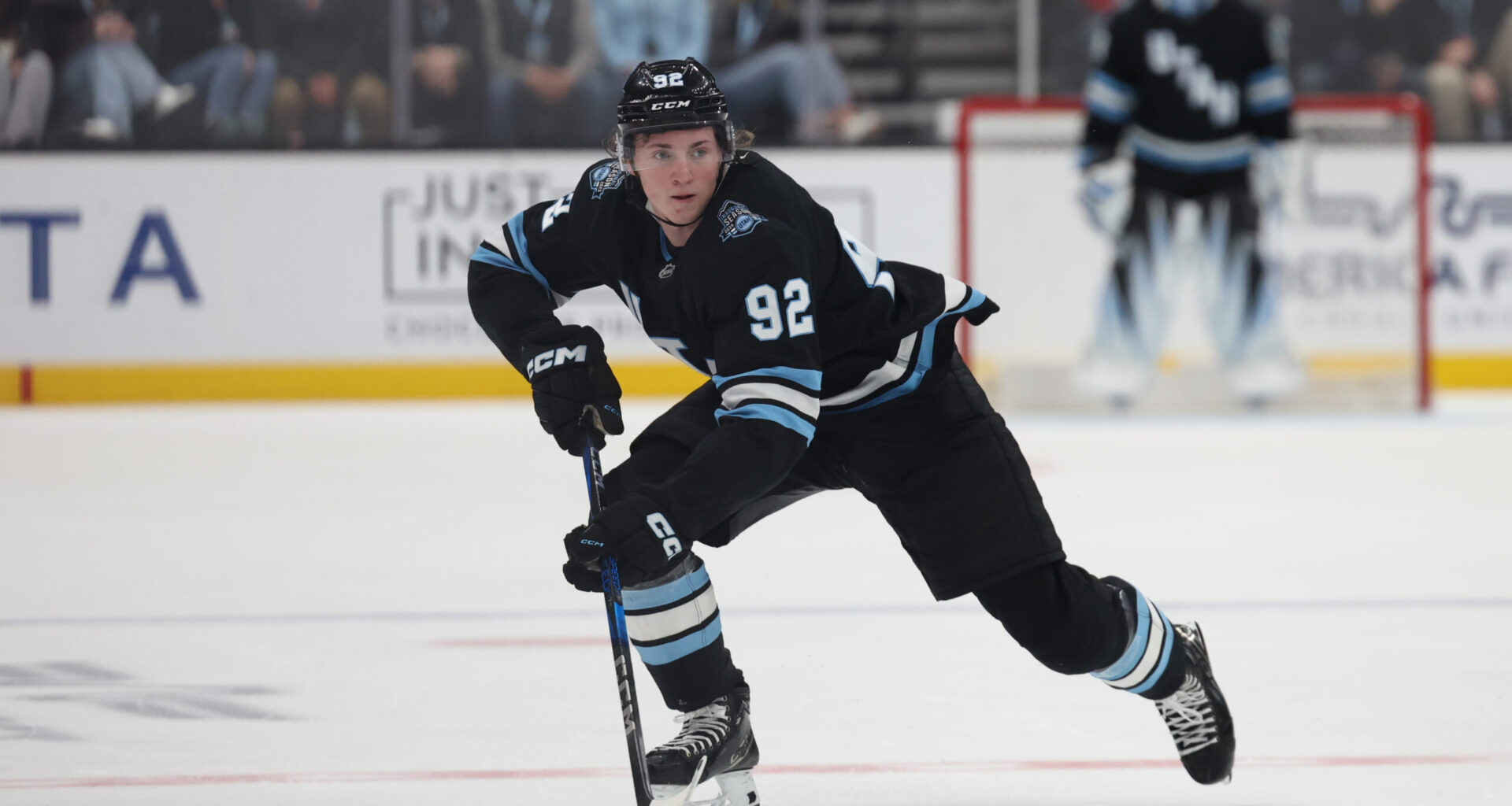
Explore the rise of Logan Cooley and the Utah Mammoth as they aim for playoff success in their upcoming season.
The Utah Mammoth have playoff aspirations for the 2025-26 season. Years of basement dwelling are finally bearing fruit. Maybe all it took was moving the organization out of Arizona? Young players are growing. The team has depth. And their owner is willing to spend money on players.
Utah finished its first season in franchise history with 89 points. Missing the playoffs, but they aren’t far.
Clayton Keller and Dylan Guenther were among the best forwards in the NHL last season. Keller ranked 12th overall in points per game (3.49) and Guenther ranked 38th (3.03). Nick Schmaltz was third in scoring on the team with 63 points. And now they have JJ Peterka, who scored 68 points in 77 games with the Buffalo Sabres last season. The Mammoth are dangerous on the wing.
General manager Bill Armstrong was willing to part with defensemen Michael Kesselring as part of the JJ Peterka trade package. A move that spoke to the depth of the blue line. John Marino, Ian Cole, and Sean Durzi, with Mikhail Sergachev as their No. 1 defenseman, make a formidable group of defensemen.
Utah has its eyes set on the playoffs next season, but its success hinges on its star center: Logan Cooley.
Logan Cooley — Is He Utah’s No. 1 Center?
Utah’s 5-on-5 expected goals share at 53% ranked 5th in the NHL. Utah was a solid possession team (5th in Corsi) that created decent chances. But their 8.32 shooting percentage ranked 24th overall.
Utah’s offense couldn’t convert goals in the slot. They ranked third overall in high danger Corsi (54%) but 15th in high danger goal share (51%). A factor in this is Cooley’s tendency to pass in the slot rather than shoot.
More Sports News
.wp-block-group__inner-container:has(> .embla),
.wp-block-group:where(.alignfull) > .wp-block-group__inner-container:has(> .embla) {
width: calc(100vw – (var(–side-spacing) * 2)) !important;
}
.embla {
position: relative;
overflow: hidden;
}
.embla__container {
display: flex;
flex-wrap: nowrap;
gap: 0 !important;
width: 75%;
}
.embla__slide {
margin-inline-end: var(–column-gap);
}
.embla__arrow,
.embla__arrow:active,
.embla__arrow:target,
.embla__arrow:hover,
.embla__arrow:focus-visible {
display: none;
position: absolute;
top: 50%;
transform: translateY(-50%);
width: 40px;
height: 40px;
margin: 0;
padding: 0;
line-height: 0;
background: rgba(255, 255, 255, 0.75);
color: var(–color-primary);
border-radius: 100vw;
svg {
width: 24px;
}
}
.embla__prev {
left: 0;
}
.embla__next {
right: 0;
}
]]>
Cooley scored 25 goals and 65 points in 75 games in his second NHL season. Impressive for a 21-year-old. But this isn’t elite. Even with a 90-point winger (Keller) and Dylan Guenther, more is expected. Connor Bedard scored 67 points without consistent linemates on his wing.
There is an explanation for this: Cooley needs to shoot the puck.
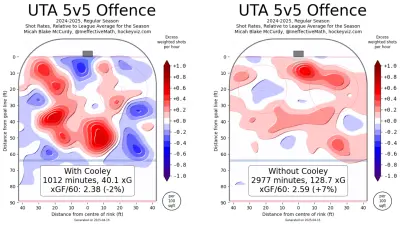 Utah’s 5-on-5 offense with and without Logan Cooley.
Logan Cooley was far above average in high-danger assists according to All Three Zones data, with a 2.56 Z-score. Linemate Clayton Keller had 77 high-danger shot attempts at 5-on-5 (33rd overall). Logan Cooley ranked 201st with 49.
If Cooley can score from the slot and truly look like an elite 1C, the Utah Mammoth are in a great place. They have two excellent bottom-six centers in Barrett Hayton and Jack McBain. Fourth overall pick Caleb Desnoyers has the potential to be an excellent 2C.
But if Cooley doesn’t take that next step, Utah has to find a 1C if they want to make deep playoff runs.
Tactical Usage
Last season, head coach Andre Tourigny ran a 2-3 offensive zone pressure (OZP). His forwards worked the puck low to high, which pulled their opponents’ defense out of position.
This type of play does not suit Cooley.
Cooley is best off the rush. According to All Three Zones, Cooley scored a 1.71 Z-Score in rush attempts/60, above average, but he scored a -0.57 on cycle and forecheck offense/60. Utilizing a 2-3 OZP relies on excellent forechecking and cycling the puck. Utah also ran a conservative 1-2-2 forecheck last season.
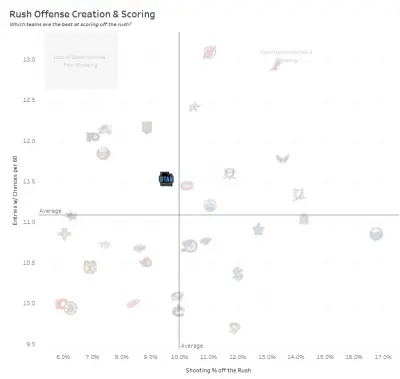 Utah’s effectiveness on the rush.
Utah led the league in rush offense/60 (15.03) according to All Three Zones. But they had poor shooting off the rush with a 9.6 SH%. League average was 10%. They were also above average in rush entries with chances/60 with 11.53.
The solution? Something similar to another rush team, like the Dallas Stars. Instead of a 1-2-2 forecheck, Utah could use a 2-1-2, which is more aggressive. F1 can hound the puck, F2 trails in support, and this could create space to allow the weakside defenseman to pinch and outnumber their opponent.
Cooley struggled on defense last season, which will come with experience, and it comes with the territory of playing rush offense. But it’s what Cooley is good at.
What’s On Tap Next?
Utah has a bright future. They’ll enter the 2025-26 season with playoff aspirations. The Mammoth still needs to figure out their top-defensive pair and their backup goaltending, but Logan Cooley’s next step is a critical piece to their path to success. If the Mammoth can find Mikhail Sergachev’s partner, and Cooley looks like an elite 1C, Utah will be a dangerous playoff team, not just a bubble team.
Follow @OnTapSportsNet on social media!