
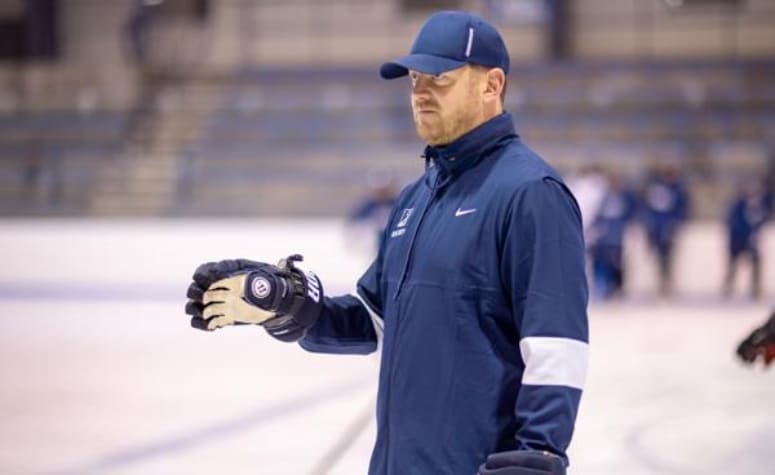
Sean O’Brien when he coached The Hill School. (The Hill School)
Sean O’Brien is right where he belongs at Phillips Exeter.
The Big Red’s new bench boss is back in the prep ranks, and he has lofty goals and expectations for the program.
After spending the last season working with the Pittsburgh Junior Penguins, O’Brien jumped at the opportunity when the job at Exeter became available.
Before the Junior Penguins, he coached at the Hill School for four years, which followed three seasons as hockey director of hockey operations for Harvard’s men’s hockey program.
As a player, O’Brien played college hockey for New England College in the mid-1990s and spent a year playing in Germany. Following his playing days, he began his career as a scout for the NHL’s Florida Panthers. He followed that up by serving as owner and coach of the Portland Junior Pirates before joining Legacy Global Sports and starting the Selects Academy program at South Kent.
O’Brien joined New England Hockey Journal editor Evan Marinofsky and writer Patrick Donnelly on the latest RinkWise podcast to discuss his goals at Exeter, his coaching philosophy and much more.
RinkWise podcast: Phillips Exeter’s Sean O’Brien
On the importance of video analysis:
O’Brien: “If you react in real time, you can be wrong a lot of times because you’re not seeing how a play might have developed or what might have happened in practice. So having the ability to go back, watch, process and evaluate what did happen and where the breakdown may have gone wrong or happened, or why a decision was made, it’s critical. … I just think that the more our guys can have access to their own video, watching themselves play, it’s only gonna help in self-evaluation and their overall player development as they prepare to get to the next level. … It’s taught me to be more patient, and I believe it’s going to allow players to become more patient and more intentional in their self-evaluation. For me, it takes the emotion out of it. It really allows you to become much more of a teacher mentality and want to be able to see the ‘why’ of something, then be able to come up with a solution to fix the ‘why.’”
On laying the foundation for long-term success
O’Brien: “I think about my life. I still talk to and see guys — talking 30, 35, 40 years ago — that I played with, who I still see daily or talk to. It’s a huge piece. I feel like we’ve lost that a little bit with the heavy focus on the hockey side. I hope I’m intentional about it with all of my recruits that, if you’re gonna come to Exeter, it’s starting to build that network long-term. Because you’re gonna be classmates, dormmates and teammates with guys that aren’t even thinking about hockey at the next level or don’t play hockey at all. Yet you guys are gonna become buddies in the dining hall, in class or in the dorm, and that checks a box in terms of… establishing these relationships that are gonna have a positive impact on your life. One thing I say to every one of my players and my recruits: We’ve all had ups and downs in life, and you make mistakes and you evaluate. The one thing I have not been able to figure out is how to turn back the clock. You can evaluate, you can change, you can reflect and you can make changes in anything that you do, but you can’t turn back time. I feel like these young players, once you pass on these opportunities, you can’t go back. So, establishing your professional network early and putting yourself in a great position to succeed and create that balance between hockey and non-hockey… You got one chance to do it. Why not do it right?”