
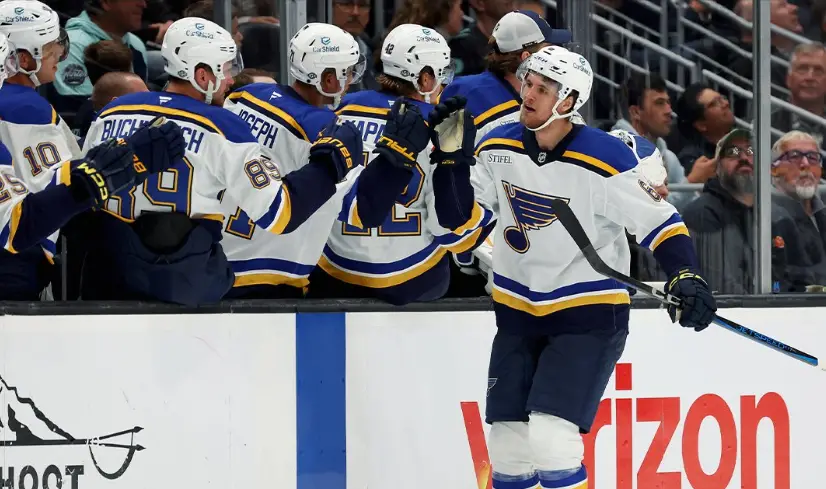
Fresh off a loss in Game 7 of the 2024 Stanley Cup Final, the Edmonton Oilers lost not one but two key pieces to their future. On August 13, 2024, the Pittsburgh Penguins made a trade with the St. Louis Blues, and it was a weird one. At the time, it didn’t really make sense unless the Blues were going to give out an offer sheet.
Offer sheet rundown
An offer sheet is a contract offered to a restricted free agent (RFA) by a team other than the player’s current team. If the player signs the offer sheet, their original team has one week to decide whether to match the offer and keep the player, or let the player go and receive draft pick compensation.
That’s rare enough as it is, in the last twenty years, there have only been 10 offer sheets in the NHL. Two of them have gone unmatched: Dustin Penner to the Edmonton Oilers, and Jesperi Kotkaniemi to the Carolina Hurricanes. And then the Blues gave offer sheets to defenceman Philip Broberg and forward Dylan Holloway, both of which went unmatched.
The offer sheets on Broberg and Holloway
They offered Broberg $4.5M per year for two years, the maximum offer that would require a second-round pick as compensation. The offer to Holloway was a two-year contract at $2.2M per year, the maximum amount to require a third-round pick as compensation. As a result, the Oilers were given a second-round pick and a third-round pick in exchange for their former first-round picks.
You might be thinking to yourself: “Why didn’t the Oilers just match those offers?” Broberg might’ve been a little pricey considering the amount of games he played, but he was only 23 and he’d likely grow into that contract. Dylan Holloway was 22, but as with Broberg, he hadn’t played much. However, as a 14th overall pick, he would likely also grow into his new contract.
Holloway had 26 goals and 63 points in 77 games. After playing in just 38 games the year prior. However, Holloway got a lot more playing time in St. Louis than he otherwise would’ve in Edmonton, and he was a big reason the Blues were able to make the playoffs. However, Holloway missed the Blues’ seven-game series with the Winnipeg Jets due to injury.
As for Broberg, he played 68 games for the Blues last season, which was a career high for him. He also missed part of the season due to an injury, but still put up 29 points. Broberg really found his stride in the 2024 playoffs for the Oilers, which resulted in him getting paid more than he probably otherwise would’ve.
What happened in Edmonton after the offer sheets
Obviously, we now have the benefit of hindsight, and we now realize that this was a mistake. As a result of letting Holloway and Broberg walk, the Oilers signed Jeff Skinner and Victor Arvidsson. Last season, Holloway had more points than Skinner and Arvidsson combined.
I think the Oilers mismanaged these two as prospects. When you have first-round picks, if they’re in the NHL, they need to get minutes. If they’re in the AHL, they need to get bigger minutes. The Oilers messed that up specifically with Broberg, who spent the majority of 2023–24 as the seventh defenceman and getting little to no playing time, even resulting in a trade request.
If I were the general manager, I would’ve prioritized signing Holloway and Broberg, rather than signing Skinner or Arvidsson or giving guys like Adam Henrique and Corey Perry a raise. Having said that, the Oilers are in their championship window, and sometimes when that happens, teams don’t take as much risk on younger players because you’re potentially gambling with their upside.
What if Edmonton kept Broberg and Holloway
Sports fans always love “what if” scenarios, so let’s say the Oilers do keep Broberg and Holloway. They probably wouldn’t have been able to afford Henrique at $3M, and that would’ve worked out better. This would’ve slid Ryan Nugent-Hopkins down in the lineup and given the Oilers a worse bottom-six defensively.
If the Oilers re-signed Broberg, they probably wouldn’t trade for Jake Walman at the trade deadline. Maybe the Oilers don’t trade for Vasily Podkolzin because they wouldn’t need to dump salary. That’s what is amazing about professional sports: every decision your team makes has a ripple effect.
If they had matched both players, they would’ve had a lot less flexibility and would’ve been in trouble with the salary cap. Evander Kane was off the books due to him being on LTIR for most of the season. However, when Kane was ready to return, they would’ve been in trouble.
A roster decision with major team impact
By choosing to let Holloway and Broberg walk, that was a sense of where the Oilers wanted to go. They wanted guys with experience and an NHL reputation rather than waiting for the younger guys to develop because they’re in a “win now” mentality. Stan Bowman added a couple of guys who can compete for similar minutes as Broberg and Holloway. This gave them more flexibility heading into last season.
Overall, I’d say this move didn’t work, and I know I’m not the only one who thinks that. Why didn’t it work? Jeff Skinner never had Kris Knoblauch’s trust, Victor Arvidsson didn’t end up being what the Oilers wanted him to be, and most of all, the Oilers didn’t win a championship. If they win that series against the Panthers, none of this matters because they won a cup.
Instead, the Oilers got back to the Stanley Cup Final with an arguably worse team last season than they had in 2024 and are now in a similar position heading into the 2025–26 season: without either Broberg nor Holloway.
Like this:
Like Loading…