
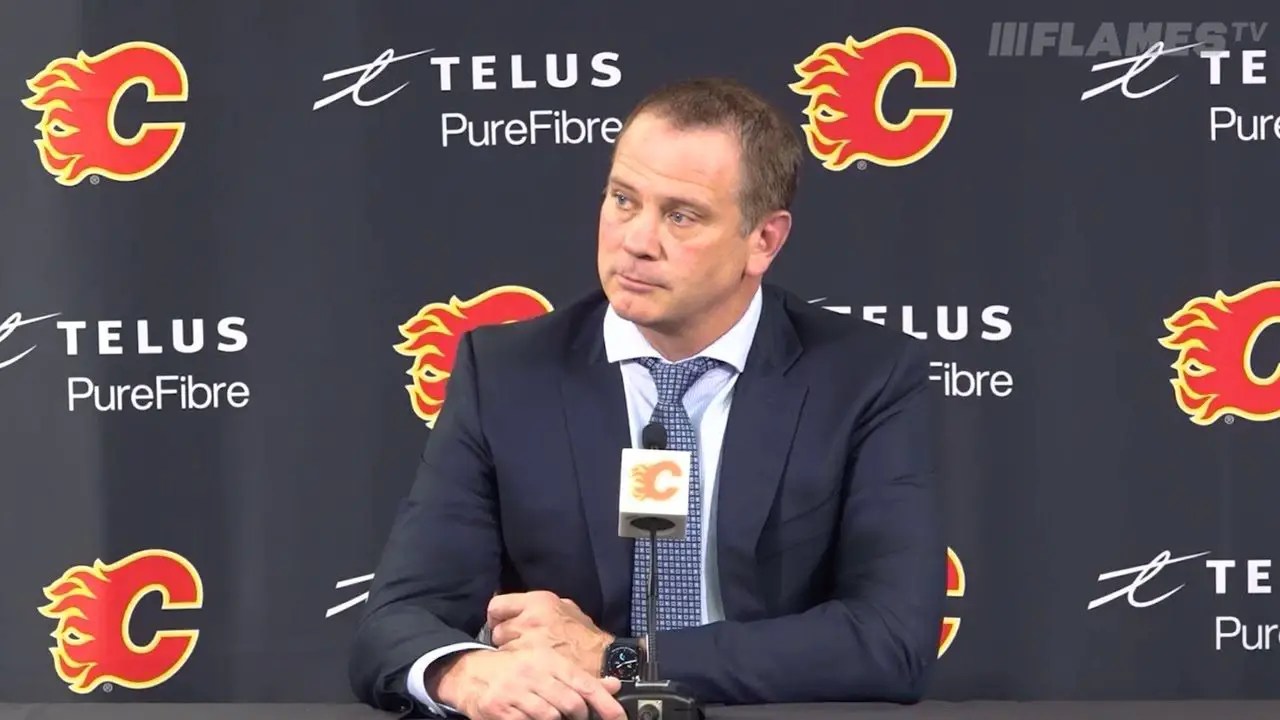
This has been a tranquil summer for the Calgary Flames organisation, with few moves made. The biggest thing that hasn’t happened is the expected Rasmus Andersson trade, but it appears that General Manager Craig Conroy is holding on, waiting for the right deal to emerge. This, along with his growing body of work as GM of the Flames, has created a lot of controversy among the fan base, especially with regard to the direction of the team. Loud voices online have pushed passionately to tear the team down, while others argue equally passionately that this team should be pushing for the Stanley Cup this season.
Around the team and from Conroy himself, there has been a lot of talk about sticking to the plan. The Flames have a plan that Conroy has developed for the team, which he is sticking to. He is not interested in deviating from this plan unless something major happens. But what exactly is this plan?
We have gone through his interviews and quotes to break down exactly what this plan looks like:
Retool, not a rebuild
Whether or not you agree with it, Craig Conroy is not tearing this team down to its studs to rebuild from the bottom up. However, he has been clear that this team needs to go through a retool, moving away from older players and getting younger while retaining a competitive team through this process.
He specifically mentioned this on The Jeff Marek Show in an interview with Matt Marchese after the Elias Lindholm trade, in which he termed his work a “retool on the fly.”
Whether you agree or disagree with the philosophy or its results is irrelevant, but he has been clear that this is the approach he is taking. When he took over the team, he was clear to point to the Dallas Stars as the model he wanted to emulate. Specifically, he said, “You’re trying to look at a team like Dallas. They had a good veteran core. They’ve added really good—hey, they had a great draft, they really did, the one draft with Heiskanen and Oettinger and [Robertson].”
The Stars had two boat anchor contracts they couldn’t move in Jamie Benn and Tyler Seguin. They also had some really good prospects in the pipeline, including Roope Hintz and Denis Gurianov, that they wanted to build around, and they had no desire to tear it down completely.
In the 2017 draft, they took Miro Heiskanen with their first pick in the first round, then traded up with a pick they acquired by trading Patrick Eaves that season and took Jake Oettinger. They then took Jason Robertson with their second-round pick. Put together, these three players form the core of this team.
This is remarkably similar to the Flames. The team still has two boat anchor contracts that are very tough to move in Jonathan Huberdeau and Nazem Kadri, and at the time had some outstanding prospects to build around in Dustin Wolf and Matt Coronato.
This team was not built for a rebuild and required a different approach. The retool he mentioned in numerous interviews has been something he has been firm on.
Finding young NHL-ready players with high upside
The Flames have made several trades since Conroy came on board, and the commonality in all of them is that the key players that the Flames have gotten back have been young NHLers, typically between 23 and 25, who have upside that may not have been reached on their previous teams.
This includes Joel Farabee (24), Morgan Frost (25), Kevin Bahl (23), Daniil Miromanov (26), Artyom Grushnikov (20), Hunter Brzustewicz (20), and Yegor Sharangovich (25). Conroy was very explicit in what he wanted to acquire, going so far as to say, “If it’s a younger player, and we have them under control, or even maybe a 26-year-old that you’re going to have control of, it might make more sense.”
Under Brad Treliving, the Flames’ acquisition strategy was all over the place, sometimes getting older, other times trading older players for picks, and sometimes trading picks for players at the tail end of their careers. Conroy has been all-in on his strategy and has been very purposeful about what he wants in a trade.
Retaining a competitive culture in Calgary
Rebuilds are tough to orchestrate at the best of times. Not only can they be risky if the draft picks don’t pan out, but they are expensive on ownership, as it’s hard to sell tickets to see your team lose night in and night out. Beyond this, developing a winning culture matters, and it takes more than just flipping a switch to do so. To build, you need to tell players for some time that losing is okay as they go through the rebuild, then tell them that losing is all of a sudden not okay as you build towards the future. This is not something that happens just overnight and often at all.
Conroy has been in the room. He understands what it takes to play and win in the playoffs, and having a good culture matters to win long-term. This team was constantly lauded all of last season for the culture that they built around the organization, and while some will point to last year and say that culture doesn’t win championships, one year is far from enough evidence to point to that.
Conroy was keen to point to building this culture and how important it is to have the buy-in from the locker room. After acquiring Frost and Farabee, Conroy said, “[The Calgary Flames] are trying to build something here and you’re trying to bring in the right people, but it’s the [locker room] that’s doing it.”
Building a winning culture matters. Anyone who has been in any organisation, whether a sports team, a work team, or otherwise, can point to the impact of having a supportive environment on morale, enjoyment, and willingness to put in their best work day in and day out.
Looking at teams that have gone through unsuccessful rebuilds, the one commonality that can be pointed to is that the players were good and the drafting was strong, but the team couldn’t take the next step to put it all together and win. Looking at the Buffalo Sabres, Ottawa Senators, Vancouver Canucks, and even the Edmonton Oilers’ decade of darkness as key examples of teams that went into rebuilds that took a heck of a lot longer than previously expected.
Calgary as a destination for free agents
As much as Calgarians may love Calgary, for those who haven’t visited the city, it doesn’t immediately evoke the same sense of excitement as cities like Toronto, Las Vegas, or Los Angeles. For NHL free agents who have a choice in where they want to play, Calgary does not top the list of cities for them to want to play in, and Conroy got this immediately and set out to change this.
In his introductory press conference, Conroy outlined that “I want to make it where we’re not on the no-trade list, and that is to bring a culture of winning and fun. Players talk to each other, and if you build that culture here, they’ll tell each other, ‘Calgary is actually a pretty good place to play,’ and I think that’s what we need, the word to get out.”
That means building a team where the energy is good and where the team remains competitive. Examining teams across the league, it’s evident that players prefer to join teams where they can win and where the atmosphere in the room is enjoyable. As much as some fans may say things like “vibes don’t win championships,” the reality is that they are one part of building a winning organisation, and Conroy is clear that this is what he wants.
The Flames continue to target one specific position
Over and over again, the Flames have been looking to find a top-line right-shot centreman. This has been the goal for this team for months now, and Conroy has mentioned this as a priority for him, saying, “I think we’ve been looking for a younger centre for a while, and talking to all the teams, it’s not easy to do.”
Frost and Farabee add to centre depth to go along with Nazem Kadri and Mikael Backlund. They also have Martin Pospisil, who can play centre, and potentially Connor Zary, but the latter has been mostly used on the wing at the NHL level.
This year, the team drafted centres with their first three picks in Cole Reschny, Cullen Potter, and Theo Stockselius to go along with Rory Kerins, Samuel Honzek, Luke Misa, and others in the organization who can play down the middle. The Flames spent years in the Jarome Iginla era trying to find a centreman to round out their team, and Conroy knows full well how important that position is. Expect finding one to continue to be an organizational priority going forward.
What to expect going into the 2025–26 season
As with any plan, there comes a point where something may force you to consider amending or changing course completely. However, barring a superstar centreman landing in their lap or a complete implosion by this team’s prospects and NHL team, odds are that Craig Conroy continues on the path of retooling this team.
Last year, the Flames came out on the right side of a lot of one-goal games, leading the league in wins after 60 minutes. It’s hard to imagine the team replicating that, and unless several players take steps forward this year, this team could very well be worse this coming season than last.
That likely won’t impact the way Conroy sees this team, as he is building for the future. So long as young players like Frost, Farabee, Bahl, and Coronato move in the right direction and the team sees a good first season from Zayne Parekh in the NHL and their numerous prospects going into the AHL, this will be considered a good season.
Expect the Flames to be active in the trade market as they not only continue to try to acquire a top centreman but also as they look for a dance partner to move Rasmus Andersson. It’s going to be an interesting year in Calgary, but expect Conroy to stay the course.
Related