
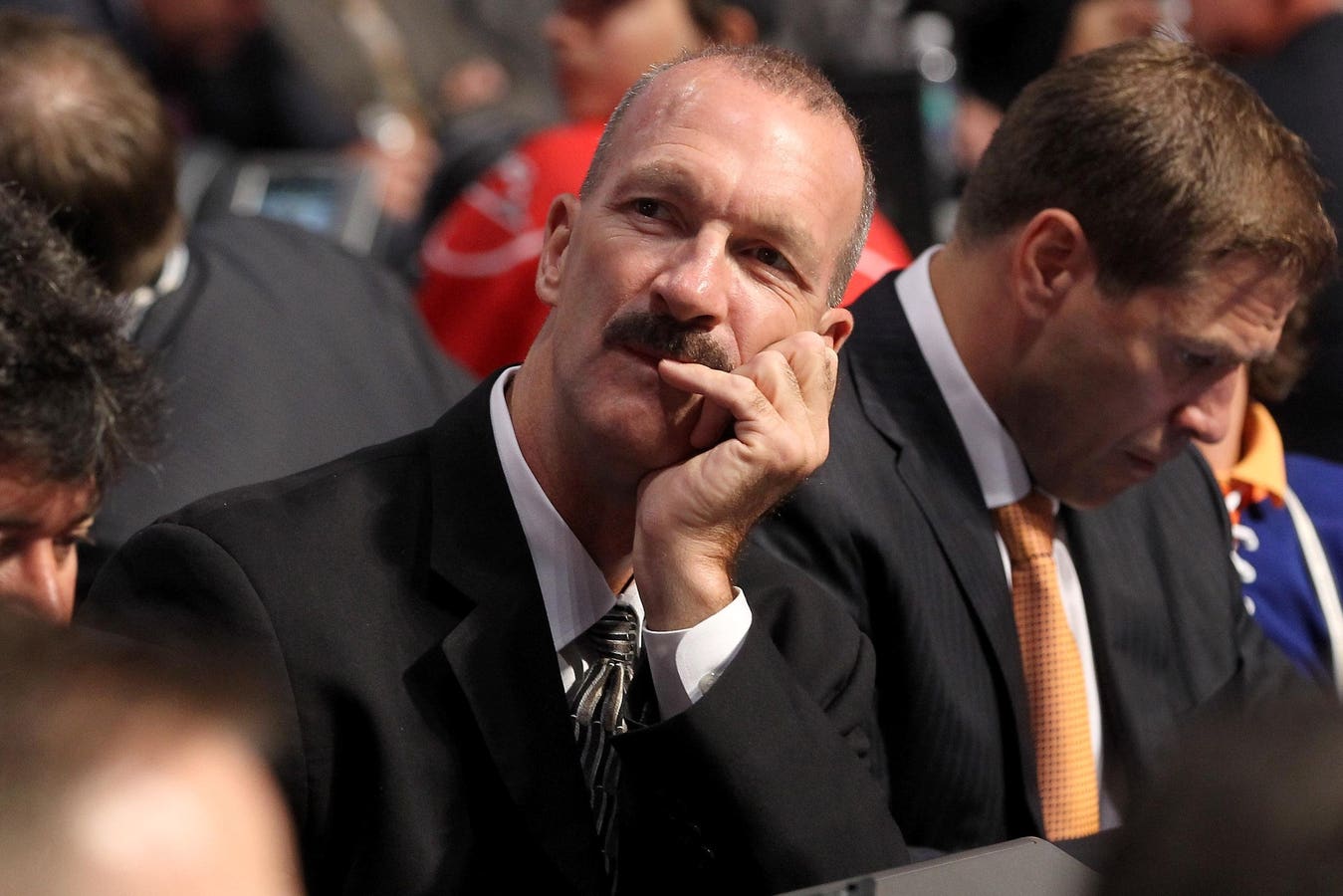
PITTSBURGH, PA – JUNE 22: New York Islanders scout Ken Morrow looks on during Round One of the 2012 NHL Entry Draft at Consol Energy Center on June 22, 2012 in Pittsburgh, Pennsylvania. (Photo by Bruce Bennett/Getty Images)
Getty Images
On the heels of the National Hockey League’s historic Four Nations Face-Off where Team Canada defeated Team USA in the championship game, another historic event took place almost to the day, 45 years ago. In 1980, Ken Morrow went down in history as the only athlete to have won an Olympic gold medal and Stanley Cup in the same year. He has led the kind of career that most athletes can only dream of. Along with long-time New York sportswriter Allan Kreda, Morrow recently detailed his storied career in Miracle Gold, Four Stanley Cups, and a Lifetime of Islanders Hockey.
I have been an avid hockey fan since I was a little girl growing up in Toronto, Canada. I was mesmerized by the puck-handling skill, the speed with which players would fly up and down the ice, the uncanny ability to stick-handle the puck, stay on-side, then fire a wrist-shot in the top corner past a highly-skilled goaltender—all the while avoiding bodychecks by large, Mack-truck sized defenseman!
Now, as a practicing physician and medical communicator, I am fascinated by the health aspects within the NHL, perhaps the most physically-demanding of professional sports leagues. At the elite level, most athletes acknowledge that the game is as much mental as it is physical. Morrow understands this. In my interview with the Islanders’ long-time Director of Pro Scouting, Morrow shares his fascinating life of hockey including the many triumphs, as well as hardships and loss, all told through Allan Kreda’s gifted storytelling blended with a high threshold of empathy.
The Grind
Ken Morrow holds his 1980 Olympic medal
Lipi Roy, MD, MPH
Playing in the NHL is not for the faint-hearted. Starting in October and ending in April, the 82-game regular season is nothing short of grueling. In Miracle Gold, Morrow describes the challenges of transitioning from the Olympics to the NHL: “Being on the ice every day, practicing and playing games and traveling—there was a new pressure to play well and to win.” Suffice to say, NHL players do not work nine-to-five hours. They typically arrive at the rink at nine or 10 in the morning, have breakfast, stretch in the gym, practice on the ice, talk to media, have lunch, go home to take a nap, return to the rink a few hours before their evening game, warm up, play at seven or eight in the evening, talk to the press after the game, shower then catch a flight to the next city, arriving as late as two or three at night. Lather, rinse, repeat for 82 games in a seven-month span (perhaps only 40 games as half the games are at home).
Today’s elite players are operating within a well-oiled machine. Each NHL club has an army of skilled professionals guiding each player throughout the season: from a team chef and dietitian to athletic trainers, physical and massage therapists to assistant and head coaches, structure is the name of the game—and something the Morrow knows well.
“Routine was key in my playing career,” reflects the durable defenseman. “Most athletes need to have structure and discipline.”
Health And Injuries Among Hockey Players
Mike Bossy (R) is congratulated by teammates Ken Morrow (L) and Gord Lane (center), after his second period “hat trick” goal in the Stanley Cup semi-final with the Boston Bruins at Uniondale, N.Y., May 7, 1983. The NHL regular and post-season make for a grueling schedule of practices, games and travel.
Associated Press
Staying in top physical shape is critical for NHL players. Unfortunately, “all hockey players play through injuries,” reflects Morrow. Musculoskeletal injuries are perhaps the most common ailment experienced by hockey players. Morrow sustained eight knee surgeries including four in his first four years with the Islanders, followed by extensive physical therapy (PT) and rehab which limited his NHL career to ten seasons. In fact, Morrow once said, “I think physical therapy might have been a profession I would have liked,” having spent so much time around trainers and PT.
The risk of injury in hockey increases as players become bigger, stronger, faster and wear less protective equipment. Medical teams including orthopedists, internists and sports psychologists must continually review the best available literature, treatment, and strength and conditioning strategies in order to reduce player injury and optimize their health.
Head injuries are sadly not uncommon in a high-speed, contact sport like hockey. In fact, hockey has the highest rate of concussion incidence among contact sports. Brain injuries have forced several players into retirement. The league along with the NHL Players Association is taking this health issue seriously, having introduced the NHL Concussion Program in 1997. Numerous high-profile players have experienced concussions including Mike Richter, Pat Lafontaine, Stu Grimson, Nick Kypreos and three-time Stanley Cup and recent Four Nations Champion, Sidney Crosby.
Grief And Loss
Ken Morrow (L) stands with NHL Network analyst, E.J. Hradek across a Stanley Cup replica
Lipi Roy, MD, MPH
At 6’5”, Don Morrow was described by his son, Ken, as a “gentle giant.” When he spoke, people stopped and listened. A gifted baseball player, the senior Morrow took an interest in hockey and seeing his sons skate in their backyard. In Miracle Gold, the younger Morrow reveals that he owes his hockey career to his father and his family. So it came as a shock when Morrow, at age 19, lost his beloved dad to brain cancer. Don Morrow was only 48 years old. Watching his big, athletic and robust hero deteriorate so quickly was “very hard” on the burgeoning hockey star. Morrow internalized things back then (“just as my dad did”). Thanks to research for this book, he was able to learn new things about his father. He knows that grief is universal, so his advice to people is to lean on family and friends during these difficult times and to relieve your stress by staying active and caring for your health.
Don Morrow was unable to witness his son’s historic Olympic gold medal or four consecutive Stanley Cups. But during every game, Morrow “would look up at the flag, think about my dad and thank him for all he had done. My father was with me for every game I played.” This story resonated with me. My own father who was my number one fan died March 16th, 2023 from heart failure. I think about him every day. Kreda also lost his father a year before I lost mine. Most of my patients have experienced childhood trauma and loss of family and friends through overdose, suicide and chronic diseases. On behalf of my patients and the public, I am grateful to Morrow for sharing his personal story of grief and loss; and the reminder that hockey players are people, too.
Social Media And Mental Health
NYI Co-owner, Jon Ledecky (R), celebrates Ken Morrow (center) and Allan Kreda (L) on their book, “Miracle Gold, Four Stanley Cups, and a Lifetime of Islanders Hockey.”
Lipi Roy, MD, MPH
Instagram stories and viral TikTok videos did not exist in the 1980s heyday of the of NYI’s dynasty. “I don’t know what I would have done in the era of social media,” said the soft-spoken Morrow. But people who are familiar with the quiet fortitude of Morrow believe he would have survived today’s tech era just fine.
“It wouldn’t bother him at all,” declares E.J. Hradek, NHL Network Analyst who has covered Morrow’s career for three decades. “Kenny does the work. He does the job. Others may get distracted, but not Kenny Morrow.”
Staying focused is key. Mindful practice such as daily meditation, yoga, prayer and gratitude can help us stay in the present. Having a strong support system is also fundamental in maintaining a well-balanced mental and emotional state, particularly for NHL athletes playing high-pressure, high-stakes games amid non-stop media attention and scrutiny, and opinionated fans on social media.
Health Today
Sports writer and author, Allan Kreda, standing next to poster of his book’s cover.
Lipi Roy, MD, MPH
Hockey has come a long way since the ‘70s and ‘80s when players would smoke in the locker room in between periods. Today’s players operate at a different level, often training in the off-season with their personal team, adopting healthy meal plans and practicing mindfulness.
At 68, Morrow still tries to lead a healthy lifestyle including staying active. He works out three to four times per week. Going for walks helps him mentally: “Walking relieves a lot of stress.” He’s also a firm believer in moderation particularly with his diet. Lastly, he recognizes that at his age, maintaining regular doctor appointments—and encouraging his grown kids to do the same—is critical for living a healthy life. For Morrow, “being on the ice was my comfort zone.”
A Global Game
Hockey is a truly global sport. The NHL is certainly emblematic of the international nature of the game, with talented players representing 20 countries including Finland, Sweden, Czech Republic, Slovakia, Russia, Germany and many others. As a physician, hockey fan and storyteller, I firmly believe we need more pro athletes and writers like Ken Morrow and Allan Kreda, respectively, to share their captivating stories with the world!